27th March, 2026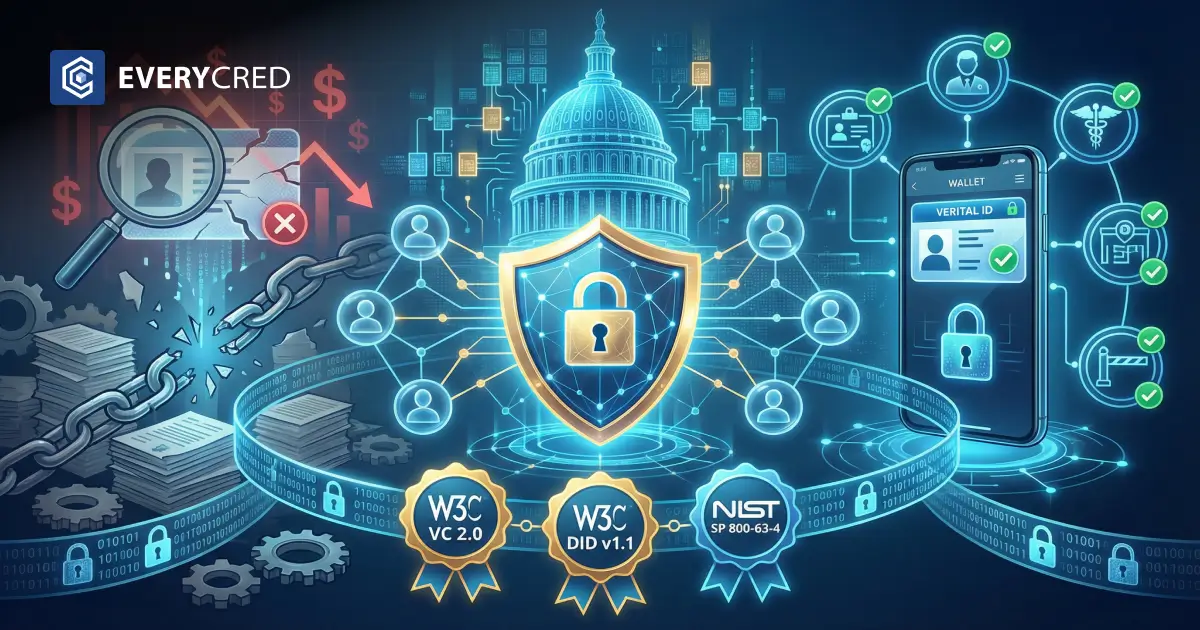
- The Trust Gap Is Real, and It Has a Price Tag
- What a Digital Trust Platform Is, and What It Is Not
- Verifiable Credentials Are Now a Web Standard
- Why Decentralized Identity Eliminates the Honeypot Problem
- The Compliance Baseline Every CIO Must Confirm Before Signing a Contract
- Six Questions That Separate the Right Platform from a Costly Mistake
- EveryCRED Handles the Full Credential Lifecycle
- The Platform You Choose Today Shapes What Your Agency Can Do for Years


Americans lose $56 billion to identity fraud every year. A significant portion of that loss runs through federal and state government programs. Fraudulent benefit claims, forged licenses, and unverifiable credentials cost public agencies billions annually. The tools most agencies use to stop this were built for a different era.
Public sector CIOs already know the problem. What many still need is a clear framework for evaluating a digital trust platform that can operate at government scale, meet federal standards, and integrate with legacy systems that cannot be replaced overnight.
This guide gives you that framework.
The Trust Gap Is Real, and It Has a Price Tag
The OECD’s 2024 Survey on Drivers of Trust in Public Institutions found that only 22% of citizens who feel excluded from government decisions actually trust their national government. Among those who feel included, that number rises to 69%. The gap is not about messaging. It is about systems that fail citizens at the point of verification and service delivery.
The operational cost of that failure is measurable:
- Digital document forgeries now account for 57% of all document fraud, growing at 244% annually
- Federal programs lose billions each year to identity-based fraud that manual checks cannot catch
- Manual credential verification in government takes days, automated cryptographic checks take milliseconds
Legacy infrastructure is the root cause. Paper records, siloed databases, and visual inspection workflows were never designed to handle the scale or the threat landscape that government agencies face today.
What a Digital Trust Platform Is, and What It Is Not
A digital trust platform is not a document scanner, an e-signature tool, or an identity database. It is a system that manages the complete lifecycle of digital credentials, issuance, storage, presentation, verification, and revocation, using cryptographic proof rather than human judgment.
The system operates across three roles:
- Issuer: The government agency that creates and cryptographically signs the credential
- Holder: The citizen who stores it in a secure digital wallet
- Verifier: The officer, department, or system that checks its authenticity in real time
The platform connects all three actors within a shared trust framework. Verification does not require a phone call to the issuing agency or access to a central database. The math confirms the credential, or it does not.
This is the core architectural difference from legacy systems: the platform checks cryptographic signatures, not physical appearances or manually updated records.
Verifiable Credentials Are Now a Web Standard
In May 2025, the W3C published Verifiable Credentials 2.0 as a full Web Recommendation. This moved digital trust out of the experimental category and into production-ready infrastructure for governments worldwide.
A verifiable credential is a cryptographically signed digital record. The issuing agency applies a private key. Any verifying system can confirm the signature instantly using the public key. Altering the credential breaks the signature. There is no workaround.
What verifiable credentials make operationally possible:
- Instant authentication without contacting the issuing agency
- Selective disclosure: a citizen proves age without revealing their full date of birth or home address
- Offline verification: valid without an active network connection
- Tamper-evidence: any modification is detectable immediately
The use cases for verifiable credentials across government are wide: professional licensing, benefits administration, law enforcement IDs, inter-agency access credentials, and border-crossing documents.
Why Decentralized Identity Eliminates the Honeypot Problem
Centralized government databases are high-value targets. One breach exposes millions of citizen records at once. One unauthorized administrator can alter records without detection. One point of failure disrupts services for entire agencies.
Decentralized identity addresses this at the architecture level. The citizen holds their own credential on their personal device. The government does not maintain a central repository of document scans or personal records tied to that credential. The verifying agency receives only the data it needs for that specific transaction — nothing more is transmitted.
Core properties of this model:
- The issuing agency does not track when or where a citizen uses their credential
- Citizens share minimum necessary data for each interaction
- Government agencies reduce their legal and financial exposure from data breach events
- Cross-department verification works without building new shared databases
The W3C DID v1.1 specification defines the exact standard for creating and resolving decentralized identifiers globally. Building on this standard is what makes decentralized identity for government interoperable, not just within one agency, but across departments, jurisdictions, and borders.
The Compliance Baseline Every CIO Must Confirm Before Signing a Contract
In July 2025, NIST released the final version of SP 800-63, Revision 4, a four-year process incorporating nearly 6,000 public comments. The updated guidelines now formally cover digital wallets, verifiable credentials, and mobile driver’s licenses. Federal agencies are required to align their digital identity systems with this framework.
When evaluating any digital trust platform, CIOs should confirm direct compliance with:
- W3C VC 2.0: the global standard for verifiable credentials
- W3C DID v1.1: the standard for decentralized identifiers
- NIST SP 800-63-4: the federal digital identity guideline
- Open REST APIs: for integration with existing legacy infrastructure
Platforms built on proprietary formats create long-term compatibility problems. Cross-agency and cross-jurisdiction digital government solutions depend on shared technical foundations. A closed system selected today becomes a costly migration problem during every future upgrade cycle.
Six Questions That Separate the Right Platform from a Costly Mistake
Most government procurement processes focus on feature lists. The more useful approach is to evaluate operational fit and compliance readiness. Before selecting a platform, a CIO should get direct answers to these questions:
1. Does It Cover the Full Credential Lifecycle?
Issuance, verification, updates, expiry, and revocation must be managed in one system, not spread across multiple tools.
2. Does It Integrate with Existing Legacy Databases?
An API-first architecture is a requirement. The platform must connect to current government systems without requiring a complete IT overhaul.
3. Does It Support Selective Disclosure?
Citizens must be able to share only the data required for a specific transaction. This is a privacy requirement and a federal compliance standard under NIST SP 800-63-4.
4. Is Revocation Real-Time?
Expired or revoked credentials must stop working immediately across all verification points, not after a scheduled refresh. Agencies that manage digital ID cards for field personnel need this to be instantaneous.
5. Does It Produce Immutable Audit Trails?
Every issuance and verification event must be logged and tamper-proof. This is non-negotiable for regulatory accountability and compliance reporting.
6. Can It Scale Beyond a Pilot Program?
Many platforms perform well in controlled environments. Fewer handle citizen-scale issuance without performance degradation or manual workarounds. Evaluate based on production-scale throughput, not demo environments.
EveryCRED Handles the Full Credential Lifecycle
Built for Government and Public Sector Agencies
EveryCRED is a digital trust platform built on W3C standards and open REST APIs. It manages credential issuance, holder storage, and real-time verification within a single trust framework, without requiring a complete replacement of existing government infrastructure.
The platform’s core capabilities include cryptographically signed credential issuance, one-click verification for field and back-office teams, and real-time revocation across all verification points. The decentralized identity method ensures citizen data stays with the citizen, not in a centralized database that represents a breach risk.
Government agencies that have deployed EveryCRED, including law enforcement bodies, have moved from paper-based document checks to cryptographic verification without rebuilding their core systems. The platform’s API-first design connects directly to legacy databases, making the transition incremental rather than disruptive.
If your agency is in the process of evaluating platforms, a direct consultation can help map your current infrastructure gaps to the right deployment approach.
The Platform You Choose Today Shapes What Your Agency Can Do for Years
Digital trust is an outcome. A digital trust platform is the infrastructure that produces it, consistently, at scale, across every citizen interaction and inter-agency workflow.
The right platform is standards-compliant, API-integrated, privacy-respecting, and built to scale. The wrong one creates vendor lock-in, interoperability failures, and data risks that outlast any single administration. Decentralized identity and verifiable credentials are now active federal standards with published implementation guidelines.
Public sector CIOs who evaluate platforms against compliance requirements, lifecycle coverage, and open architecture will be in a stronger position to build systems that work across departments, across jurisdictions, and across time, without rebuilding from scratch every few years.