9th April, 2026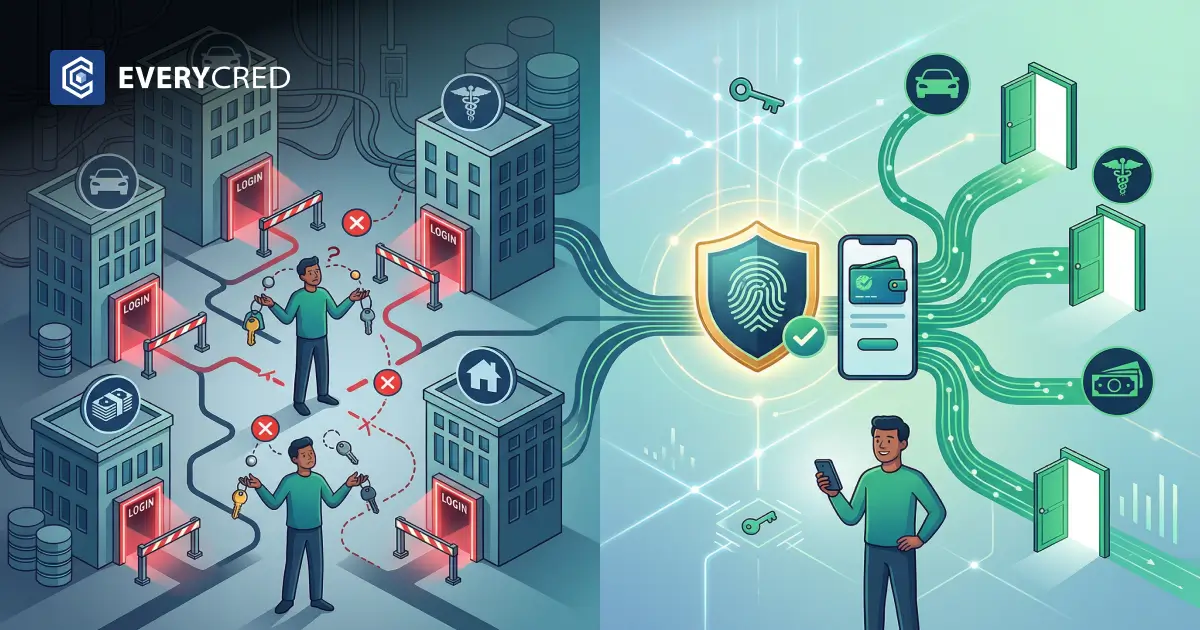
- Why Disconnected Portals Are More Expensive Than They Look
- What "Unified Citizen Identity" Actually Means in Practice
- The Open Standards That Make Cross-Portal Identity Work
- Identity Proofing Software Sits at the Front Door
- Five Capabilities State Digital Departments Must Require
- What State Digital Departments Gain After Deployment
- EveryCRED is Built for Cross-Agency State Identity
- Conclusion
- FAQs


State government websites were built department by department. The DMV built its portal. The Department of Health built its own. The benefits office launched another. Each system issued its own login. Each portal asked citizens to verify their identity from scratch.
The result is a fragmented experience that costs agencies money and costs citizens time.
A 2025 survey by the National Association of State Technology Directors found that 73% of states still organize their portal services by agency rather than by citizen need. That single data point captures a structural problem. Agencies built infrastructure for themselves. Citizens are left to navigate it.
A digital identity platform changes this. It creates a single, verified citizen identity that works across every state portal, every department, and every service. Citizens prove who they are once. Every connected system trusts that proof.
Why Disconnected Portals Are More Expensive Than They Look
The visible cost of fragmented portals is friction. Citizens abandon applications, call helpdesks, and miss benefit deadlines because they cannot navigate the system. But the financial cost runs deeper.
Every disconnected portal maintains its own identity records. Agencies spend resources on:
- Duplicate data storage for the same citizen across multiple systems
- Manual identity review staff for each portal separately
- Repeated fraud exposure because siloed databases do not communicate
- Integration costs each time a new service goes online
The NASCIO 2024 State CIO Survey found that 71% of state agencies are in some stage of integrating an enterprise identity and access management system. The buying cycle is active. But many states are acquiring point solutions that solve one portal’s problem without addressing the cross-agency identity gap.
What “Unified Citizen Identity” Actually Means in Practice
A unified citizen identity is not a shared password. It is a cryptographically verified digital record that proves who a citizen is, what credentials they hold, and what services they are eligible for, all without requiring each agency to re-verify from scratch.
This works through three components:
1. A Verified Identity Credential
The state issues one verifiable credential tied to the citizen’s identity. It is digitally signed and tamper-proof. Any agency that checks this credential gets a mathematically confirmed identity, not a database lookup.
2. A Citizen-Held Digital Wallet
The citizen stores their credential in a secure digital wallet. They control what they share and with whom. No central government server stores their biometric or personal data after issuance.
3. A Cross-Agency Verification Layer
Every connected portal uses a common verification standard to read and confirm the credentials. The citizen presents their identity once. All integrated portals accept it.
This is the “verify once, trust everywhere” model. It eliminates the redundant re-verification that consumes agency resources today.
The Open Standards That Make Cross-Portal Identity Work
A digital identity platform built on proprietary standards creates new silos. Agencies end up locked into one vendor’s ecosystem, which is the same structural problem they started with.
The correct approach is open-standard compliance. Two specifications define the current baseline:
- W3C Verifiable Credentials 2.0, published as an official web standard in May 2025, defines how digital credentials are issued, held, and verified across systems with cryptographic security and privacy preservation.
- NIST SP 800-63-4, finalized in July 2025, defines the identity assurance levels state agencies must meet when providing digital identity services to citizens.
EveryCRED’s decentralized identity infrastructure is built on these standards. This means credentials issued through EveryCRED can be verified by any compliant system, regardless of which agency issued them or which portal requests verification.
Identity Proofing Software Sits at the Front Door
Before a citizen receives a unified digital identity, their real-world identity must be confirmed. This is where identity proofing software performs the critical function.
Modern identity proofing for government onboarding includes:
- Document validation with cryptographic checks, not static image review
- Liveness detection to confirm the applicant is physically present
- Biometric matching between the presented ID and the live capture
- Immediate issuance of a verifiable credential upon successful proofing
The citizen goes through this process once. The resulting credential becomes their cross-portal identity. Agencies downstream do not repeat the proofing step. They verify the credentials.
This shifts identity proofing from a per-portal cost to a one-time infrastructure investment.
Five Capabilities State Digital Departments Must Require
When evaluating a digital identity platform for state portals, procurement teams should require these specific capabilities:
- W3C and NIST compliance: The platform must produce credentials that meet both open-standard and federal assurance-level requirements. Proprietary formats create future incompatibility.
- REST API integration: The platform must connect to existing agency systems without requiring those systems to be rebuilt. API-first design is non-negotiable for cross-portal deployment.
- Selective disclosure: Citizens should be able to prove a specific fact, such as residency status, without exposing their full identity record. This is a privacy requirement, not a feature.
- Real-time revocation: When a credential expires or a citizen’s status changes, every connected portal must reflect that change immediately. Static document systems cannot do this.
- Audit trail generation: Every credential issuance and verification event must be logged in an immutable, cryptographically verifiable record for compliance reporting.
These are the technical requirements that separate a genuine cross-portal identity infrastructure from a single sign-on patch applied to a fragmented system. For a deeper comparison of platform approaches, the digital credential platform vs legacy systems breakdown is useful reference material.
What State Digital Departments Gain After Deployment
The operational outcomes of a deployed digital identity platform are measurable:
- Citizens access multiple services without repeating identity verification
- Agencies reduce manual review queues because credential validation is automated
- Fraud attempts are blocked at the front door, not discovered after benefits are disbursed
- Compliance reporting is generated automatically from audit logs
- New services can be integrated into the trusted identity network via API without rebuilding identity infrastructure
These outcomes address the exact challenges the NASTD survey identified: funding pressure, accessibility gaps, and the difficulty of connecting services across agency lines. A unified identity layer lowers the per-service integration cost significantly.
EveryCRED is Built for Cross-Agency State Identity
EveryCRED operates as a digital trust platform designed specifically for regulated industries, including public sector agencies at the state level.
The platform issues W3C-compliant verifiable credentials, integrates with legacy databases through secure REST APIs, and supports real-time revocation and audit logging. State digital departments can deploy EveryCRED as the identity layer across multiple portals without replacing existing back-end systems.
EveryCRED’s credential infrastructure supports the full citizen identity lifecycle: proofing, issuance, presentation, verification, and revocation. Every step is cryptographically secured and logged.
If your department is evaluating options for a unified citizen identity architecture, schedule a demo to see how EveryCRED integrates with existing state portal infrastructure.
Conclusion
State citizen portals are not going away. More services will move online. The identity problem will grow if it is left unsolved at the infrastructure level.
A digital identity platform built on open standards resolves fragmentation at its source. Citizens prove their identity once. Agencies verify it everywhere. The result is lower operational cost, stronger fraud prevention, and a measurably better experience for the citizens these portals exist to serve.
FAQs
What is a digital identity platform for government citizen portals?
A system that issues, verifies, and manages citizen identities securely across multiple state agency portals using open standards.
How does identity proofing software work in state citizen portals?
It cryptographically verifies a citizen’s identity once, enabling secure access to all connected state government services.
What standards should a state digital identity platform comply with?
Platforms must align with W3C Verifiable Credentials 2.0, NIST SP 800-63-4 guidelines, and open DID interoperability standards.
How does unified digital identity solve disconnected state government portals?
It creates a single verified citizen credential reusable across departments, eliminating repeated logins and redundant manual verifications.
Why do state digital departments need a cross-agency identity platform?
Fragmented portals create security vulnerabilities, poor citizen experience, and duplicated costs that a unified platform eliminates efficiently.