3rd June, 2026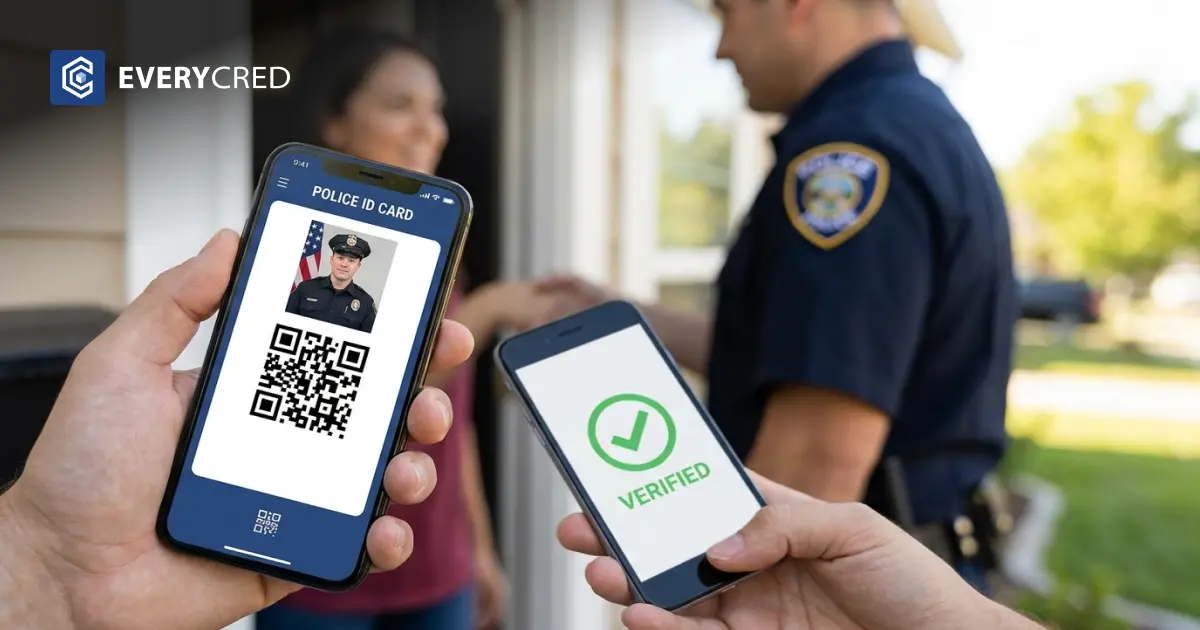
- Why Officer Impersonation Became a 2026 Public-Trust Crisis
- How a Citizen Verifies a Digital ID Card in Under 10 Seconds
- The 90-Day Digital Officer ID Rollout Framework
- A Partner-Agency Acceptance Plan for Mutual Recognition
- Three Rollout Mistakes That Stall Digital Officer ID Programs
- Deploy Digital ID Cards Through Existing Procurement
- Conclusion
- FAQs


Digital ID cards let a citizen verify a real police officer in under 10 seconds by scanning a QR code, with no phone call and no internet connection required. They solve the exact gap behind the 2026 officer impersonation surge: a person at the doorstep has no fast way to confirm a uniformed individual is who they claim to be. This article gives police chiefs and sheriffs a 90-day rollout framework for digital ID cards, including the citizen verification flow and a partner-agency acceptance plan. The framework draws on a live officer credential deployment, not theory.
Key Takeaways
– The FBI warned in November 2025 and January 2026 that criminals impersonating police and ICE agents have committed robberies, kidnappings, and assaults nationwide.
– Digital ID cards built on the ISO 18013-5 standard let citizens confirm a police badge by QR or NFC scan in under 10 seconds, offline.
– A pilot precinct can issue and field-test digital officer IDs within 90 days, with department-wide issuance by day 90.
– Raigad Police cut officer verification time from 30 minutes to under 10 seconds and reduced administrative overhead by 85% after deploying digital officer IDs.
– US agencies can deploy through Carahsoft contract vehicles, including NASA SEWP V, with no new competitive procurement cycle.
Why Officer Impersonation Became a 2026 Public-Trust Crisis
Officer impersonation moved from an isolated incident to a documented national problem in 2026. The FBI issued public warnings in November 2025 and January 2026 about criminals posing as police and immigration agents to commit robberies, kidnappings, and assaults. The bureau noted the line between real officers and imposters has become dangerously blurred.
Citizens currently have no reliable defense. Standard advice tells people to ask for a police badge and photo credentials. That advice fails because a printed badge or laminated card is trivial to fake. AI-assisted document forgery now costs under $30 and grew 311% from Q1 2024 to Q1 2025.
The regulatory direction is also clear. California SB 627, effective January 1, 2026, requires most law enforcement to display visible identification and badge numbers. A digital ID card satisfies that mandate with proof that a citizen can actually check. This is where digital ID cards stop being a convenience and become a public safety identity control.
How a Citizen Verifies a Digital ID Card in Under 10 Seconds
A digital ID card is a cryptographically signed credential that an officer carries on a phone, verified by a citizen through a scan rather than a phone call. The citizen verification flow follows four steps:
- The officer opens the credential and displays a QR code or offers an NFC tap.
- The citizen scans it with a standard phone camera or reader.
- The phone validates the cryptographic signature against the issuing department’s public key.
- The screen confirms the officer’s name, badge number, agency, and active duty status.
This flow runs on the ISO 18013-5 standard, the same mobile credential framework behind state mobile driver’s licenses. The check works offline because the signature is verified locally, which matters at a rural curb stop with no signal. Selective disclosure shares only the officer’s badge and agency, never a home address.
Consider a concrete case. In April 2026, a resident named Maria answered a knock from a person in a dark uniform claiming to be a detective. She scanned the QR code on his credential. The screen returned no valid signature, and she kept the door locked and called 911. A printed badge would have passed her inspection. The cryptographic check did not.
This citizen verification step is the single feature that separates a genuine officer from an imposter at the doorstep. You can see how the same QR verification model works in other field deployments.
The 90-Day Digital Officer ID Rollout Framework
A department can issue and field-test digital ID cards within 90 days using a phased plan. Each phase produces a working result rather than a planning document.
Days 1 to 30: Scope, Enroll, and Integrate
Define the credential schema first: officer name, badge number, rank, agency, and duty status. Connect the credential issuer to the existing records system through a REST API, with no front-end changes to police databases. Enroll a single pilot precinct or detective unit. Sergeant Daniel Ruiz at a mid-size department ran this stage by enrolling 40 officers in two weeks, because issuance is bulk and no-code.
Days 31 to 60: Pilot and Field-Test the Citizen Flow
Activate the citizen verification flow for the pilot unit. Officers display their digital ID cards on real calls. Track scan success rate, offline performance, and any citizen confusion. Fix friction before you scale. This is the stage where public safety identity claims get tested against live conditions.
Days 61 to 90: Department-Wide Issuance and Public Awareness
Issue digital ID cards to the full department. Run a public awareness campaign that shows residents how to scan a police badge and what a valid result looks like. Publish metrics: issuance count, verification volume, and impersonation reports flagged. By day 90, the department has a working public-facing verification capability.
The field deployment guide covers the operational details beneath each of these phases for teams that want a deeper technical reference.
A Partner-Agency Acceptance Plan for Mutual Recognition
Officer impersonation crosses jurisdictions, so a digital ID card must be verifiable beyond the issuing department. A partner-agency acceptance plan establishes mutual recognition across neighboring departments, county sheriffs, and state programs. Shared public safety identity standards make a single officer credential trusted region-wide.
Standards make this practical. Because the credentials follow W3C Verifiable Credentials 2.0, NIST SP 800-63-4, and ISO 18013-5, a deputy from one county can verify an officer from another without shared database access. NIST documents how this verifiable credential ecosystem supports cross-issuer trust.
Revocation closes the loop. When an officer is suspended or separated, the department deactivates the credential in seconds, and every subsequent scan shows it as invalid. A suspended officer cannot present a valid digital ID card the next day. Partner agencies and the public both benefit from this shared layer of public sector credentials.
Three Rollout Mistakes That Stall Digital Officer ID Programs
Most digital ID card programs fail in operations, not technology. Three gaps account for the majority of them. Address each one inside the 90-day plan rather than after launch.
Skipping officer training
Officers who do not trust the credential default to the paper badge, and citizens never learn to scan. Build a 30-minute enrollment briefing into the pilot phase. Every officer should present the QR code confidently on the first call, not fumble for it.
Running no citizen awareness campaign
A digital ID card only stops officer impersonation if the public knows to scan it. Captain Lena Ortiz ran a 2026 pilot where citizen scan rates sat near zero for three weeks. After one local-news segment that showed residents how to verify a police badge, weekly scans climbed past 400. The technology had not changed. Public awareness had.
Disconnecting revocation from personnel records
A credential that does not deactivate when an officer separates recreates the exact impersonation risk it was meant to remove. Wire the revocation trigger to the existing personnel system through the REST API. Status changes then propagate to every verification within seconds, with no manual step for an administrator to forget.
Deploy Digital ID Cards Through Existing Procurement
We deployed digital officer IDs for Raigad Police and reduced field verification time from 30 minutes to under 10 seconds, with an 85% reduction in administrative overhead. The credentials are cryptographically signed, verified offline through QR or NFC, and revoked in seconds when an officer’s status changes. US police departments can deploy the same capability without a new procurement cycle:
- Procurement vehicles: Available through Carahsoft on NASA SEWP V, ITES-SW2, and NASPO ValuePoint.
- Standards compliance: W3C VC 2.0, NIST SP 800-63-4, and ISO 18013-5.
- Integration: Connects to existing records systems via REST API with no front-end changes.
Book a demo to see the 90-day rollout and citizen verification flow applied to your department.
Conclusion
Officer impersonation became a national problem in 2026, and a printed police badge no longer proves anything to the person at the door. Digital ID cards close that gap by giving citizens a cryptographic check they can run in under 10 seconds, offline. The 90-day rollout framework moves a department from a single pilot precinct to full issuance and public verification within one quarter. A partner-agency acceptance plan extends that trust across jurisdictions, and instant revocation keeps separated officers from misusing a credential. Departments that deploy digital officer IDs now build public safety identity infrastructure before impersonation incidents climb further. The technology is proven, standards-based, and available through procurement vehicles that agencies already hold.
FAQs
How do digital ID cards stop officer impersonation?
They let citizens verify an officer’s cryptographic signature by QR or NFC scan, which a forged police badge cannot pass.
Can a citizen verify a police officer without internet access?
Yes, ISO 18013-5 digital ID cards verify offline by checking the cryptographic signature locally, with no network connection required.
How long does it take to roll out digital ID cards for a police department?
A pilot precinct can issue and field-test digital officer IDs within 30 days, with full department issuance by day 90.
What happens to a digital ID card when an officer is suspended?
The department revokes the credential in seconds, and every subsequent citizen verification scan shows it as invalid immediately.
Can US police departments buy digital ID cards without new procurement?
Yes, agencies can deploy through Carahsoft contract vehicles, including NASA SEWP V, ITES-SW2, and NASPO ValuePoint.