25th June, 2026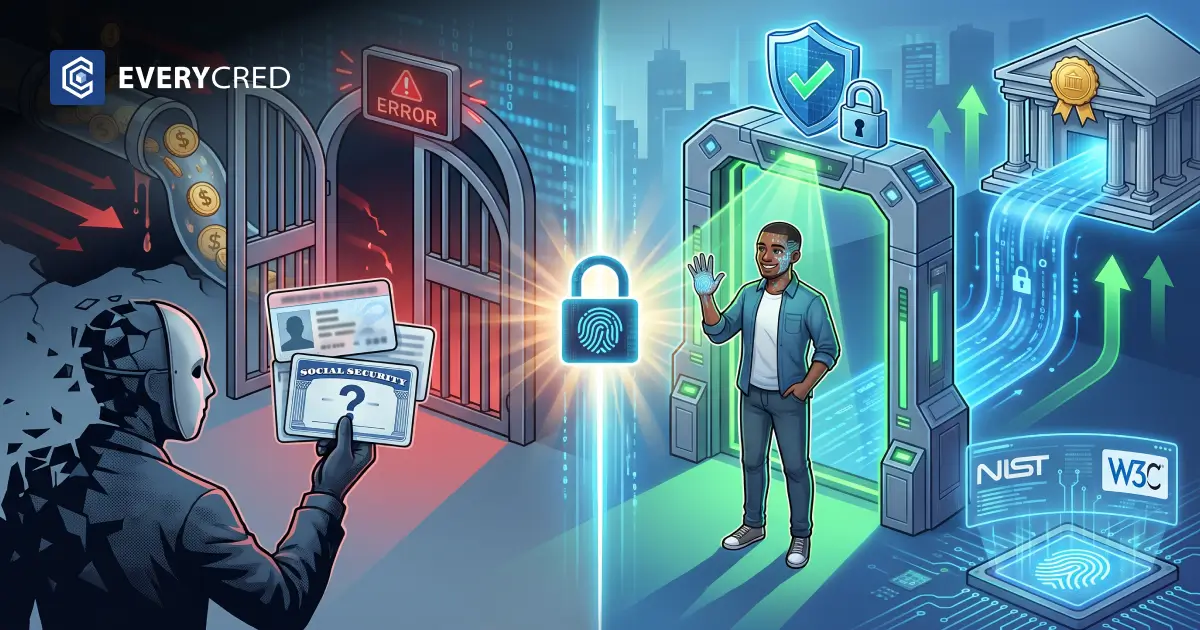
- Why Synthetic Identities Pass Traditional Benefit Eligibility Checks
- What Identity Proofing Software Does Differently at Enrollment
- How State Agencies Verify Benefit Eligibility Without Re-Proofing
- NIST SP 800-63-4 and the Cost Case for Identity Proofing Software
- How We Help State Agencies Deploy Identity Proofing
- Conclusion
- FAQs


Identity proofing software stops synthetic-identity welfare fraud at enrollment. It verifies that a real person stands behind every application before the agency issues benefits. State benefit agencies lose money when fabricated identities clear document checks. Because those checks confirm paperwork, not people, the fix has to happen at enrollment. After the payment leaves the treasury, recovery is slow and rarely complete.
The federal government reported $162 billion in improper payments across major programs in one fiscal year. A measurable share of that loss traces back to identities that were never real. This guide explains how identity proofing software closes the enrollment gap that synthetic identity fraud exploits. In addition, it shows how state benefit agencies use welfare fraud prevention to confirm benefit eligibility without slowing real applicants.
Key Takeaways
- Synthetic identity fraud blends a real ID number with fabricated details to pass standard document checks.
- Identity proofing software verifies the applicant at enrollment and binds them to a tamper-proof credential.
- NIST SP 800-63-4, finalized July 2025, defines the identity assurance levels agencies should map their process against.
- Manual verification costs $15 to $25 per check, while cryptographic verification costs under $0.10.
- At 500,000 checks a year, that gap means $7.4 to $12.4 million in first-year savings.
Why Synthetic Identities Pass Traditional Benefit Eligibility Checks
Synthetic identity fraud is the fastest-growing financial crime against government programs. A fraudster takes a real Social Security number, often from a child or a deceased person. Then they pair it with a fabricated name and date of birth. As a result, the applicant does not exist, yet the paperwork checks out.
Traditional benefit eligibility screening confirms a document’s format and matches it to a record. However, it never confirms that a living person holds that identity. That gap is exactly where synthetic identity fraud succeeds.
For example, AI-generated forged documents grew 311% from Q1 2024 to Q1 2025. Today, the entry cost for document fraud sits under $30. An eligibility officer sees a clean driver’s license and a valid SSN. Manually, they have no way to spot a synthetic identity. So the fabricated applicant enrolls and then collects payments for months before anomalies surface.
Consider a caseworker named Karen at a state human services office. She approved an applicant whose documents looked flawless. Eight months later, an audit flagged the same SSN on three benefit accounts in two states. The identity was synthetic. In the end, the recovery effort cost more than the benefits ever would have.
What Identity Proofing Software Does Differently at Enrollment
Identity proofing software verifies a real person at the point of enrollment. Then it issues a credential that no one can forge or reuse. In short, it answers the question that document checks cannot: Is this a genuine, unique individual?
The process layers several controls that synthetic identities cannot satisfy at once:
- Document verification confirms the ID is authentic and unaltered.
- Liveness detection and biometric matching confirm a live person is present.
- Cross-referencing against authoritative records confirms the identity is real and unique.
Once proofing succeeds, the platform binds the applicant to a cryptographically signed credential. This is the core of effective identity proofing for benefit programs. After that, any alteration breaks the signature and fails verification instantly.
This enrollment-time approach separates strong identity proofing software from downstream fraud detection. Detection only looks for patterns after money moves. By contrast, proofing keeps the fabricated identity out of the system entirely. For welfare fraud prevention, stopping fraud at the door costs far less than clawing back payments.
How State Agencies Verify Benefit Eligibility Without Re-Proofing
A proofed identity becomes reusable across programs once the agency issues it as a verifiable credential. The applicant holds that credential in a secure wallet. Then, any authorized agency confirms benefit eligibility by checking the cryptographic signature. No repeat proofing happens, and no one calls another office.
This solves a structural problem in public sector credentials. Today, every program proves the same citizen again and again, which multiplies cost and friction. Verify once, trust everywhere replaces that repetition. For example, a SNAP applicant who proved today can present the same credentials to Medicaid tomorrow.
Every verification also writes to an immutable audit trail. As a result, program integrity teams hold a timestamped record of each check. That record shows who verified what, and whether the credential was valid at that moment. It supports both fraud investigations and compliance reporting.
The model also strengthens ghost beneficiary prevention. No one can quietly duplicate a credential into payments for people who do not exist. Real-time revocation closes another gap, too. A credential invalidated on Monday will not pass as valid on Tuesday.
Marcus, a fraud investigator at a state benefits agency, described the difference plainly. Before credential-based proofing, he chased improper payments across disconnected case files. After enrollment-time proofing, synthetic applications never cleared intake. As a result, his caseload shifted from recovery to oversight.
NIST SP 800-63-4 and the Cost Case for Identity Proofing Software
The standard that governs identity proofing for US agencies is NIST SP 800-63-4, finalized in July 2025. It defines Identity Assurance Levels, which describe how strongly a process proves an identity. IAL1 allows self-asserted identity, while IAL2 and IAL3 require remote or in-person verification with biometric binding. Agencies should map their process to these levels. The NIST Digital Identity Guidelines set out exactly what each level requires.
Mapping to a recognized assurance level does two things. First, it gives auditors a defensible benchmark. Second, it forces a clear answer on whether the current process can detect synthetic identity fraud. Most document-only workflows sit below the level needed to stop fabricated identities.
The cost case is just as direct. Manual verification runs $15 to $25 per check. By contrast, identity proofing software verifies for under $0.10 per check. At 500,000 verifications a year, that gap reaches $7.4 to $12.4 million in first-year savings. It also avoids improper payments, which is the core of welfare fraud prevention. In short, strong government identity fraud prevention pays for itself.
How We Help State Agencies Deploy Identity Proofing
We deploy identity proofing software that binds each verified applicant to a tamper-proof credential. As a result, the platform blocks synthetic identities at enrollment instead of catching them after payment. It integrates with existing eligibility systems through a REST API, with no front-end changes. It also meets W3C VC 2.0 and NIST SP 800-63-4 requirements. US agencies can procure through Carahsoft on existing vehicles such as NASA SEWP V, ITES-SW2, and NASPO ValuePoint. We are also running a college admissions pilot that uses the same enrollment-time proofing to stop application fraud. Book a demo to see the workflow.
Conclusion
Synthetic identity fraud succeeds because traditional benefit eligibility checks confirm documents, not people. Identity proofing software changes that outcome. It verifies a real applicant at enrollment and issues a credential that no one can forge. As a result, state benefit agencies stop fabricated applicants before they ever receive a payment, instead of chasing losses later.
The economics favor prevention. Cryptographic verification costs a fraction of manual review. Moreover, every check meets NIST SP 800-63-4 expectations and leaves a permanent audit trail. Federal scrutiny of improper payments keeps rising. That is why identity proofing software now anchors welfare fraud prevention for state programs.
FAQs
What is identity proofing software, and how does it stop welfare fraud?
It verifies a real applicant at enrollment and issues a tamper-proof credential that blocks synthetic identities before any payment.
How is synthetic identity fraud different from regular identity theft?
Synthetic identity fraud fabricates a new identity from real and fake data, while identity theft misuses an existing person’s identity.
Does identity proofing software meet NIST SP 800-63-4 requirements?
Yes, strong identity proofing software maps to NIST SP 800-63-4 Identity Assurance Levels and documents each verification for audit purposes.
Can state benefit agencies verify eligibility without re-proofing every applicant?
Yes. A proofed identity issued as a verifiable credential works across programs through instant cryptographic checks, with no repeat proofing.
How much can identity proofing software save a state benefit program?
Verification drops from $15 to $25 per manual check to under $0.10. At 500,000 checks, that saves $7.4 to $12.4 million a year.