8th July, 2026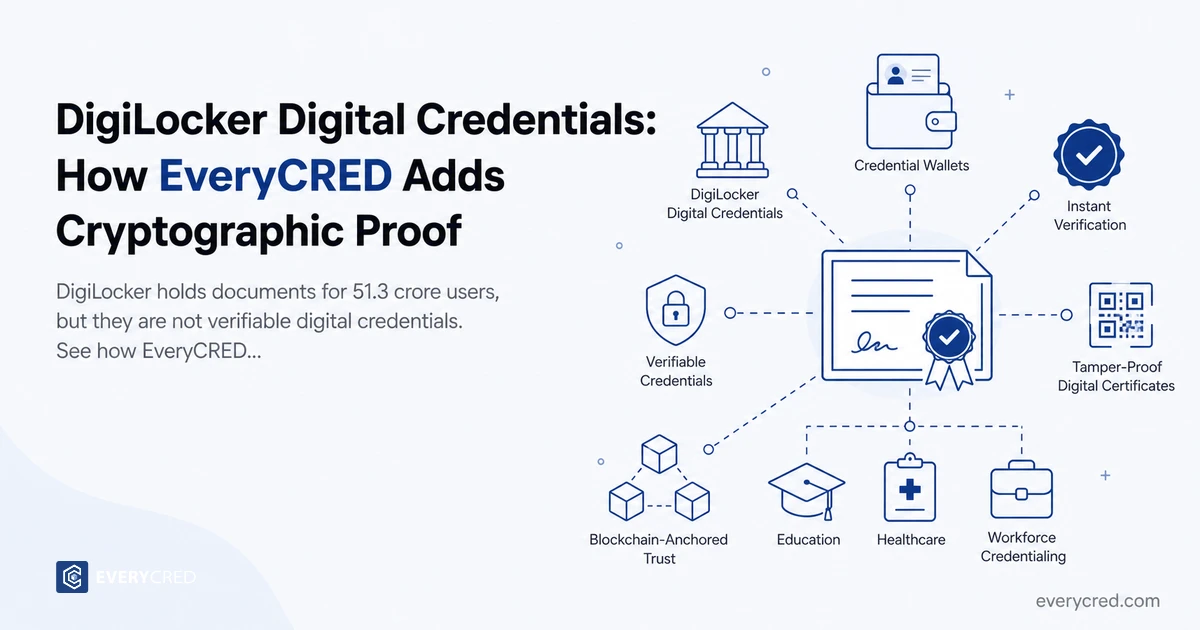
- Why DigiLocker Documents Are Not Verifiable Digital Credentials
- How EveryCRED Adds Cryptographic Proof to Digital Credentials
- Offline Verification Removes the Network Dependency
- Selective Disclosure Keeps DigiLocker Data DPDP Act Compliant
- DigiLocker Integration for Universities and State Agencies
- How We Deploy DigiLocker Verifiable Credentials
- Conclusion
- FAQs


DigiLocker stores documents for 51.3 crore users, but those records are not W3C verifiable credentials. A stored file proves a document exists. It does not carry a cryptographic signature that a verifier can check on the spot. EveryCRED adds that proof layer on top of DigiLocker-issued documents. It turns them into tamper-evident digital credentials that verify offline in under 10 seconds.
This guide explains how the DigiLocker integration works and why field verification no longer needs a live network. It also shows how selective disclosure keeps the process compliant with the DPDP Act. It is written for the state IT directors, university registrars, and program heads who already issue documents through DigiLocker. They gain cryptographic assurance without replacing the systems they run today.
Key Takeaways
- DigiLocker holds about 5.6 billion documents for 51.3 crore users, but these are stored files, not cryptographically verifiable digital credentials.
- EveryCRED anchors each document with a SHA-512 hash and a W3C VC 2.0 signature, so any change breaks verification instantly.
- Verification runs offline through cached cryptographic proofs, so field checks no longer need a live DigiLocker document pull.
- Selective disclosure through zk-SNARKs shares only the fact that a verifier needs, aligning the DigiLocker integration with DPDP Act data minimization.
- The credential layer connects over REST API, so agencies and universities keep their existing DigiLocker workflows.
Why DigiLocker Documents Are Not Verifiable Digital Credentials
DigiLocker is India’s national document repository. It has issued roughly 5.6 billion documents and serves 51.3 crore registered users across central and state services. For most citizens, it is now where a marksheet, license, or registration certificate lives.
A DigiLocker document is a government-issued file linked to an account. It proves the file was issued and stored. It does not carry an independent cryptographic signature that a verifier can validate without contacting the source.
That gap shows up in the field. To confirm a DigiLocker document, a verifier needs internet connectivity and a live pull from the repository. For a state IT director, that means every check still depends on uptime and a document fetch. A verifiable credential works differently because it carries its own proof. This is the difference between a stored document and a portable digital credential, the foundation of verifiable credentials and DigiLocker.
How EveryCRED Adds Cryptographic Proof to Digital Credentials
EveryCRED wraps a DigiLocker-issued document in a credential that follows the W3C Verifiable Credentials Data Model 2.0. The credential is signed with the issuing authority’s Decentralized Identifier (DID). A SHA-512 hash of the document is anchored to a blockchain ledger at the time of issuance.
The anchoring step creates trust. If one character in the document changes later, the hash no longer matches, and verification fails. The verifier does not call the university, the department, or DigiLocker to confirm authenticity. That self-contained proof is the core property of true digital credentials.
EveryCRED can also revoke a credential in seconds, and the next verification anywhere returns an invalid result. This design follows the open W3C Verifiable Credentials Data Model. An EveryCRED credential is therefore recognized well beyond India. A degree issued in Pune can be checked by an employer in Toronto with the same certainty.
Offline Verification Removes the Network Dependency
The biggest operational gain from this DigiLocker integration is offline verification. EveryCRED stores a cached cryptographic proof on the verifying device. A QR scan checks the credential against that proof, with no data connection required.
This matters most in the field. Consider a highway checkpoint with a weak signal, or a rural welfare camp with no reliable network. A DigiLocker document pull would stall there, while a cached credential check resolves in seconds. For a program head running thousands of daily checks, removing the network dependency also removes a major point of failure.
EveryCRED deployed this exact model for the Raigad Police. Officers moved from 30-minute manual identity checks to verification in under 10 seconds, and the department cut administrative overhead by 85%. The same offline pattern powers the Raigad Police digital ID program, which pairs DigiLocker with cryptographic proof.
Selective Disclosure Keeps DigiLocker Data DPDP Act Compliant
Selective disclosure is where digital credentials protect privacy better than a shared document. A DigiLocker file, once opened, exposes everything printed on it. A verifiable credential can prove a single fact and reveal nothing else.
EveryCRED uses zero-knowledge proofs (zk-SNARKs) to make this work. A verifier can confirm that a person is over 18, holds a valid license, or graduated from a recognized university. The credential answers only that question. Date of birth, address, and roll number stay hidden.
This maps directly onto the DPDP Act. The law requires data minimization, and selective disclosure enforces it at the technical layer. A DigiLocker integration built on selective disclosure shares the minimum a verifier needs, which lowers both privacy risk and audit exposure.
DigiLocker Integration for Universities and State Agencies
The DigiLocker integration serves two groups that already run on India Stack: education and government. Both issue documents at scale, and both face rising forgery pressure. AI-generated forged documents grew 311% between the first quarter of 2024 and the first quarter of 2025.
For universities, EveryCRED issues degrees and marksheets as verifiable credentials alongside the DigiLocker copy. Picture Kavita, a registrar at a state university, signing a graduating batch of 8,000 students in one run. Every employer can then verify a certificate without a records office email or phone call. This education model is set out for DigiLocker in education.
For state agencies, the same layer secures welfare IDs, officer credentials, and license records. Integration runs over the REST API, so no front-end change is needed for existing portals. EveryCRED treats this as an upgrade path for public sector credentials, not a replacement for DigiLocker.
How We Deploy DigiLocker Verifiable Credentials
We built the DigiLocker integration around cryptographic proof, offline verification, and selective disclosure. We deployed it operationally for the Raigad Police in 2025. Field officers verify credentials in under 10 seconds without a network, and every check writes to an immutable audit trail. We connect over REST API, so your DigiLocker workflows and portals stay in place. State agencies and universities can start with a pilot and scale to a full rollout in 36 weeks. The pilot goes live by week 20. Download our DigiLocker integration guide, or book a demo to see offline verification and selective disclosure working on real digital credentials.
Conclusion
DigiLocker solved storage and access for hundreds of millions of Indians. It did not solve instant, offline, tamper-evident verification, because a stored file is not a signed credential. That is the gap EveryCRED closes.
By anchoring each DigiLocker document with a SHA-512 hash and a W3C signature, EveryCRED turns it into a self-proving digital credential. Verification runs offline in seconds. Selective disclosure shares only what a verifier needs, which keeps the process inside the DPDP Act limits. Integration runs over REST API, so nothing already in production has to be torn out.
India is moving more services onto verifiable credentials. The agencies that add cryptographic proof now will verify faster, cut forgery, and protect citizen data by design.
FAQs
Are DigiLocker documents the same as verifiable credentials?
No. DigiLocker stores issued files, while verifiable credentials add a cryptographic signature that proves authenticity and detects any tampering instantly.
Can EveryCRED verify DigiLocker credentials without an internet connection?
Yes. Cached cryptographic proofs let field officers verify digital credentials offline, with no live document pull from DigiLocker required.
How does selective disclosure work with a DigiLocker integration?
Selective disclosure uses zk-SNARKs to share only one required fact while keeping the rest of the document private.
Does adding cryptographic proof replace the existing DigiLocker system?
No. EveryCRED connects through a REST API and adds a credential layer, so current DigiLocker workflows stay in place.
Is a DigiLocker verifiable credentials integration DPDP Act compliant?
Yes. Selective disclosure shares minimal data, aligning digital credentials with the DPDP Act data minimization requirement.