27th July, 2026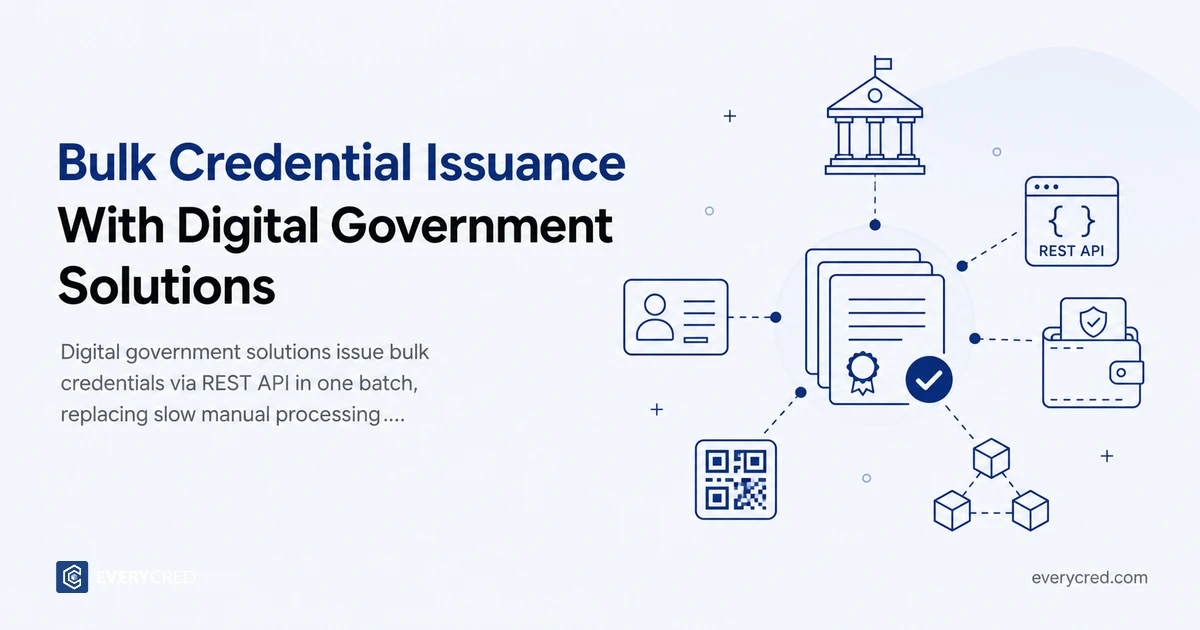
- Why Manual Credential Batches Delay Graduates and Programs
- How Bulk Issuance via REST API Works
- Digital Government Solutions Built for Program-Scale Issuance
- Bulk Credential Issuance for Universities and Training Programs
- How Digital Government Solutions Scale From Pilot to Statewide
- Deploy Bulk Issuance With EveryCRED
- Conclusion
- FAQs


Digital government solutions issue credentials in bulk through a REST API, sending thousands of records in a single request instead of processing them by hand. This removes the manual batching that delays graduates, employees, and program participants. Agencies, universities, and training programs issuing tens of thousands of credentials per cycle can move from weeks of manual work to minutes of automated issuance.
Manual issuance does not scale. A registrar keying diplomas one record at a time creates backlogs. An agency printing officer IDs in slow batches does the same. This guide explains how bulk issuance over an API works, what integration engineers plan for, and how program administrators cut issuance time without adding staff.
Key Takeaways
- Bulk issuance via REST API sends thousands of batch credentials in one authenticated request, replacing manual, record-by-record processing.
- Digital government solutions cut issuance cycles from weeks to minutes, so graduates and program participants are not left waiting.
- EveryCRED issued digital officer IDs for Raigad Police and reduced verification time from 30 minutes to under 10 seconds.
- US agencies can deploy through Carahsoft on NASA SEWP V and ITES-SW2, with no new procurement cycle required.
Why Manual Credential Batches Delay Graduates and Programs
Large programs do not issue a handful of credentials. A state university graduates tens of thousands of students each year. A federal training program certifies thousands of employees per cycle. A police department rolls out IDs to an entire force. Manual issuance treats each record as a separate task, so the work grows with every added name.
The result is a backlog. Graduates wait weeks for verifiable diplomas they need for jobs. Program participants cannot prove completion when it matters. Every delayed credential becomes a support ticket, a phone call, or a re-issued document.
The cost is measurable. Manual credential verification runs $15 to $25 per check, and issuance carries similar overhead. Fraud raises the stakes further. The GAO estimates annual US federal fraud between $233 billion and $521 billion, much of it tied to weak identity and credential processes. Digital government solutions replace slow, paper-based work with automated batch credential issuance that scales with the program, not against it.
How Bulk Issuance via REST API Works
Bulk issuance replaces manual entry with a single automated workflow. An integration connects the program’s system of record, a student information system, or an HR database, to the credential platform. The platform then issues every credential in the batch from one instruction.
The workflow has four steps:
- The source system exports a batch file or connects directly through an API.
- The platform validates each record against a shared credential template.
- One REST API call signs and issues the entire batch in a single request.
- Each recipient receives a cryptographically signed credential in a digital wallet.
EveryCRED supports both paths. A registrar can upload a batch for a graduating class through the issuer portal, and no code is required. Engineers who prefer direct integration can call the developer REST API from an existing application. This is how batch credentials move from a spreadsheet to a verifiable format without manual keying.
Bulk issuance is faster, and it is also consistent. Every credential in the batch follows the same schema, carries the same signature standard, and lands in the recipient’s wallet ready to verify. Manual processing cannot guarantee that at scale.
Digital Government Solutions Built for Program-Scale Issuance
Government programs carry requirements that consumer tools ignore. Credentials must follow open standards, produce an audit trail, and integrate with systems already in place. Digital government solutions for bulk issuance are built around these constraints from the start.
EveryCRED issues credentials that follow the W3C Verifiable Credentials Data Model 2.0. This open standard keeps batch credentials interoperable across agencies and borders. Every issuance event writes to an immutable record, which gives compliance teams the audit trail they need. For US agencies, the platform also aligns with NIST SP 800-63-4 identity assurance requirements.
Integration matters as much as standards. EveryCRED connects to existing HR systems, grant portals, and databases through a REST API, with no front-end changes for the teams already using them. This is the difference between a pilot who stalls and a program that ships. Agencies evaluating public sector credentials can add bulk issuance as a layer over the current infrastructure rather than replacing it.
Digital government solutions also account for the field. Credentials are verified offline using cached cryptographic signatures, so a checkpoint with no connectivity can still confirm a credential in seconds.
Bulk Credential Issuance for Universities and Training Programs
Universities feel the issue problem most sharply at graduation. Thousands of diplomas and transcripts come due in the same short window. Manual issuance turns a milestone into a bottleneck, and graduates who need proof for jobs or further study wait in line.
Bulk issuance changes the timeline. A registrar prepares one batch for the entire graduating class, and the platform issues every diploma at once. Each graduate receives a verifiable credential they keep for life, and any employer can confirm it in seconds without calling the registrar’s office.
The same pattern fits training programs and certification bodies. A program that certifies 10,000 participants per cycle issues all of them as batch credentials in a single run. EveryCRED supports this with no-code credentialing, so staff without engineering support can still issue at scale.
Education programs also gain fraud protection. A cryptographically signed diploma cannot be altered without breaking its signature, which makes fake degrees detectable at the point of verification. Bulk issuance and fraud prevention arrive in one workflow, not as separate projects.
How Digital Government Solutions Scale From Pilot to Statewide
Scale is where most credential projects fail. A pilot works for 500 records, then breaks at 50,000. Deployment experience is the difference, and EveryCRED has issued credentials for live government programs at that scale.
Raigad Police deployed digital officer IDs across the force. The rollout reduced credential verification time from 30 minutes to under 10 seconds and cut administrative overhead by 85%. Officers verify credentials in the field in seconds, and the system works offline when there is no network. That deployment, part of the wider police identity modernization for the Government of Maharashtra, proves the model at an operational scale.
A statewide rollout follows a clear timeline. EveryCRED plans deployments over 36 weeks, with a pilot operational by week 20. Bulk issuance is central to that plan because a statewide program cannot onboard tens of thousands of holders by hand.
These digital government solutions move from pilot to production without a rewrite. The same REST API that issues a 500-record pilot issues a 500,000-record program. Only the batch size changes.
Deploy Bulk Issuance With EveryCRED
We built EveryCRED for issuance at program scale. Our platform issues thousands of batch credentials through a single REST API call, with an immutable audit trail on every event. Universities issue an entire graduating class in one run, and agencies onboard a full workforce without manual batches. US government teams can deploy through Carahsoft on existing contract vehicles, including NASA SEWP V and ITES-SW2, so there is no new procurement cycle to clear. Programs facing issuance backlogs can replace manual work with automated bulk issuance in weeks. Book a demo to see the API issue a live batch.
Conclusion
Manual credential issuance cannot keep pace with program-scale demand. Every record processed by hand adds delay, cost, and a chance for error. Bulk issuance over a REST API removes that ceiling by issuing thousands of batch credentials in a single request.
For government agencies and universities, the shift is practical, not theoretical. EveryCRED has already issued credentials for live government programs and cut verification time from 30 minutes to under 10 seconds. Digital government solutions built on open standards issue at scale, integrate with existing systems, and produce the audit trail compliance teams require.
The next issuance cycle does not have to be a backlog. Programs that adopt automated bulk issuance now will onboard the next class, cohort, or workforce in minutes instead of weeks.
FAQs
What is bulk credential issuance via API?
Bulk credential issuance via API sends thousands of records to the platform in one request, replacing manual, record-by-record processing.
How do digital government solutions issue credentials at scale?
Digital government solutions connect a system of record to a REST API that signs and issues the entire batch at once.
What are batch credentials?
Batch credentials are many credentials issued together in a single run, each cryptographically signed and individually verifiable in a holder’s wallet.
Can universities issue diplomas in bulk without code?
Yes, registrars upload one batch for a graduating class through the issuer portal, and no-code credentialing issues every diploma at once.
Can US agencies buy EveryCRED through existing contracts?
Yes, US agencies procure through Carahsoft on NASA SEWP V and ITES-SW2, with no new procurement cycle required.