24th March, 2026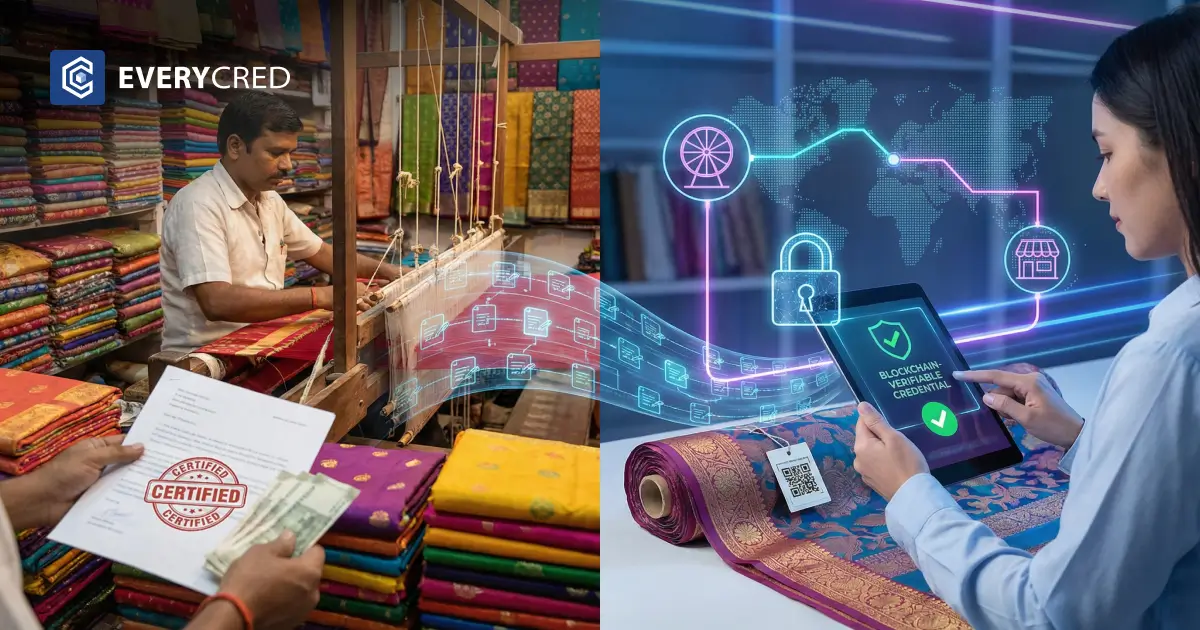
- Why Are Traditional Supply Chains Failing to Stop Textile Counterfeits?
- How Does Blockchain Identity Verification Secure the Textile Supply Chain?
- What Role Do Verifiable Credentials Play in Proving Fabric Authenticity?
- Can Digital Identity Integration Protect Indian Handloom Weavers?
- How Do Digital Trust Services Compare to Legacy PDF Certificates?
- Is Your Textile Brand Ready for Cryptographic Traceability?
- Conclusion


Counterfeit textile production costs the Indian economy an estimated $2.7 billion annually. Fraudulent actors replicate high-value fabrics, such as pure silk, organic cotton, and traditional handlooms. They sell these substandard materials to retailers and consumers under false pretenses. Textile manufacturers lose revenue. Supply chains lose integrity.
A report on heritage textiles and economic impact indicates that millions of textile workers experience direct income loss due to the influx of cheap, fake imitations. Manufacturers require strict anti-fraud systems to prove product authenticity from the factory to the retail shelf.
The application of cryptography provides a factual, verifiable method to track fabrics. Textile manufacturers now use digital systems to issue cryptographic proofs of origin. This infrastructure prevents bad actors from injecting fake goods into legitimate supply chains.
Why Are Traditional Supply Chains Failing to Stop Textile Counterfeits?
Textile supply chains rely on outdated documentation methods. These legacy systems create vulnerabilities at multiple transit points.
- Reliance on Paper Documents: Suppliers use paper invoices and physical certificates to claim fabric authenticity. Forgers easily replicate these physical documents using standard printing equipment.
- Easily Altered PDF Files: Many manufacturers send standard digital certificates via email. Fraudsters use basic editing software to alter dates, batch numbers, and material compositions on these PDFs.
- Lack of Real-Time Verification: Retailers cannot instantly verify the origin of a fabric batch. They must contact the original manufacturer and wait for manual confirmation.
- Fragmented Data Silos: Different participants in the supply chain store data on local servers. This fragmentation prevents a unified, transparent view of the fabric’s journey from spinning to retail.
- Inadequate Auditing: Third-party audits occur infrequently. Fraudulent activities happen between these audit periods without detection.
How Does Blockchain Identity Verification Secure the Textile Supply Chain?
A decentralized ledger provides a permanent record of manufacturing events. Implementing blockchain identity verification removes the possibility of data tampering.
- Immutable Ledger Records: The system records every transaction on a decentralized network. Once a manufacturer logs a batch of organic cotton on the ledger, no user can delete or alter that entry.
- Cryptographic Hashing: The technology assigns a unique cryptographic hash to each data input. If a bad actor attempts to modify a supply chain record, the hash changes completely. This alerts all network participants to the tampering attempt.
- Decentralized Identifiers (DIDs): The system assigns a unique mathematical identifier to the manufacturer. This confirms the exact origin of the data.
- Consensus Mechanisms: Multiple nodes on the network must validate a new entry before it becomes permanent. This eliminates single points of failure.
- Automated Smart Contracts: The system uses programmable rules to execute actions. A smart contract can automatically flag a shipment if the recorded weight differs from the original manufacturer’s input.
- According to a systematic review published in Frontiers in Blockchain, this technology specifically addresses traceability and product authenticity by establishing an unbroken chain of custody.
What Role Do Verifiable Credentials Play in Proving Fabric Authenticity?
Manufacturers use cryptographic documents to assert facts about their products. These digital proofs function as secure, machine-readable claims.
- Data Issuance: A certified textile mill issues verifiable credentials detailing the specific attributes of a fabric batch. The data includes material type, dye composition, weave technique, and production date.
- Cryptographic Signatures: The manufacturer applies a digital signature to the credential using their private cryptographic key. This signature proves the mill authorized the data.
- Tamper-Proof Transmission: The supplier transmits the verifiable credentials to the buyer. The data remains secure during transit.
- Instant Verification: The receiving retailer uses software to scan the credential. The software checks the public blockchain ledger to confirm the manufacturer’s signature.
- Revocation Capabilities: If a manufacturer discovers a quality defect after shipping, they can revoke the specific credential. The system instantly updates the status to invalid.
- Standardized Formats: These systems adhere to W3C (World Wide Web Consortium) standards. This ensures interoperability across different supply chain management software. You can review the widespread applications of verifiable credentials across various high-risk industries.
Can Digital Identity Integration Protect Indian Handloom Weavers?
Linking physical fabrics to a secure digital framework protects specific geographic indicators and artisanal techniques. Establishing a digital identity for physical goods prevents impersonation.
- Physical-to-Digital Linking: Manufacturers attach secure QR codes, NFC (Near Field Communication) tags, or cryptographic RFID threads directly to the textile.
- Unique Product Passports: Each physical tag corresponds to a specific digital identity stored on the network.
- Consumer Verification: An end-user scans the tag with a smartphone. The system retrieves the product’s history and displays the verified manufacturer data.
- Geographic Origin Proof: Weavers in specific regions, such as Banaras or Kanchipuram, tie their unique geographic location to the product’s digital identity. This proves the item is not a mass-produced imitation from another region.
- Supply Chain Visibility: Authorized stakeholders track the exact location and status of the physical good by querying its digital identity on the network.
- Anti-Impersonation: Implementing strict digital identity verification prevents unauthorized factories from claiming to be certified ethical producers.
How Do Digital Trust Services Compare to Legacy PDF Certificates?
Digital trust services utilize cryptography to establish automated, mathematical proof of claims. Legacy systems rely on visual inspection and human trust.
| Feature | Legacy PDF Certificates | Digital Trust Services |
| Authentication Method | Visual inspection of logos and signatures. | Cryptographic signature validation. |
| Tamper Resistance | Low. Easily modified with PDF editors. | High. Hashing prevents undetected changes. |
| Verification Speed | Slow. Requires manual phone calls or emails. | Instant. Automated software validation. |
| Revocation Status | Static. Recalling PDFs is difficult. | Dynamic. Instant registry updates. |
| Data Storage | Centralized local servers. | Decentralized blockchain ledgers. |
| Interoperability | Low. Proprietary formats vary by company. | High. W3C standard compliance. |
Organizations utilize digital trust services to remove human error from the verification process. The software performs the mathematical checks in milliseconds. This provides absolute certainty regarding the origin and quality of the textile shipment.
Is Your Textile Brand Ready for Cryptographic Traceability?
Implementing a secure traceability infrastructure requires specialized credentialing software. Textile manufacturers need a system that issues, manages, and verifies cryptographic proofs without requiring extensive in-house blockchain developers.
EveryCRED provides a comprehensive platform for issuing verifiable digital credentials. Our system allows textile manufacturers to generate secure, tamper-proof certificates for every batch of fabric.
EveryCRED capabilities include:
- Automated issuance of verifiable credentials tied to your specific production data.
- Integration with your existing supply chain management systems via API.
- A secure wallet infrastructure for your distribution partners to hold and present credentials.
- Instant verification portals for retailers and end-consumers.
- Built-in blockchain identity verification to ensure your brand’s data remains immutable and authentic.
- Comprehensive digital trust services to manage credential revocation and expiration.
Manufacturers use EveryCRED to stop counterfeiters and protect their revenue. Schedule a demo with EveryCRED today to deploy a cryptographic traceability system for your textile supply chain.
Conclusion
Counterfeit textiles cause severe financial damage to legitimate manufacturers in India. Paper certificates and standard PDF files fail to stop fraudulent actors from infiltrating the supply chain. Technology provides a factual solution.
By implementing blockchain identity verification, manufacturers secure their production data on an immutable ledger. Issuing verifiable credentials allows suppliers and retailers to authenticate fabric origins instantly. Connecting physical goods to a secure digital identity eliminates the ambiguity of supply chain transit.
Utilizing digital trust services replaces vulnerable manual checks with definitive mathematical proofs. Textile brands that adopt cryptographic traceability protect their revenue, secure their supply chains, and eliminate counterfeit fraud.