6th December, 2025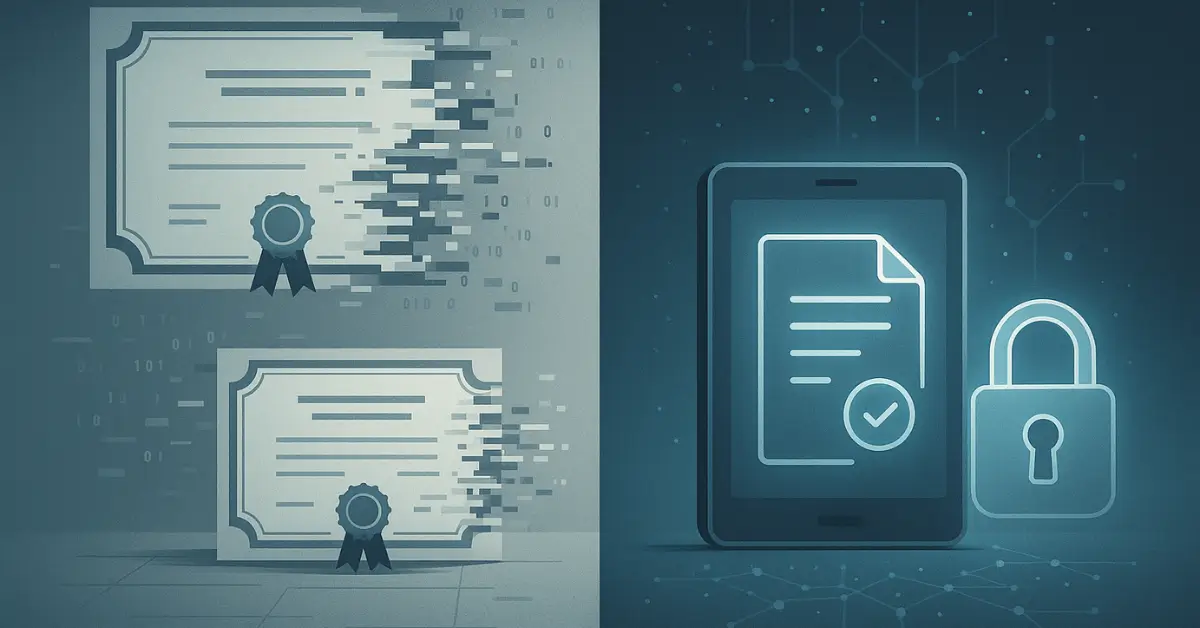


Synthetic credential fraud — AI-generated certificates, fake degrees, tampered PDFs, and fabricated issuer sites — grew faster than any other credential-related threat in 2025.
Europe recorded the sharpest increase globally, with fraud rings using generative AI to mass-produce “credible-looking” documents that bypass traditional verification.
Regional growth in synthetic credential fraud:
- Europe: +378% (highest globally)
- North America: +311%
- MENA: +258%
- APAC: +233%
- LATAM: +140%
- Africa: +121%
Within Europe, credential fraud grew sharply in:
- Germany: +567%
- France: +281%
- UK: +275%
These markets saw the biggest spikes because universities, training bodies, regulators, and private issuers still rely heavily on PDF-based certificates, email-based verification, and static QR codes—all easy to spoof with AI.
Industries Most Impacted by Synthetic Credential Fraud (Global)
- Crypto & Web3 — fake compliance certifications, counterfeit KYC training
- Trading & brokerage platforms — fabricated financial training certificates
- Transportation & mobility — falsified driver permits, fleet operator training
- Fintech — counterfeit AML/KYC, security, or professional credentials
- Gambling / iGaming — fake responsible-gaming, AML, operational licenses
Each of these industries onboards large volumes of users or workers, creating attack surfaces that fraudsters can automate at scale.
Traditional Credential Forgery Is Declining — Except in Europe
While synthetic credential fraud surged everywhere, traditional document forgery (altered PDFs, photoshopped certificates, reused templates) declined globally.
The only exception: Europe, where traditional forgery grew as fraudsters blended old and new techniques to exploit inconsistent verification standards across jurisdictions.
Change in traditional credential forgery (YoY):
- Europe: +33% (the only region with growth)
- Global: –46%
- APAC: –49%
- North America: –50%
- LATAM: –64%
- Africa: –82%
- MENA: –46%
Most regions became better at catching obvious fakes — but not synthetic credentials, which look “perfect” because they’re AI-generated from scratch.
Fast Facts
- Credential fraud cases increased across hiring, higher education, and government programs.
- Most fraud exploited PDF-based certificates, outdated registries, and manual checks.
- Deepfake documents and cloned issuer websites became common fraud vectors.
- Auditors flagged missing or unverifiable issuer records as the top compliance breach.
- High-risk sectors: healthcare, manufacturing, logistics, government programs, EdTech.
- 2026 trend: regulators moving toward real-time verification and cryptographic proofs.
- Institutions without audit trails faced the highest reputational exposure.
- Root cause: unverifiable documents treated as proof of skill, training, or compliance.
2025 was the first year institutions realized the problem wasn’t “more fraudsters.”
The problem was: the system still trusts documents that anyone can fake.
Key Concepts Explained
Credential fraud isn’t a new problem. What changed in 2025 is the speed and scale. AI tools made it trivial to create certificates that look identical to official ones. Fraud shifted from “manual forgery” to “software-assisted replication.” To understand why 2025 was a breaking point, you have to understand how trust is constructed in credential systems.
Credentials as Documents vs. Credentials as Data
Most institutions treat a certificate as a final product. It is just a PDF with a logo, signature, and a line of text. The issue is that documents are not proof. They are claims. If the issuer doesn’t provide a public, secure verification endpoint, the certificate is unverified data. Fraud thrives in environments where the claim is accepted without checking the source.
Why PDF Certificates Fail
PDFs are editable.
PDF signatures are inconsistent.
Logos and seals can be copied.
Serial numbers often have no real registry behind them.
When the “proof” is indistinguishable from a forgery, fraud naturally increases.
How Fake Issuer Websites Emerged
In 2025, fraudsters began cloning issuer websites. They purchased similar domains, copied the layout, and created a fake verification page. Employers rarely know what the legitimate URL should be, so many accepted the forged verification.
This wasn’t a technical failure. It was an assumption failure.
AI-Generated Identities + Fake Certificates
AI lowered two barriers simultaneously:
- Creating personas
- Creating documents supporting those personas
This created a complete illusion of legitimacy. A PDF attached to a real-sounding LinkedIn profile created enough credibility to bypass human screening.
The Compliance Angle
Audits began flagging unverifiable records because regulators realized institutions were accepting credentials without evidence of origin. Compliance failures rose not because rules changed, but because auditors finally tested whether issuers were real.
The System-Level Insight
Credential fraud rises whenever institutions rely on:
- Documents over verification
- Trust over validation
- Manual checks over automated registries
- Local files over auditable trails
2025 exposed how fragile these assumptions were.
Step-by-Step Guide
Step 1: Stop Accepting Documents as Proof
Treat every certificate, license, or training record as a claim requiring independent verification.
Step 2: Validate the Issuer’s Existence Before the Credential
Confirm the institution is accredited, legitimate, and maintains real verification endpoints.
Step 3: Check Provenance (Origin of Data)
Ask:
Where did this credential come from?
Is the issuer responsible for delivering proof?
Can the proof be reproduced without user-supplied documents?
Step 4: Maintain an Audit Trail
Store verification events, not PDFs. Regulators increasingly expect this evidence.
Step 5: Build Automated Workflows for Repeat Checks
High-volume teams (government, employers, HR tech, EdTech) should automate:
- Issuer lookup
- Credential validation
- Expiry checks
- Revocation checks
Manual checks can’t scale with 2025’s fraud patterns.
Mistakes
Mistake 1: Accepting PDFs as Proof
Why it happens: PDFs feel official.
Do this instead: Treat them as pointers. Verify through issuers directly.
Mistake 2: Verifying People but Not Issuers
Why it happens: Workflow bias toward applicant-centric checks.
Do this instead: Validate the institution and accreditation first.
Mistake 3: Relying on Google Searches for Issuer URLs
Why it happens: Convenience.
Do this instead: Use validated issuer registries or official directories.
Mistake 4: Logging Files Instead of Verification Events
Why it happens: Legacy systems accept uploads.
Do this instead: Store evidence of verification, not the document.
Mistake 5: Assuming Repeat Credentials Are Low Risk
Why it happens: Familiar names create false confidence.
Do this instead: Re-verify every issuance; fraud clusters around known formats.
Mistake 6: Not Checking Revocation Status
Why it happens: Most workflows ignore revocation.
Do this instead: Treat revocation as a required data point.
Mistake 7: Treating EdTech Certificates as Verified by Default
Why it happens: Big brands create trust bias.
Do this instead: Validate each program independently.
Myths
Myth 1: Fraud is mostly small-scale.
Reality: 2025 showed coordinated, industrialized fraud rings targeting entire sectors.
Myth 2: More training solves credential fraud.
Reality: Fraud is a systems problem, not a user problem.
Myth 3: Blockchain alone will solve verification.
Reality: Without issuer authentication and provenance, blockchain is just a storage method.
Myth 4: Compliance checks catch most fraud.
Reality: Compliance depends on inputs. If inputs are fake, compliance fails silently.
Examples
When HR teams investigated rejected applicants in 2025, they found that:
- 1 in 5 unverifiable certificates came from cloned issuer websites.
- Most fake documents copied real course names and real faculty signatures.
- Healthcare hiring teams reported the highest risk due to mandatory licensing.
- Government skill programs saw forged completion certificates used to claim subsidies.
- EdTech platforms faced rising impersonation attempts, especially in fast-growing markets.
One employer discovered 42 forged forklift operation certificates in a single quarter.
Another government program found that 28% of submitted training proofs came from issuers with no public registry.
These numbers weren’t anomalies, they were early indicators.
Proprietary Framework: Verification Paradox
The Verification Paradox explains why fraud rises even as institutions “add more checks.”
What it is
The paradox is that verification workflows fail because they check the document but not the system that produced it.
The Steps
- Document Presented — Looks credible.
- Human Assumes Legitimacy — Visual cues overpower skepticism.
- Verification Step Misplaced — Focus on format, not origin.
- System Accepts Claim Without Traceability — No audit trail.
- Fraud Accumulates Silently — Surface-level checks create a false sense of security.
Why It Works
Most workflows evolved from paper-era assumptions. They prioritize what’s visible, not what’s verifiable.
When to Use This Framework
Use it during audit preparation, vendor assessments, and credential policy updates to identify where trust is assumed rather than verified.
The deeper insight is that credential fraud is not a crime problem. It is a data integrity problem. And institutions are not losing to fraudsters—they are losing to outdated assumptions.
The industry still believes:
- documents are proof
- signatures guarantee authenticity
- seals imply verification
- familiarity equals trust
Fraud exploits these defaults.
The contrarian view:
Fraud does not increase because criminals get smarter. Fraud increases because systems stay the same.
The earned secret in 2025 was realizing that the credential ecosystem is shifting from documents to discoverable, verifiable data. Institutions that make this shift early will experience the lowest risk in 2026.
Checklists
Credential Verification Checklist
- Validate issuer identity
- Confirm accreditation
- Check issuance method
- Check public verification link
- Confirm revocation status
- Log verification event
- Store metadata, not files
- Repeat checks for renewals
Risk Scoring Template
Score each credential 0–5 based on:
- Issuer legitimacy
- Verification reliability
- Document edit risk
- Registry availability
- Applicant inconsistency
A score above 12 requires enhanced scrutiny.
Comparison: Old Way vs New Way
| Old Way (2025) | New Way (2026 Forward) |
|---|---|
| Trust PDFs | Trust issuer-backed data |
| Manual checks | Automated verification |
| Local storage | Centralized audit trails |
| Visual inspection | Cryptographic validation |
| Applicant-supplied evidence | Issuer-supplied evidence |
| One-time verification | Continuous verification |
If your institution handles certificates, licenses, or training records at scale, EveryCred gives you issuer-verified credentials, audit-ready trails, and automated provenance checks.
It replaces document uploads with trustable data.
Book a short walkthrough if you want to reduce fraud before the 2026 regulatory wave hits.
Wrap-up!
2025 made credential fraud impossible to ignore. AI-generated documents, fake issuer websites, and unverifiable certificates exposed how fragile document-based workflows really are. The institutions that succeed in 2026 will treat credentials as data, not files, and build verification systems that rely on issuers not applicants for proof. The shift is unavoidable. The only choice is whether to adapt before regulators force the change.
Fill the inquiry form to book a free demo with our team.