26th May, 2026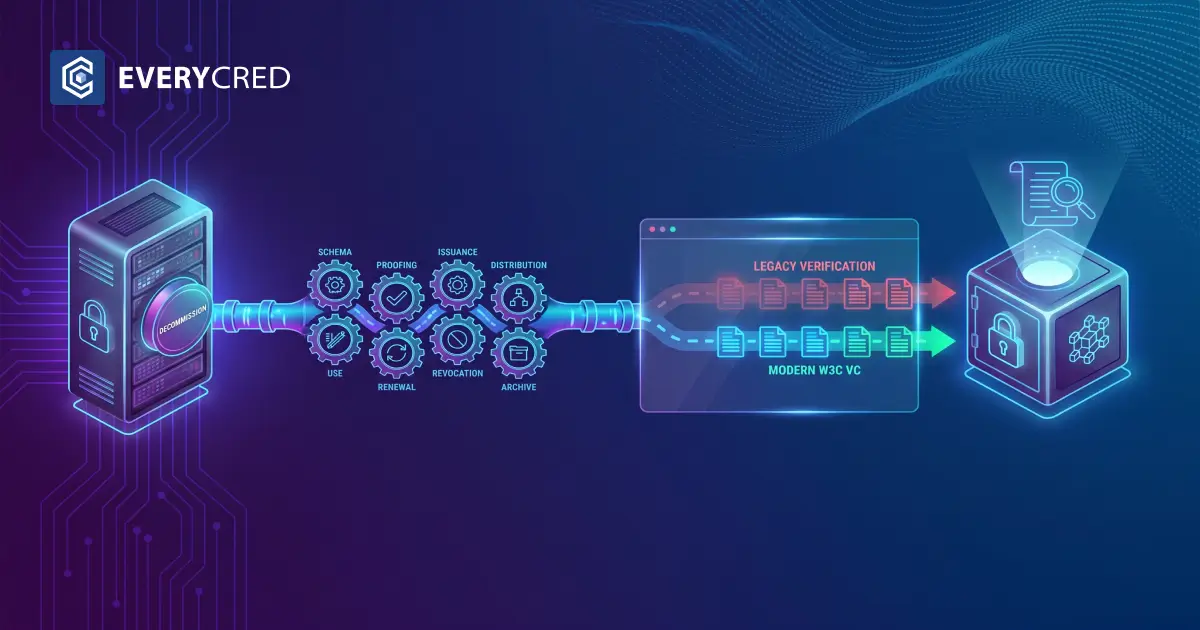
- The Credential Management Lifecycle: Eight Stages Most Legacy Systems Skip
- Why Legacy Credential Decommission Projects Stall
- A Phase-Based Approach to Credential System Migration Without Disruption
- Data Governance Rules That Survive the Decommission
- How EveryCRED Manages Credential Decommission for Government Programmes
- Conclusion
- FAQs


Credential management decommission projects fail when the lifecycle is treated as a single event instead of eight distinct stages. This guide gives government IT operations directors, programme managers, and data governance teams a phase-based approach to retire a legacy credential issuer or registry without disrupting active verification, breaking inter-agency trust, or losing the historical record of who held what.
The cost of getting it wrong is concrete. A state agency that switches off its legacy credential database before re-issuing active credentials creates a verification gap that touches every downstream system, including payroll, building access, benefit disbursement, and citizen service portals. Most decommission overruns trace to one missed stage in the credential lifecycle, not to infrastructure complexity.
Key Takeaways
– The credential management lifecycle has eight stages, and most legacy systems only operate four of them, which is why decommission projects stall mid-program.
– Database-coupled legacy credentials lose verifiability the moment the source system is switched off, regardless of how many copies of the credential exist in circulation.
– A phased re-issuance window with dual verification removes cutover risk and preserves audit trails for both the legacy and new systems.
– NIST SP 800-63B and equivalent national identity frameworks treat credential archive and revocation as mandatory lifecycle obligations that survive decommission.
– Raigad Police completed a credential system migration with zero verification downtime and an 85% reduction in administrative overhead.
Decommission planning that begins with the lifecycle, rather than the database schema, produces a clean retirement of the old system and a defensible audit record that withstands compliance review.
The Credential Management Lifecycle: Eight Stages Most Legacy Systems Skip
Effective credential management runs across eight discrete stages. Each stage produces an artifact, a log entry, and a compliance obligation. Legacy issuer platforms typically operate only the first four.
- Schema design: Define what each credential type asserts and which fields are mandatory.
- Identity proofing: Verify the subject before any credential is created.
- Issuance: Generate and bind the credential to the holder.
- Distribution: Deliver the credential to the holder in a usable format.
- Use and verification: Allow the holder to present, and any verifier to confirm authenticity.
- Renewal and re-issuance: Update credentials when policy, employment, or attributes change.
- Suspension and revocation: Invalidate a credential in real time when status changes.
- Archive and decommission: Preserve the historical record after the issuer system retires.
Most legacy systems treat the lifecycle as issuance, distribution, use, and replacement. Suspension is manual. Revocation depends on a database flag. Archive is whatever spreadsheets the team kept. When the system is decommissioned, the missing stages become acute. Verifiers cannot confirm the legitimacy of credentials that the old system once asserted, because the cryptographic chain of trust never existed.
A modern credential lifecycle management model treats every stage as a first-class operation with logs, signatures, and a status registry that outlives the issuing system.
Why Legacy Credential Decommission Projects Stall
Three failure patterns appear in nearly every stalled decommission program. Each one comes from a missing lifecycle stage rather than from infrastructure incompatibility.
Database-coupled verification. Legacy credentials carry no self-contained proof. Every verification query hits the source database. The moment the source database is switched off, every credential in circulation becomes unverifiable. There is no rollback path because the credentials themselves carry no signature.
Absent revocation registry. Legacy systems often have no real-time revocation surface. Credentials issued to officers, contractors, or beneficiaries who have since left service remain in nominal circulation. A decommission cannot complete cleanly because the team cannot prove which credentials are still valid.
Unarchivable history. Audit obligations under FedRAMP, NIST SP 800-53, and the Digital Personal Data Protection (DPDP) Act require organizations to demonstrate who held a credential, when, and under what authority, for years after the issuing system retires. Legacy databases store this as live records that disappear with the database.
The pattern is consistent across federal civilian agencies, US state governments, and Indian state administrations. The infrastructure team plans for server decommission. The identity team rarely plans for the credential continuity that the decommission depends on. The work required to bridge legacy credential platforms and a modern issuer is the lifecycle work the legacy platform never performed.
A Phase-Based Approach to Credential System Migration Without Disruption
Credential system migration succeeds when re-issuance, dual verification, and source archive run as sequential phases with explicit exit criteria. The approach below mirrors the structure deployed for Raigad Police and Government of Maharashtra programmes, where verification remained operational throughout migration.
Phase 1: Continuity Audit and Parallel Issuer Setup (Weeks 1 to 8)
The first phase establishes what must continue working after cutover.
- Inventory every credential type the legacy system currently issues and identify which require offline verification, cross-agency presentation, or court-admissible status.
- Stand up the new credential issuer with W3C Verifiable Credentials Data Model 2.0 schemas matching each legacy credential type.
- Configure the revocation registry and status list before any credential is re-issued.
- Confirm REST API integration to every downstream system that currently queries the legacy database, including HR, access control, payroll, and any inter-agency portal.
- Document the audit log structure the new system will produce, and confirm it satisfies retention requirements under applicable national identity frameworks.
Programme manager Anjali, running migration for a state transport department, used this audit to discover that 14% of credentials in her legacy database belonged to staff who had left service more than three years earlier. The continuity audit produced the first clean credential roll the department had ever held.
Phase 2: Re-Issuance Window With Dual Verification (Weeks 9 to 20)
Phase 2 operates both systems in parallel. Holders carry the new credential while the legacy credential remains valid.
- Re-issue credentials in the new format to all active holders, prioritizing roles with the highest verification volume.
- Configure verifier endpoints to accept both formats and log which format was presented for every check.
- Run verification load testing under peak operational demand. For police, this means shift change. For benefit programs, disbursement days.
- Test offline verification for any deployment context that requires it, including field officers and rural service delivery teams.
- Reach pilot operational status by week 20, with the new issuer producing every new credential and the legacy system producing none.
This window is the safety net. If the new system encounters a defect, the legacy credential remains a valid fallback while the issue is resolved.
Phase 3: Read-Only Archive and Source Decommission (Weeks 21 to 36)
The final phase retires the legacy issuer and locks the historical record into a verifiable archive.
- Convert the legacy credential database into a read-only archive with cryptographic integrity, satisfying retention obligations under NIST SP 800-53 record control requirements.
- Anchor the archive index on the new issuer’s audit ledger so that historical credential states remain verifiable without querying the legacy database.
- Switch off the legacy issuer’s write surface, then its verification surface, then the database itself, in that order, with at least a one-week gap between each step.
- Run a post-decommission audit confirming every active credential resolves on the new system and every retired credential returns a clear invalid status with a reason code.
The Maharashtra Police modernization deployment used this phase structure, with offline field verification validated on the new system before any legacy database write surface was closed.
Data Governance Rules That Survive the Decommission
Credential decommission carries data governance obligations that outlast the issuing system. Two rules apply across both US and Indian government programmes and shape the archive design.
Retention with selective disclosure. Retention rules require organizations to preserve credential history for years after issuance. Data minimization rules under the DPDP Act in India and similar standards in US state privacy regimes prohibit retaining personally identifiable information beyond what auditing requires. The archive must support selective disclosure, where a verifier can confirm a credential’s historical status without exposing the underlying attributes.
Immutable audit log. Every issuance, presentation, suspension, and revocation must be loggable years later. A live database satisfies this for as long as it runs. A blockchain-anchored audit log satisfies it after the source system is gone. The credential management lifecycle treats the log as a permanent artifact, not a system feature.
Agencies operating under NIST SP 800-63B treat lifecycle log retention as part of authenticator management itself, not as an optional add-on. The archive design should match.
How EveryCRED Manages Credential Decommission for Government Programmes
We deployed the credential management lifecycle that this guide describes for Raigad Police, integrating with CCTNS and DigiLocker via REST API while the legacy credential workflow continued operating in parallel. Verification time moved from 30 minutes to under 10 seconds, administrative overhead dropped 85%, and offline field verification was operational before any legacy system was retired. Our migration capabilities for active replacement buyers include:
- W3C VC 2.0 issuance: Credentials remain verifiable without the source system, satisfying decommission continuity.
- Real-time revocation: Status changes propagate to every verifier in seconds, including offline contexts.
- Read-only legacy archive: Historical credential states preserved with cryptographic integrity under retention rules.
- REST API integration: No front-end changes to downstream systems.
- Procurement-ready access: US agencies deploy through NASA SEWP V, ITES-SW2, NASPO ValuePoint, and OMNIA Partners.
Migration teams running active replacement projects can book a demo and walk this lifecycle against their current legacy system inventory.
Conclusion
A credential management decommission succeeds when the program runs against the lifecycle, not against the database. Eight stages, three phases, and two governance rules cover the full retirement path for any legacy credential system. The phased structure preserves verification through cutover, satisfies retention obligations after archive, and produces an audit record that holds against compliance review.
The Raigad Police migration shows that the work compresses into a 36-week timeline with the pilot operational by week 20. Government IT operations teams currently scoping legacy decommission projects can use this structure to scope phase exit criteria, parallel verification windows, and archive readiness against their own deployment context. The credential lifecycle is the dependency that determines whether a legacy decommission completes cleanly or stalls at cutover.
FAQs
What is the credential management lifecycle?
The credential management lifecycle is the eight-stage process covering schema design, proofing, issuance, distribution, use, renewal, revocation, and archive.
How do agencies decommission a legacy credential system without disruption?
Agencies run a parallel re-issuance window with dual verification, then retire the legacy issuer’s write, read, and database layers in sequence after archive.
What happens to existing credentials after a legacy credential decommission?
Active credentials are re-issued in W3C VC 2.0 format before cutover, and retired credentials are preserved in a cryptographically signed read-only archive.
How long does a credential system migration take for a government agency?
A statewide credential system migration completes in 36 weeks, with pilot operational by week 20 and the legacy database retired in phase three.
Does credential lifecycle management require blockchain anchoring for archive?
Blockchain anchoring is the most defensible archive model because credential history remains verifiable years after the issuing system is fully decommissioned.