5th June, 2026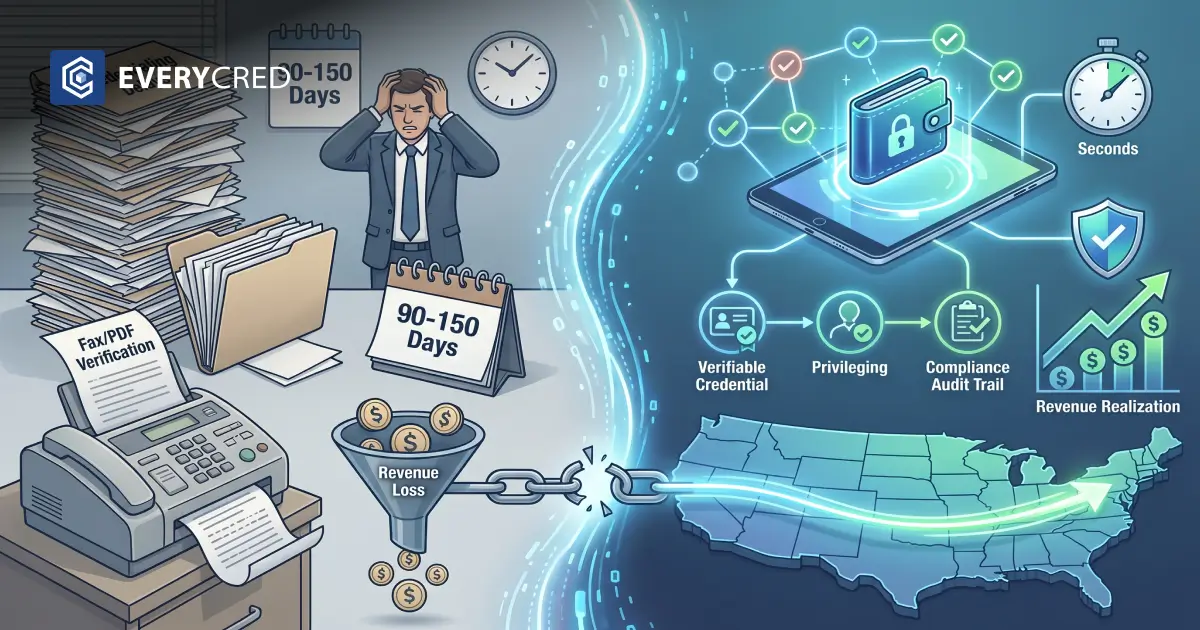


Credential management for multi-state telehealth fails for one reason. Verification still runs on fax and PDF, even after the Interstate Medical Licensure Compact made licensing fast. A clinician can hold a license for 19 days. The health system then waits 90 to 150 days to re-verify the same primary sources for each new state. That gap costs contract revenue. This guide shows how a portable, verifiable credential record removes the repeated verification step from multi-state telehealth credentialing.
Most CMIOs and Medical Staff Office directors already know the licensing side is solved. The bottleneck sits inside hospital credentialing. Every new state restarts the same checks. The fix is a verifiable credential layer. It lets a clinician prove verified status once, then present it to each privileging workflow.
Key Takeaways
– The IMLC issues a multi-state license in about 19 days. Hospital credentialing still takes 90 to 150 days for telehealth providers.
– Credentialing delays cost $1,000 to $9,000 per provider per day in lost contract revenue.
– Credentialing by proxy under 42 CFR § 482.22 reduces duplication but does not remove fax-based verification.
– Verifiable credentials let a clinician’s verified record move across state privileging workflows without re-running every check.
Why Multi-State Telehealth Breaks Hospital Credentialing
Licensing is no longer the slow step in multi-state telehealth. The Interstate Medical Licensure Compact covers 43 member states plus the District of Columbia and Guam in 2026. It issues an interstate medical license in about 19 days. More than half of licenses arrive within a week.
Hospital credentialing has not kept pace. Credentialing and privileging average 90 to 120 days. Telehealth credentialing now runs 90 to 150 days across multiple states and payers. The license is ready in weeks. The privilege to bill is not.
The reason is structural. Each added state triggers a fresh round of primary source verification, even when the facts have not changed. Medical staff offices reconfirm the same education, training, board certification, and work history. They already verified it for another state. Credential management becomes a repeated task instead of a single source of truth.
The Hidden Cost of Re-Credentialing Every New State
Re-credentialing for each new state is a direct revenue problem, not an administrative inconvenience. Industry data puts the cost of a credentialing delay at $1,000 to $9,000 per provider per day. A 120-day delay can cost a single physician up to roughly $122,000.
Consider a regional health system expanding a tele-stroke service. Dr. Marcus Hale is a neurologist already credentialed in three states. He was added to a fourth in April 2026. His interstate medical license was cleared in 17 days through the compact. His hospital credentialing took 104 days. The medical staff office re-verified his entire file by fax and email. The system lost 87 billable days on a contract it had already signed.
The friction point is the verification method. Cross-state verification still relies on fax-back forms, mailed PDFs, and phone calls to registrars and prior employers. This manual approach is the single largest driver of the re-credentialing delay. It scales badly as a clinician adds states.
How the IMLC and Credentialing by Proxy Fit Together
The IMLC and credentialing by proxy solve different parts of the problem. Neither removes manual verification on its own. The compact issues the interstate medical license. Credentialing by proxy governs how a hospital grants privileges to a telehealth provider.
Credentialing by proxy lets an originating-site hospital rely on the distant-site telehealth entity’s credentialing decisions. It avoids fully credentialing each remote clinician again. The Centers for Medicare and Medicaid Services authorizes this under 42 CFR § 482.22 for hospitals. A parallel rule, § 485.616, covers Critical Access Hospitals. The distant site must be accredited by the Joint Commission or enrolled in Medicare. Both parties must hold a written agreement with ongoing performance data exchange.
Proxy reduces duplication between two facilities. It does not eliminate the underlying primary source verification. It also does not make a clinician’s verified record portable across every state’s privileging workflow. The verification data still lives in documents that are moved by fax and PDF. That is the layer that verifiable credentials replace.
A Portable Credential Management Model for Multi-State Telehealth
A portable credential model fixes multi-state telehealth credentialing in one move. It verifies a clinician’s record once and makes it presentable everywhere. A verifiable credential is a cryptographically signed digital record. Any party can validate it using the issuer’s public key, with no fax or phone call. Verification resolves in seconds.
In this model, the clinician’s verified license, board certification, and training become verifiable credentials. They sit in a digital wallet that the clinician controls. When the health system adds a new state, the medical staff office pulls the verified record into the privileging workflow. There is no fax-back form. There is no repeated primary source verification for facts already cryptographically proven.
The model also strengthens compliance. Every credential event is written to an immutable audit trail. That gives compliance officers defensible proof of who verified what, and when, for each cross-state decision. For healthcare leaders evaluating verifiable credentials in healthcare, this replaces a document folder with a verifiable system of record.
Verifiable credentials also support real-time revocation. If a license is suspended in one state, the credential reflects that status at the next verification. This closes a gap that manual credential management leaves open. Today, a clinician suspended in one state can still appear current in another facility’s files. The shift from automated license verification to a portable record makes multi-state telehealth credentialing fast and defensible.
How EveryCRED Supports Multi-State Credential Management
We built EveryCRED to remove repeated verification from credential management. The platform issues a clinician’s license, board certification, and training as cryptographically signed verifiable credentials. Those records pull directly into a privileging workflow, with no fax and no PDF. Every verification resolves in under 10 seconds. Each one writes to an immutable audit trail for compliance review. The platform integrates with existing medical staff office and HR systems via REST API, with no front-end changes. It meets NIST SP 800-63-4 assurance requirements. US health systems can deploy through Carahsoft on NASA SEWP V and ITES-SW2. Book a demo to see the multi-state workflow.
Conclusion
Credential management is the real bottleneck in multi-state telehealth, not licensing. The Interstate Medical Licensure Compact issues an interstate medical license in days. Hospital credentialing still takes months, because cross-state verification runs on fax and PDF. Credentialing by proxy reduces duplication between facilities. It still leaves the manual verification layer in place.
A portable, verifiable credential record removes that layer. It lets a clinician prove verified status once and present it to every state privileging workflow. It also keeps an immutable audit trail for compliance. Health systems that adopt healthcare credential verification on this model recover the billable days they now lose to re-credentialing. As telehealth programs add states, portable credential management becomes core infrastructure. It keeps contract revenue from waiting on a fax machine.
FAQs
Why does multi-state telehealth credentialing take so long, even with the IMLC?
The IMLC speeds licensing, but hospital credentialing re-verifies primary sources for each state by fax, adding 90 to 150 days.
What is credentialing by proxy in telehealth?
Credentialing by proxy lets a hospital rely on the distant-site entity’s credentialing decisions, under CMS rule 42 CFR § 482.22.
How much does a credentialing delay cost a health system?
Credentialing delays cost an estimated $1,000 to $9,000 per provider per day in delayed or lost revenue.
Can verifiable credentials replace fax-based credential verification?
Yes. Verifiable credentials are cryptographically signed and validated in seconds using the issuer’s public key.
Does an interstate medical license remove the need for hospital credentialing?
No. An interstate medical license grants the right to practice, but each hospital must still credential and privilege the clinician.