15th January, 2026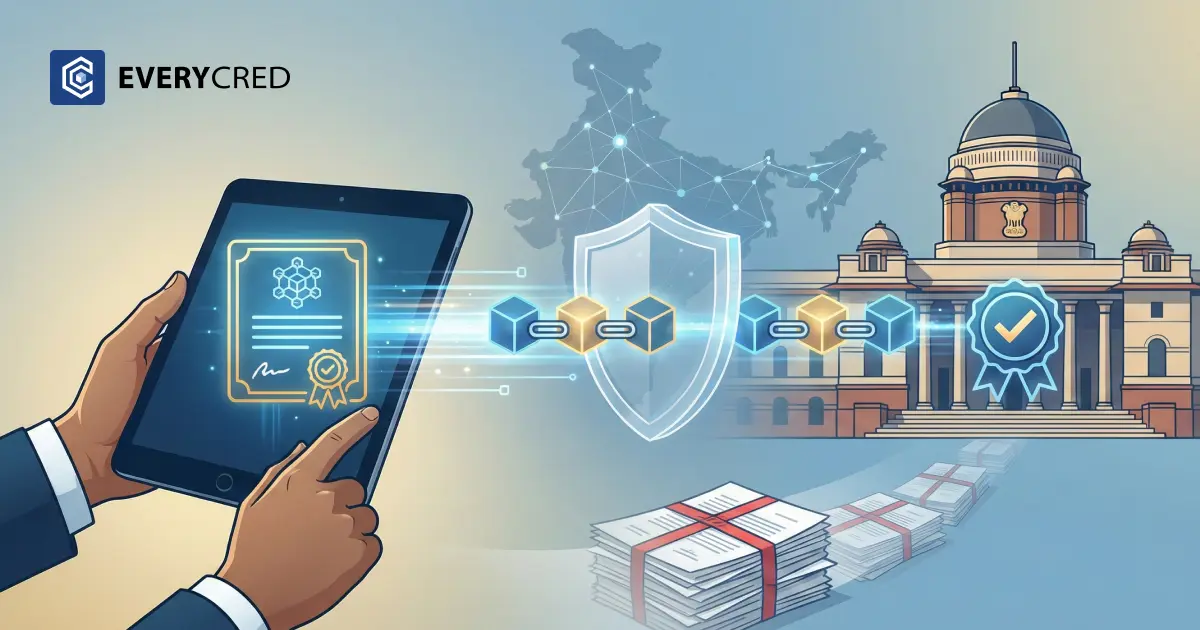


The recruitment aspect for Public Sector Undertakings (PSUs) and government ministries in India operates at a massive scale. Ensuring the integrity of this process is critical for national interests and organizational efficiency.
A primary challenge in public sector hiring is the validation of academic and professional documents submitted by candidates. Traditional, manual methods of document checking are no longer sufficient to handle the volume of applications or the increasing sophistication of qualification fraud.
The adoption of a digital credential verification platform is now a necessity for government bodies. Moving to an automated, blockchain-based infrastructure aligns recruitment processes with the Digital India initiative and ensures compliance with vigilant governance mandates.
Here, we have discussed the requirements for deploying secure verification systems in Indian government hiring and how decentralized technologies address current systemic gaps.
The Current Verification Bottleneck in PSU Recruitment
Recruitment drives by Central Public Sector Enterprises (CPSEs) and ministries often receive tens of thousands of applications for limited positions. The subsequent document verification (DV) process creates significant operational bottlenecks.
Currently, HR departments in PSUs must manually validate certificates. This involves sending physical mail or emails to issuing universities and previous employers. Responses from these institutions can take anywhere from 90 to 180 days. These delays retard the onboarding of essential personnel, leaving critical project roles vacant for extended periods.
Furthermore, the manual process is susceptible to fraud. The prevalence of forged degrees from unproven institutions is a documented issue in the Indian education sector. The University Grants Commission (UGC) periodically maintains lists of fake universities operating in India to warn stakeholders.
- Resource Drain: Significant man-hours are spent chasing responses from educational institutions.
- Human Error: Manual cross-checking of data points increases the risk of oversight.
- Lack of Standardization: Different universities have varying processes for verification, complicating the PSU’s workflow.
To mitigate these risks, government bodies require a standardized, automated approach to credential verification.
The Regulatory Imperative for Digital Transformation
Shifting to digital verification is supported by India’s legal and regulatory framework. Government organizations are mandated to adopt technologies that enhance transparency and efficiency.
The Information Technology Act, 2000, provides legal recognition for electronic records. Section 4 of the Act states that if any law requires information to be in written or typewritten form, that requirement is satisfied if the information is rendered in an electronic form and remains accessible for subsequent reference. This provides the legal basis for accepting digital credentials over physical copies.
Additionally, the Central Vigilance Commission (CVC) emphasizes “preventive vigilance” as a core function of PSU management. Preventive vigilance involves adopting systems that reduce opportunities for corruption or malpractice. An automated, tamper-proof credential verification system acts as a primary tool for preventive vigilance in recruitment by eliminating the possibility of human manipulation during the vetting process.
For deeper insight into international standards that influence digital trust frameworks, read our analysis on eIDAS 2.0 compliance guidelines.
How Verifiable Credentials Work in Government Hiring
The technical solution to recruitment fraud lies in verifiable credentials (VCs). VCs are not mere digital images of physical certificates. They are cryptographically secure data objects issued based on World Wide Web Consortium (W3C) standards.
A verifiable credentials ecosystem involves three primary parties:
- The Issuer: The authority that grants the credential (e.g., an IIT, IIM, or a State University). They cryptographically sign the digital certificate.
- The Holder: The candidate who receives and stores the credential in a secure digital wallet.
- The Verifier: The PSU or ministry HR department that requests proof of the credential from the holder.
When a PSU receives a VC from a candidate, the verification platform instantly checks the cryptographic signature against the issuer’s public registry on a blockchain. This process confirms two things immediately: the credential was issued by a legitimate authority, and the data within the credential has not been altered since issuance.
This mechanism allows for instant, trustless verification without needing to contact the issuing university directly. For a comprehensive understanding of decentralized identity architecture, refer to our guide on decentralized identity.
EveryCRED Infrastructure: Built for Government Compliance
EveryCRED provides a purpose-built platform for credential verification government India requirements. The infrastructure addresses the specific security, scale, and compliance needs of PSUs and ministries.
The platform utilizes Decentralized Identifiers (DIDs) and blockchain technology to create immutable audit trails. Every verification request and its outcome is cryptographically logged. This feature is essential for government audits and CVC inspections, as it provides definitive proof that due diligence was followed in the hiring process. The capability of this technology in high-stakes government environments is demonstrated in our work with law enforcement agencies. You can review the practical application in the Raigad Police verification case study.
Key features for government deployment include:
- Data Sovereignty and Residency: All verification data and personal identifiable information (PII) reside on servers located physically within India, complying with government data localization norms.
- Bulk Verification Capability: PSU recruitment often involves thousands of candidates simultaneously. The platform allows HR departments to upload batches of credentials for parallel verification, reducing processing time from months to minutes.
- API-First Integration: The platform integrates directly with existing PSU recruitment portals, such as those used for GATE-score-based hiring. This ensures HR teams do not need to learn new workflows; the verification happens in the background of their current systems.
Operational Benefits for Ministries and CPSEs
Implementing a platform based on verifiable credentials yields immediate operational improvements. The transition from manual to digital vetting fundamentally changes the speed and security profile of recruitment.
The Ministry of Electronics and Information Technology (MeitY) actively promotes the adoption of blockchain technology to build trusted digital infrastructure whereby different organizational systems can interact without a central intermediary.
Below is a comparison of the operational impact:
| Feature | Traditional Manual Verification | EveryCRED Digital Verification |
| Time to Verify | 90 to 180 Days | Instant to < 24 Hours |
| Cost Per Candidate | High (Postal, manpower costs) | Low (Fixed transactional cost) |
| Audit Trail | Paper-based files, disjointed emails | Immutable blockchain ledger |
| Fraud Detection | Manual visual inspection | Cryptographic validation |
| Data Security | Physical documents prone to loss | Encrypted, permissioned access |
The adoption of verifiable credentials significantly reduces the administrative burden on HR departments. It allows personnel to focus on candidate assessment rather than document logistics.
Conclusion
The reliance on physical document checking is a severe impediment to efficient governance and PSU administration in India. As fraud becomes more sophisticated, the verification mechanisms must evolve. A platform utilizing verifiable credentials offers the necessary speed, security, and legal compliance required for government hiring.
EveryCRED provides the infrastructure to close the verification gap. By adopting this technology, ministries and PSUs ensure a secure recruitment pipeline, align with Digital India objectives, and maintain the highest standards of preventive vigilance.
For consultations regarding deploying credential verification solutions within PSUs or government ministries, contact the EveryCRED team.