7th May, 2026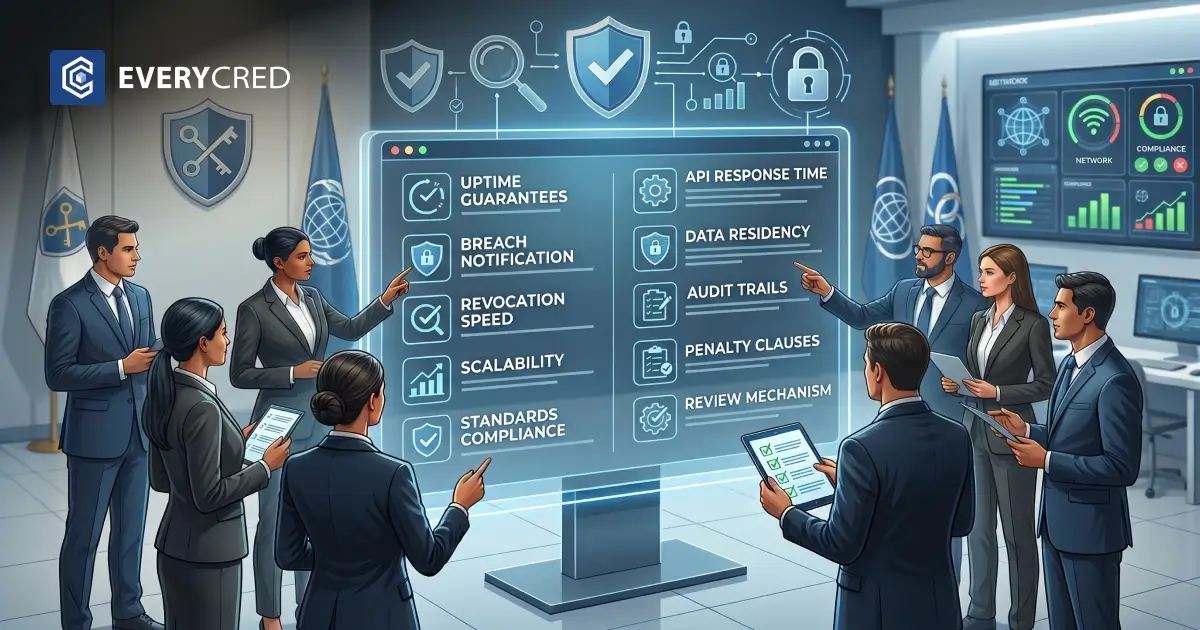


Government agencies process millions of licenses, permits, and identity records every year. The vendors they hire for credentials verification handle sensitive citizen data under strict regulatory timelines. A weak contract puts public services, citizen trust, and compliance at risk.
Most procurement failures in this space trace back to one root cause: the service level agreement was either missing, vague, or written in the vendor’s favor. Here, we have provided a government vendor SLA checklist that procurement officers, legal teams, and IT contract managers can use before signing any credential verification SLA.
Why Most Government Vendor Contracts Fall Short on Verification
Government procurement teams evaluate vendors on features, pricing, and compliance certifications. SLA terms often receive surface-level review. The result is a contract that looks complete but lacks enforceable performance standards for credentials verification.
Common gaps include:
- No defined verification uptime requirements with measurable thresholds
- Vague language around incident response and breach notification timelines
- Missing penalty structures for repeated SLA violations
- No data residency clauses aligned with national regulations
- Absent or weak revocation SLA terms for expired or fraudulent credentials
These gaps become visible only during a service failure or an audit, when the cost of correction is highest.
The 10-Point Government Vendor SLA Checklist for Credential Verification
Every credential verification SLA should address these ten areas. Procurement officers should treat this as a minimum baseline, not an aspirational target.
1. Verification Uptime Requirements
The SLA must specify a minimum uptime percentage for the verification service. For government-grade systems, 99.9% uptime is the accepted floor. The agreement should define what counts as “downtime,” including partial outages and degraded performance. Scheduled maintenance windows must fall outside peak operating hours.
NIST’s Cloud Computing Technology Roadmap (SP 500-293) identified that vendors define reliability using different terms like uptime, resilience, or availability, and cover different resources across different time periods. This inconsistency puts government buyers at risk. Your credential verification SLA must use precise, agreed-upon definitions.
2. API Response Time
Automated credentials verification depends on API speed. The SLA should guarantee maximum response times for verification calls, typically under 500 milliseconds for standard checks. Include separate thresholds for bulk verification and single-record lookups.
3. Incident Response and Breach Notification
India’s CERT-In mandates that all entities report cybersecurity incidents within six hours of detection. The DPDPA 2023 requires a detailed breach report to the Data Protection Board within 72 hours. In the United States, FedRAMP-authorized services must follow NIST 800-53 continuous monitoring requirements, and sector-specific rules add further timelines.
Your credential verification SLA must contractually bind the vendor to these timelines. The SLA should specify:
- Maximum time from detection to internal escalation
- Maximum time from escalation to government notification
- Format and content requirements for incident reports
- Vendor obligation to support the agency’s own regulatory filings
4. Data Residency and Sovereignty
Government data often cannot leave national borders. The SLA must state where citizen data is stored, processed, and backed up. For Indian agencies, this aligns with CERT-In’s requirement that ICT system logs be retained within India for 180 days. For US agencies, FedRAMP authorization levels dictate where data resides.
5. Real-Time Revocation SLA
When a credential is revoked, every verification endpoint must reflect that change immediately. Delays create windows for fraud. The SLA should define maximum propagation time for revocation status updates. Agencies that handle digital identity verification at scale need sub-second revocation propagation.
6. Audit Trail and Logging
Every issuance, verification, and revocation event must be logged with timestamps, actor identifiers, and outcome records. The SLA should guarantee log retention periods that match regulatory minimums. It should also grant the government agency direct access to these logs for compliance audits without requiring vendor intermediation.
7. Scalability Guarantees
Government verification loads spike during enrollment periods, tax season, and welfare distribution cycles. The SLA must include performance guarantees under defined load conditions. Specify the maximum number of concurrent verification requests the system must handle without performance degradation.
8. Penalty and Service Credit Structure
A credential verification SLA without penalties is unenforceable. Define tiered service credits for uptime violations. Include financial penalties for repeated breaches of verification uptime requirements. Add termination rights if the vendor fails to meet critical SLAs for consecutive measurement periods.
Effective penalty structures include:
- Service credits of 5-10% of the monthly fees for each hour of unplanned downtime
- Financial penalties for breach notification delays beyond contractual timelines
- Right to terminate without penalty after three consecutive months of SLA failure
9. Interoperability and Standards Compliance
The vendor’s system must follow open standards. For digital credential platforms serving government, W3C Verifiable Credentials and Decentralized Identifiers (DIDs) are the baseline. The SLA should require the vendor to maintain compliance with these standards throughout the contract period and to support API-based integration with existing government databases.
10. Contract Review and Update Mechanism
Regulations change. Threat landscapes shift. The SLA must include a formal process for periodic review, typically quarterly or semi-annually. Both parties should have the right to propose amendments. This prevents the agreement from becoming outdated while the vendor’s obligations remain static.
What Happens When a Government Vendor SLA Checklist Is Ignored
Agencies that skip rigorous SLA negotiation face measurable consequences:
- Service disruptions that delay citizen-facing verification for days
- Compliance violations under CERT-In, DPDPA, FedRAMP, or FAR, each carrying significant financial penalties
- Audit failures due to missing logs or inconsistent verification records
- Vendor lock-in from proprietary systems that lack interoperability standards
- Reputational damage when credential fraud passes through a system with no real-time revocation
The cost of renegotiating a weak SLA mid-contract is always higher than getting the terms right at the procurement stage.
How EveryCRED Meets Government-Grade SLA Requirements
We built EveryCRED to meet the exact requirements that this government vendor SLA checklist describes.
Our Verifier Portal delivers one-click credentials verification with cryptographic proof, reducing authentication to milliseconds. Our API-first architecture supports defined response time guarantees and scales to handle peak government loads without degradation.
We provide real-time credential revocation through blockchain-anchored status updates. Every issuance, verification, and revocation event is logged in immutable audit trails accessible to authorized government auditors. Our platform follows W3C Verifiable Credentials and the EVRC DID method, ensuring full interoperability with existing government IT infrastructure.
We support data residency configurations aligned with Indian and US regulatory frameworks, and our incident response processes are built to meet the strictest breach notification timelines. Government procurement teams evaluating credential verification SLA readiness can schedule a technical walkthrough with our team.
Conclusion
A credential verification SLA defines the operational reality of every verification your agency performs. Verification uptime requirements, breach notification timelines, revocation speed, and penalty structures determine whether your system protects citizens or exposes them to risk. Procurement officers who use a structured government vendor SLA checklist during vendor evaluation eliminate ambiguity before it becomes a compliance failure. The checklist in this article covers the ten areas where government contracts most frequently fall short. Apply it at the RFP stage, enforce it during contract negotiation, and revisit it at every review cycle.
FAQs
What SLA terms should governments require for credentials verification services?
Governments should require defined uptime guarantees, API response times, breach notification timelines, revocation SLAs, data residency, and enforceable penalty clauses.
Why are verification uptime requirements critical in government SLAs?
Downtime halts citizen-facing services, delays credential authentication, and creates compliance risks under frameworks like FedRAMP and CERT-In.
How does India’s CERT-In rule affect credential verification SLA terms?
Vendors must support six-hour incident reporting, requiring built-in monitoring, automated alerting, and documented breach response procedures in the SLA.
What penalties should a government vendor SLA checklist include?
Include tiered service credits for downtime, financial penalties for repeated SLA failures, and termination rights for sustained non-compliance.
How can governments verify vendor SLA compliance for credential verification?
Demand real-time performance dashboards, independent audit access, automated uptime reporting, and scheduled quarterly business reviews.