17th June, 2026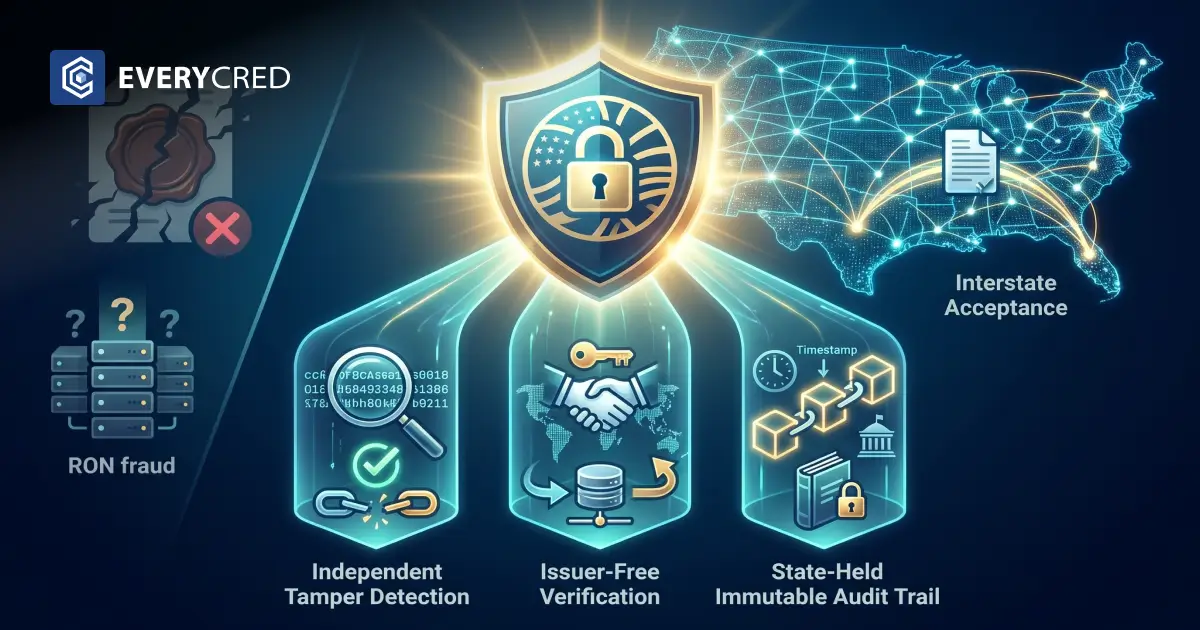


A modern state notary digital certificate program needs three properties that most current programs lack: independent tamper detection, verification that does not depend on the issuing vendor, and a state-held audit trail. Remote online notarization (RON) is now legal in 49 states and the District of Columbia. As volume grows, so does RON fraud. The per-vendor X.509 digital certificate model in use today cannot reliably detect a tampered notarization or support clean interstate acceptance. This guide gives Secretaries of State and notary commission leaders a program model to evaluate against.
Key Takeaways
– Remote online notarization is legal in 49 states plus DC, expanding the fraud surface for every notary commission.
– The FBI’s IC3 logged more than $16 billion in internet crime losses in 2024, including $2.77 billion in business email compromise that targets real estate closings and notarized documents.
– A state digital certificate program should require independent tamper detection, issuer-free verification, and an immutable audit trail that the state controls.
– Verifiable credentials anchored to a public ledger let one state confirm another state’s notarization without a phone call, which supports interstate acceptance.
Why Per-Vendor Digital Certificate Programs Miss RON Fraud
Most RON states already require notaries to sign with an X.509 digital certificate issued through a certificate authority or platform. The certificate verifies the notary’s identity at the time of signing and renders the document tamper-evident. That is a real control. It is also incomplete for a commission overseeing millions of records across competing vendors.
The gap is in detection after the fact. A notary seal image can be copied from any previously notarized PDF and reused. Criminals also purchase fake seals from online vendors by using commission data obtained from public records. When a notarization is altered or fabricated outside the issuing platform, the commission has no independent way to detect it.
Verification often depends on the vendor that produced the record staying online and cooperative. If that platform changes terms, loses data, or exits the market, the proof weakens. RON fraud succeeds in exactly these seams.
The financial stakes are concrete. According to the FBI’s Internet Crime Complaint Center, internet crime caused more than $16 billion in reported losses in 2024, a 33% rise over 2023. Business email compromise drove $2.77 billion of that, and these schemes routinely target real estate closings and the notarized documents inside them.
Forged notarizations enable many property and power-of-attorney schemes. For a state program owner, fraud prevention is the core mandate, not a vendor feature.
Three Properties a State e-Notarization Program Must Require
A digital certificate program should be specified by the commission, then met by any qualified vendor. Three requirements separate a durable program from a fragile one. These map directly to how blockchain credentials secure public records.
Independent Tamper Detection
The integrity check must work for any party, not only the issuing platform. Cryptographic hashing makes this possible. Each notarized record generates a unique hash at signing. Any later change to the file produces a different hash, and the mismatch exposes the alteration immediately.
When that hash is anchored to a public ledger, the commission can detect tampering without trusting a single vendor’s database. This is the difference between tamper-evident and independently verifiable.
Issuer-Free Verification
A verifier should confirm a notarization using a public key, not a phone call to the platform. This removes the dependency that makes current e-notarization programs brittle. It also lets county recorders, title agents, and other states validate a record on their own.
A State-Held Immutable Audit Trail
The commission, not the vendor, should hold the permanent record of who notarized what and whether the credential was valid at that moment. An immutable audit trail gives investigators provable accountability during fraud reviews and litigation.
Solving Interstate Acceptance Without a Phone Call
Interstate acceptance is a verification problem disguised as a legal one. All 50 states recognize properly executed out-of-state notarial acts, and a remotely notarized document generally carries the same legal effect as an in-person one. The practical issue is confirming authenticity across state lines quickly.
The proposed SECURE Notarization Act of 2025 would set national minimum RON standards and strengthen interstate recognition. Industry frameworks such as MISMO certification push platforms toward consistency. Neither solves the day-to-day question a county clerk in one state asks about a notary seal applied in another.
Verifiable credentials answer it directly. A notarization issued as a cryptographically signed credential resolves against a public key from anywhere. The receiving state confirms the notary seal, the certificate status, and the document hash without contacting the originating vendor. That mechanism is what makes interstate acceptance fast instead of aspirational.
Consider a deed notarized remotely in Florida and recorded in Texas. Under a verifiable-credential model, the Texas recorder validates the digital certificate and the notary seal in seconds, with no inter-vendor handoff. The same approach already powers government identity fraud prevention in other public-sector workflows.
Mapping the Program to NIST and RULONA
A state digital certificate program should sit on standards that the commission already references. Identity proofing is the floor. Leading platforms verify a notary’s identity to NIST SP 800-63B Identity Assurance Level 2 before issuing a certificate, and a program can require that level explicitly.
RULONA, the model law many states follow, lets the notarial officer select tamper-evident technology while allowing the commissioning officer to set conforming standards. According to the National Association of Secretaries of State, the commissioning authority should align rules with current remote electronic notarization standards. That authority is the lever. A commission can mandate independent tamper detection and an immutable audit trail as conditions that any vendor must satisfy.
This keeps vendor choice open while raising the security floor for the whole program. It is also how a state moves from accepting tamper-evident files to operating verifiable digital certificates. The distinction between a digital certificate and a verifiable credential is exactly the upgrade path a modern program follows.
How EveryCRED Supports a State Notary Certificate Program
We anchor every credential to a public ledger using SHA-512 hashing and the W3C Verifiable Credentials Data Model 2.0, so any party can detect a tampered record without contacting the issuer. EveryCRED meets NIST SP 800-63 Rev. 4 and logs every issuance and verification event to an immutable audit trail that the commission controls. The platform integrates with existing notary systems via REST API, with no front-end changes. US agencies can procure through Carahsoft on NASA SEWP V, ITES-SW2, and NASPO ValuePoint, without a new competitive cycle. Book a demo to see verification and revocation in a live walkthrough.
Conclusion
RON fraud grows with every state that expands remote notarization. A digital certificate program built only on per-vendor X.509 certificates cannot detect tampered notarizations or support fast interstate acceptance. The fix is a program specification, set by the commission, that requires independent tamper detection, issuer-free verification, and a state-held audit trail.
These properties turn a notary seal into a credential any party can verify, and any investigator can audit. They also make interstate acceptance a routine cryptographic check rather than a manual inquiry. Secretaries of State who specify the model now build the e-notarization infrastructure that their successors will depend on.
FAQs
What is a digital certificate in remote online notarization?
A digital certificate is a cryptographic credential that proves a notary’s identity and makes the notarized record tamper-evident at signing.
How does a digital certificate program stop RON fraud?
It detects altered or forged notarizations through cryptographic hashing and gives the state an independent audit trail to investigate fraud.
Why does a stolen notary seal still threaten e-notarization?
A notary seal image copied from an old document can be reused for forgeries unless cryptographic verification ties the seal to the original record.
How do verifiable credentials improve interstate acceptance?
They let one state verify another state’s notarization against a public key instantly, without contacting the issuing vendor or platform.
What standards should a state notary digital certificate program follow?
A program should require NIST SP 800-63B IAL2 identity proofing and align tamper-evidence rules with RULONA and current NASS standards.