13th April, 2026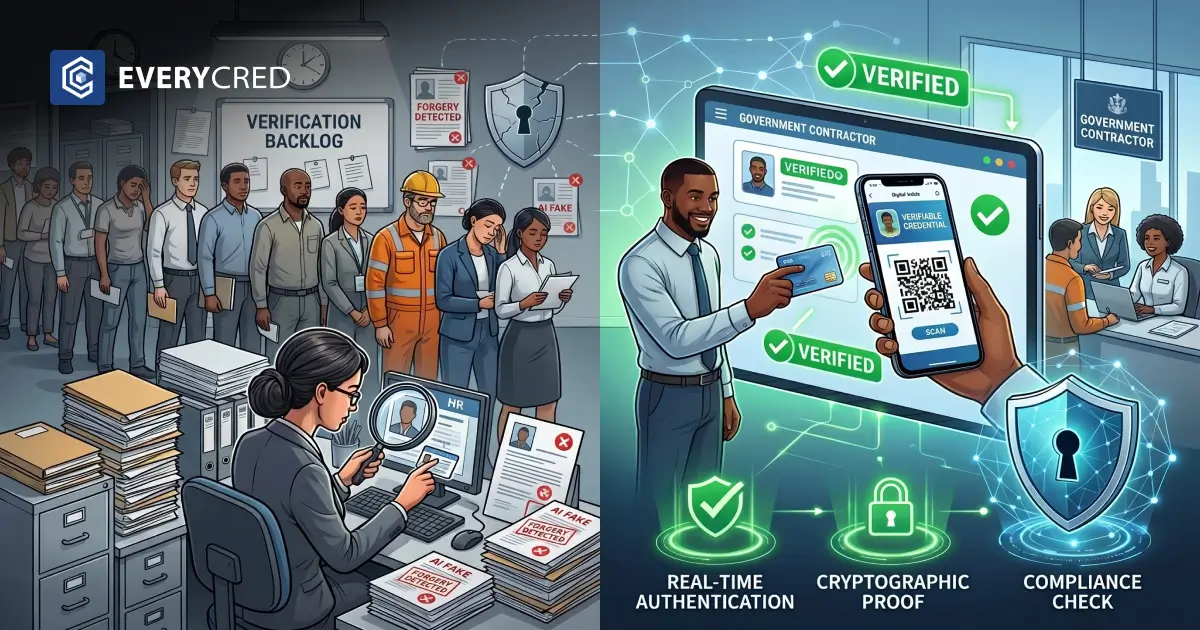
- The Verification Backlog Is a Security Gap, Not Just an Administrative Delay
- AI-Powered Forgery Has Made Manual Document Review Obsolete
- Federal Standards Already Define What Secure Contractor Verification Must Look Like
- Four Ways Contractor Credential Fraud Enters a Federal Agency
- How a Digital Credential Platform Works in a Government HR Workflow
- Capabilities a Digital Credential Platform Must Have for Government Use
- EveryCRED Provides the Infrastructure Government HR Departments Need Now
- Final Words
- FAQs


The federal government spent approximately $755 billion on contracts in FY 2024. Yet most agencies cannot confirm whether every contractor working on those contracts is who they claim to be. The U.S. Government Accountability Office estimates federal fraud losses between $233 billion and $521 billion annually. A significant share traces directly to broken identity and credential verification processes.
For government HR departments, this is not a future problem. It is an active gap in every onboarding cycle. A structured digital credential platform changes how agencies verify, manage, and revoke contractor credentials across the entire workforce lifecycle.
The Verification Backlog Is a Security Gap, Not Just an Administrative Delay
The Trusted Workforce 2.0 initiative was designed to modernize federal personnel vetting. According to a 2025 GAO report on Trusted Workforce 2.0, results have been mixed:
- 52% of contractors reported challenges getting information about ongoing background investigations.
- 45% of contractors said the initiative produced no change in their ability to manage onboarding risk.
- Nearly all agencies said adapting their IT systems to Trusted Workforce 2.0 requirements was moderately or very challenging.
The background investigation backlog peaked at 725,000 cases. By August 2025, it fell to approximately 200,000, but the underlying IT system problems remain unresolved.
When a major reform program creates new bottlenecks instead of removing them, agencies need a better approach to credential management at the point of onboarding. That means shifting from periodic manual checks to real-time cryptographic verification.
AI-Powered Forgery Has Made Manual Document Review Obsolete
Traditional verification relies on HR staff reviewing documents visually. That approach no longer works.
- Synthetic identity document fraud rose 311% between Q1 2024 and Q1 2025.
- AI tools generate realistic fake certifications, employment histories, and government-issued ID documents.
- Deepfake video is used to pass remote interviews and impersonate cleared personnel.
- The E-Verify system has been defeated using stolen identity credentials in documented federal cases.
Fake credential detection through visual inspection cannot scale when forged documents are indistinguishable from genuine ones at a glance. The problem requires a system-level response, not a manual one.
Federal Standards Already Define What Secure Contractor Verification Must Look Like
Three frameworks establish the minimum requirements for government contractor identity management. Most agencies are not meeting them with current tools.
- FIPS 201-3 requires cryptographically secured identity credentials for federal employees and contractors accessing facilities and IT systems. It covers both physical and logical access.
- NIST SP 800-63-4 (finalized July 2025) establishes Identity Assurance Levels and Authentication Assurance Levels. It now explicitly supports digital wallets and W3C Verifiable Credentials as compliant authentication mechanisms.
- HSPD-12 requires a common identification standard for federal employees and contractors, designed to be strongly resistant to identity fraud and tampering.
Automated license verification consistently outperforms manual methods in speed, accuracy, and compliance coverage. Meeting FIPS 201-3 and NIST SP 800-63-4 requirements through a digital credential platform is not an optional technology upgrade. It is a compliance requirement.
Four Ways Contractor Credential Fraud Enters a Federal Agency
HR departments need to identify where verification breaks down before they can close those gaps.
- During initial onboarding: Forged certifications, AI-generated employment history, and fake degree records submitted through standard document upload workflows.
- During access escalation: Fraudulent credentials used to obtain higher clearance levels or access to restricted systems and databases.
- Through subcontractor channels: Vendor impersonation, where an entity presents itself as a vetted prime contractor to gain contract access.
- During reverification cycles: Expired or revoked credentials that remain active because manual re-checks are infrequent or fall through administrative gaps.
Each of these entry points is addressable through structured digital identity verification and real-time credential status management built into the HR workflow itself.
How a Digital Credential Platform Works in a Government HR Workflow
This is a direct walkthrough of how credential management operates using a verifiable credential system.
Contractor Onboarding
A contractor submits credentials from a digital wallet. These include professional licenses, educational records, and security clearance documentation. Each credential carries a cryptographic signature from its issuing body. The HR system verifies that signature automatically via API. If any data has been altered since issuance, the signature fails. The credential is rejected without any human review required.
Continuous Monitoring
Once onboarded, credentials remain active in the system. When a license expires, a clearance is suspended, or a background flag is raised, the platform updates credential status in real time. HR administrators receive automated alerts. Revocation propagates instantly to every system and access point tied to that credential.
Cross-Agency Transfer
When a contractor moves between agencies or departments, their verified credentials transfer through the same trust framework. The receiving department does not repeat the full vetting process. The credential is already verified by a trusted issuer. Verifiable credentials carry that trust across departments without requiring manual resubmission of documents.
This is how modern credential management reduces onboarding timelines and eliminates redundant verification steps across the government workforce.
Capabilities a Digital Credential Platform Must Have for Government Use
Government-grade credential management requires specific technical capabilities. Not all platforms meet these requirements. A platform built for the public sector must include:
- Cryptographic signing with blockchain-anchored audit trails for every credentialing event
- Real-time revocation and immediate credential status propagation across connected systems
- API integration with existing HRIS and HR databases, without requiring a full system replacement
- Cross-department interoperability using W3C Verifiable Credential standards
- Decentralized identifier (DID) support for tamper-proof issuer authentication
- Selective disclosure controls to meet federal data minimization and privacy requirements
- Immutable logs of every issuance, verification, and revocation event for audit and compliance purposes
Digital trust infrastructure built on these capabilities directly supports compliance with FIPS 201-3 and NIST SP 800-63-4. According to FY 2025 DOJ enforcement data, total False Claims Act recoveries exceeded $6.8 billion, the highest single-year amount in FCA history, with procurement fraud remaining a consistent enforcement priority. The compliance cost of weak contractor verification is documented and growing.
EveryCRED Provides the Infrastructure Government HR Departments Need Now
EveryCRED provides a public sector digital credential platform built on W3C Verifiable Credential standards and decentralized identity. Agencies use it to issue, verify, and revoke credentials via cryptographic proof, without replacing existing HR systems.
The verifier portal authenticates contractor credentials in real time. The issuer module connects to legacy databases via REST APIs so agencies can begin issuing verifiable credentials directly from their existing workflows. Every credentialing event is logged in an immutable audit trail. Credential management is centralized, automated, and compliant by design.
If your agency is evaluating digital credential platforms for workforce and contractor verification, schedule a demo to see EveryCRED’s verification workflow in a live government HR environment.
Final Words
Contractor fraud in federal agencies does not require sophisticated hacking. It enters through broken verification processes that rely on visual document inspection and periodic manual checks. A digital credential platform built on cryptographic standards removes human error from that process. It verifies contractor identities at onboarding, monitors credential status continuously, and enforces revocation the moment a credential is invalidated. Government HR departments that standardize on this approach meet federal compliance requirements and close the verification gaps that fraudsters currently exploit.
FAQs
What is a digital credential platform in the context of government HR?
It is a system that issues, verifies, and revokes cryptographically signed credentials for employees and contractors in real time.
How does credential management help prevent contractor fraud?
It replaces manual document checks with automated cryptographic verification that detects altered or forged credentials instantly.
What federal standards apply to contractor identity verification in the United States?
FIPS 201-3, NIST SP 800-63-4, and HSPD-12 define the minimum identity assurance requirements for government contractor credentials.
Can a digital credential platform integrate with existing government HR systems?
Yes. Platforms built on open standards connect to legacy HRIS databases through REST APIs without requiring a full system replacement.
What happens when a contractor’s credential is revoked on a digital credential platform?
The revocation updates in real time across all connected systems and access points, immediately blocking access tied to that credential.