16th April, 2026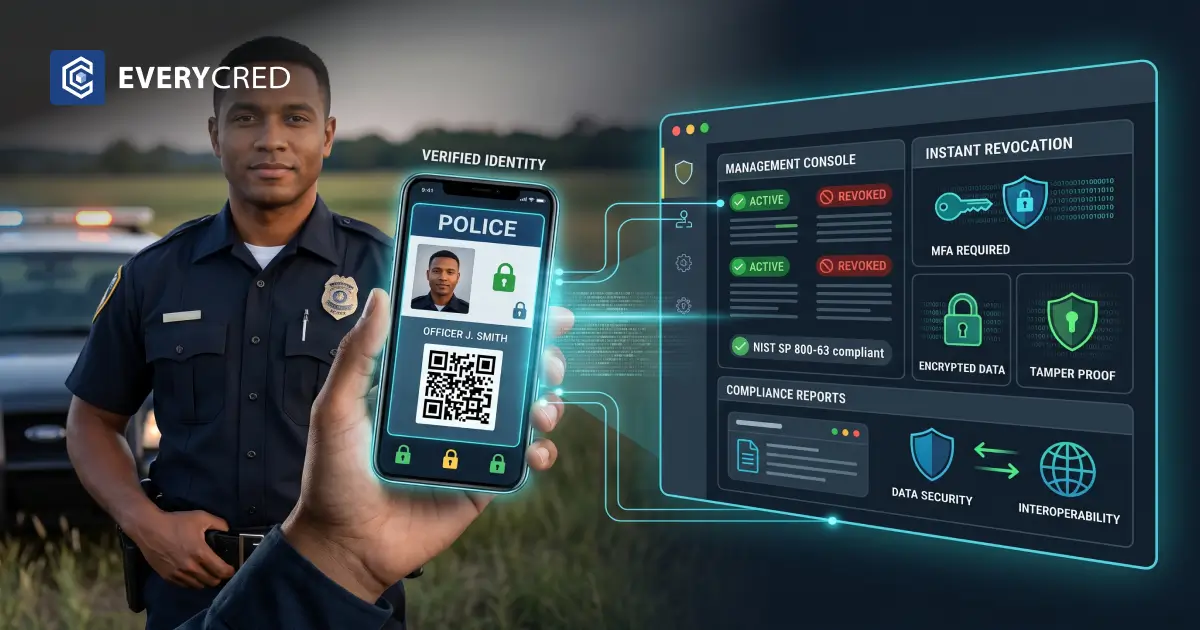
- Impersonators Exploit Vulnerabilities in Traditional Badges
- Federal Guidelines Demand Stricter Verification Protocols
- Core Infrastructure of Digital Credential Software
- Field Operations Require Instant Identity Proofing
- Transitioning Departments to Secure Verification Platforms
- EveryCRED Delivers Compliant Identity Management
- Conclusion
- FAQs


Police departments require secure methods to identify their personnel. Criminals easily manufacture physical badges and counterfeit paper documents. This creates severe risks for public safety and officer security. Departments need modern systems to stop impersonators from exploiting citizens. Implementing digital credential software solves this problem entirely. It allows agencies to issue cryptographically secure digital ID cards to sworn officers.
Impersonators Exploit Vulnerabilities in Traditional Badges
Fake officer IDs allow criminals to bypass security checkpoints and extort citizens. Physical identification methods lack real time verification capabilities. A report from the Center for American Progress highlights that unidentifiable officers spur dangerous impersonation crimes and erode public trust.
- Physical badges have no electronic verification mechanisms built into them.
- Counterfeiters purchase realistic law enforcement badges easily online.
- Stolen credentials remain visually active until police manually retrieve them.
- Citizens cannot easily verify an officer’s current duty status during interactions.
- Suspended officers can still present their old physical badges to civilians.
- Paper identification cards degrade quickly and lack security watermarks.
- Visual inspections fail to detect high quality forged documents in poor lighting.
Federal Guidelines Demand Stricter Verification Protocols
Police departments must adhere to strict data protection standards. Systems must meet specific requirements for identity proofing and lifecycle management. The National Institute of Standards and Technology outlines these strict mandates in the NIST SP 800-63 Digital Identity Guidelines.
- Agencies require multi factor authentication for all system access.
- Administrators need software tools to revoke access instantly.
- Identity platforms must protect criminal justice information during transmission.
- Databases must encrypt personal identifiable information at rest.
- Audit logs must record every instance of credential verification.
- Software must prevent unauthorized access to the central identity registry.
Digital credential software provides the exact framework necessary to meet these strict federal compliance standards. The software ensures that all data remains secure and auditable.
Core Infrastructure of Digital Credential Software
Enterprise identity platforms provide central control over officer credentials. The software architecture ensures that every issued identity remains secure and verifiable at all times.
Cryptographic Security Measures
The system issues credentials using advanced cryptography. The software generates unique public and private key pairs for each identity. This process completely prevents the unauthorized duplication of digital id cards. Forgers cannot reverse engineer the cryptographic signatures embedded in the credentials.
Instant Revocation Capabilities
Administrators cancel credentials with one click in the central dashboard. The digital credential software updates the status across all connected networks immediately. When a citizen scans a revoked badge, the system instantly displays an invalid status. This feature eliminates the risk of suspended officers impersonating active duty personnel.
Interoperable Data Standards
The platform communicates securely with other government databases. Agencies can verify identities across different state and local jurisdictions. Implementing verifiable credentials for government operations requires this seamless interoperability. The software uses open standards to ensure broad compatibility with existing dispatch systems.
Centralized Management Dashboard
IT personnel oversee the entire credential lifecycle from a single interface. The dashboard displays the real time status of all active identities. Administrators generate detailed compliance reports directly from the software. They monitor verification logs to detect any suspicious scanning activity.
Field Operations Require Instant Identity Proofing
Officers operate in high-risk environments demanding rapid identity verification. Digital id cards provide immediate and irrefutable proof of authority.
- Officers display a secure QR code on their department issued mobile devices.
- Fellow agencies scan the code to confirm the officer’s identity.
- The system checks the active status against the central encrypted database.
- The entire verification happens in seconds without dispatch intervention.
- Citizens can use standard smartphone cameras to verify the credentials.
- The verification screen displays the officer’s current photo and badge number.
- The application operates securely even in areas with low cellular connectivity.
This field process relies heavily on tamper proof digital credentials to ensure the data remains unaltered during daily operations.
Transitioning Departments to Secure Verification Platforms
Adopting digital credential software involves structured deployment phases. Departments must transition from legacy systems without disrupting daily police operations.
Audit Existing Identity Protocols
Agencies evaluate their current physical badge inventory first. They identify existing vulnerabilities in their manual issuance process. They document all active, suspended, and retired personnel records.
Deploy the Identity Platform
IT departments install the credentialing software onto secure local servers or government cloud environments. They configure the software to match internal department security policies. They establish secure connections with existing human resources databases.
Issue Mobile Credentials
Administrators onboard police officers into the new digital system. They push secure digital id cards directly to the officers’ authorized mobile devices. The software requires the officers to complete multi factor authentication to claim their credentials.
Train Personnel and Public
Departments train officers on presenting their digital credentials during traffic stops and investigations. They run public awareness campaigns. They inform the community on exactly how to request and verify these modern IDs safely.
Monitor and Update Systems
Technical teams continuously monitor the digital credential software for optimal performance. They install software updates to maintain cryptographic security standards. They audit the access logs monthly to ensure total federal compliance.
EveryCRED Delivers Compliant Identity Management
Police departments require reliable technology partners to implement secure identity programs. EveryCRED provides enterprise digital credential software designed specifically for high security environments. Our platform issues verifiable digital id cards that meet strict federal security guidelines. The system includes centralized management consoles for real time issuance and immediate revocation. Administrators control all active credentials from a single intuitive dashboard. The software integrates smoothly with your existing department databases. You can schedule a demo to see exactly how EveryCRED secures law enforcement identities and prevents impersonation.
Conclusion
Fake officer IDs present a direct threat to public safety and department integrity. Traditional physical badges cannot provide the security necessary for modern law enforcement operations. Transitioning to secure identity platforms eliminates the massive risks associated with counterfeit credentials. Departments must adopt digital solutions to protect their officers and the communities they serve daily.
FAQs
What is digital credential software?
It is a highly secure platform that allows organizations to issue and manage digital identities safely.
How do digital id cards work?
They securely store encrypted identity data on mobile devices for instant verification through scanned QR codes.
Can someone fake digital credentials?
No. Advanced cryptographic security prevents unauthorized duplication and ensures the digital credential remains entirely tamper proof.
Why do police departments need this?
It stops impersonators by allowing citizens and agencies to verify an officer’s active duty status immediately.
How quickly can administrators revoke access?
Administrators use the central software dashboard to revoke an officer’s access and credentials instantly in real time.