13th May, 2026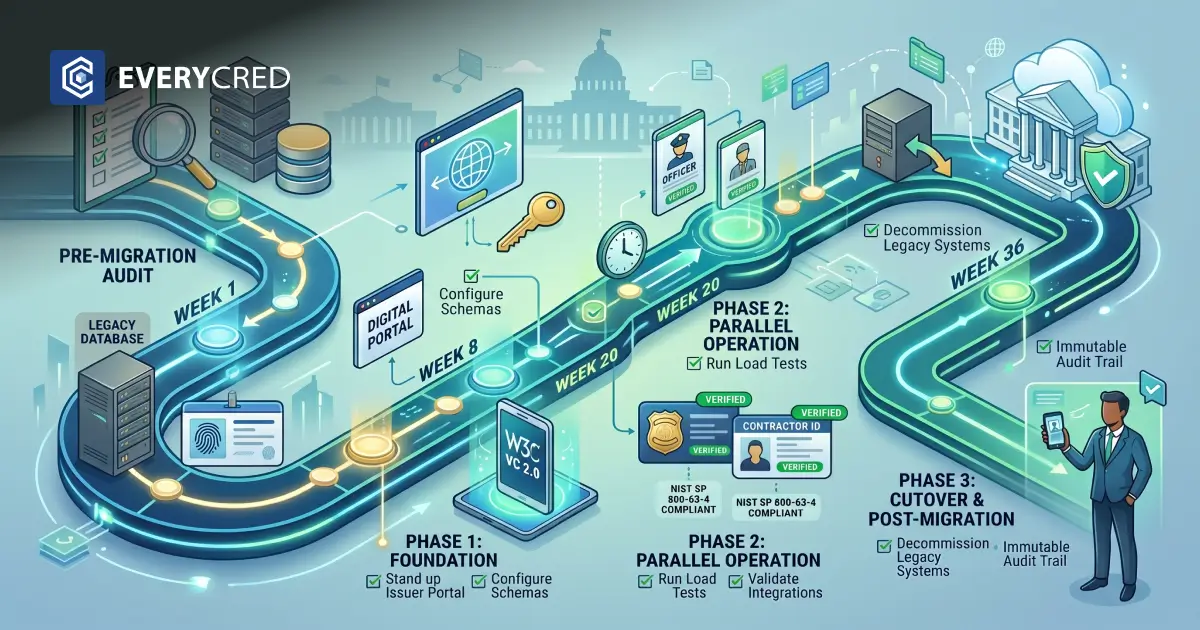
- Why Legacy Government Migrations Fail at the Credential Layer
- Pre-Migration Audit Checklist: What to Inventory Before You Start
- The Digital Government Migration Checklist: Phase by Phase
- Digital Government Solutions: Government Modernization Roadmap
- How EveryCRED Executes Government Legacy Migration Programs
- Conclusion
- FAQs


Digital government solutions programs that modernize infrastructure while ignoring the identity and credential layer produce the same verification failures on new hardware. This digital government migration checklist gives IT programme managers, migration leads, and government IT directors a phase-by-phase structure for legacy system migration that addresses credential continuity from week one.
Most government legacy migration projects overrun their timelines at the same point: when the team discovers that existing employee IDs, officer badges, contractor access credentials, and benefit entitlement cards are database-coupled to the system being decommissioned. A government modernization roadmap that does not treat the credential layer as a parallel workstream will require emergency rework at cutover.
This checklist is structured as a 36-week program with three phases, a pre-migration audit, and five compliance checkpoints.
Key Takeaways
– Government legacy migrations fail most often at the identity and credential layer, not the infrastructure stack.
– Credentials issued on W3C VC 2.0 remain verifiable after a legacy system is decommissioned, with no database dependency.
– A structured government modernization roadmap reaches pilot operation by week 20 and full deployment by week 36.
– Manual credential verification costs $15 to $25 per check; post-migration automated verification costs under $0.10 per check.
– NIST SP 800-63-4, finalized July 2025, sets identity assurance requirements that most legacy government ID systems do not meet.
Migration teams already mid-program can map the phases below directly to their current deployment stage and identify where the credential workstream needs to be inserted.
Why Legacy Government Migrations Fail at the Credential Layer
Infrastructure teams plan for database migration, API cutover, and server decommission. They rarely plan for what happens to the credentials already in circulation.
Legacy credential systems create three failure patterns during migration. First, database-coupled credentials require a live query to the source system at every verification. The moment the source system is decommissioned, verification fails across every downstream context, including payroll, access control, and inter-agency verification portals.
Second, paper, PDF, and proprietary digital credentials cannot be verified without the issuing system’s active participation. A police officer whose ID card was issued by a legacy HR system cannot have that card verified after the system is switched off, unless the credential has been reissued in a portable format.
Third, legacy systems typically have no credential revocation mechanism. Credentials issued before migration remain in circulation with no way to invalidate them if an employee leaves or a clearance is withdrawn.
The government digital transformation work of replacing legacy infrastructure only delivers its intended value when the credential layer is addressed in the same program timeline.
Pre-Migration Audit Checklist: What to Inventory Before You Start
Programme managers running legacy system migration for government IT must complete a three-part audit before any migration phase begins.
Identity and Credential System Inventory
Complete this inventory before touching any infrastructure:
- List every credential type currently issued: employee IDs, officer badges, contractor access credentials, benefit entitlement cards, inter-agency trust documents, and civil servant onboarding credentials.
- Identify which credentials require a live database query to verify and which carry self-contained cryptographic proof.
- Document current verification time per credential type and per deployment context: office, field, rural, and offline.
- Confirm whether any credential is connected to the national government identity infrastructure. In India, this means DigiLocker and Aadhaar-linked records managed through state government portals. In federal civilian programs, this means current PIV card infrastructure and its downstream integrations.
- Record credential volume by department to size the new issuer infrastructure correctly.
Integration Dependency Mapping
- Map every downstream system that queries the current credential issuer: access control systems, payroll platforms, inter-agency verification portals, HR databases, and audit trail systems.
- Identify which integrations use REST APIs and which use proprietary connectors that will not survive migration.
- Document offline verification requirements by department. Law enforcement field deployments, rural benefit verification programs, and border checkpoint operations all require offline credential checks.
- Flag any credential that carries cross-agency or cross-jurisdictional verification requirements. These require standards-compliant formats before the source system is decommissioned.
Compliance Gap Assessment
- Check whether current credentials meet NIST SP 800-63-4 Identity Assurance Level 2 requirements. Most legacy PIV card systems and state government ID platforms do not meet the updated requirements finalized in July 2025.
- For programs operating under the Digital Personal Data Protection (DPDP) Act, audit whether existing credential systems store personally identifiable information in forms that violate data minimization requirements.
- Identify credential types that require post-migration verification by parties outside the issuing department. These require W3C VC 2.0 format to remain verifiable after the source system is gone.
Reviewing an existing government deployment blueprint before completing this audit helps teams identify integration dependencies that other programs have already resolved.
The Digital Government Migration Checklist: Phase by Phase
This digital government migration checklist assumes a 36-week deployment timeline. The credential layer runs as a parallel workstream alongside infrastructure from week one.
Phase 1: Foundation (Weeks 1 to 8)
- Stand up the credential issuer portal and configure credential schemas for each credential type identified in the audit.
- Integrate the credential layer via REST API to the target state of each dependent system, not the legacy state. This step prevents a second migration cycle later.
- Configure the revocation registry and test real-time revocation across all verifier contexts, including offline field deployments.
- Issue pilot credentials to a representative subset of the workforce. Include field-deployed personnel, not just office staff, in the pilot group.
- Validate that offline verification works for every deployment context that requires it before advancing to Phase 2.
- Complete procurement documentation for any new vendor integrations. US federal and state agencies on NASA SEWP V or ITES-SW2 can onboard new credential platform vendors without initiating a new competitive procurement cycle, which typically saves six to twelve weeks.
Phase 2: Parallel Operation (Weeks 9 to 20)
- Operate both legacy and new credential systems simultaneously. Issue new W3C VC 2.0 credentials to all holders while legacy credentials remain valid.
- Run verification load testing at peak operational demand. For police departments, this means shift change periods. For benefit programs, this means disbursement days.
- Complete integration testing for every system that will query the new credential issuer after cutover.
- Conduct a compliance checkpoint against NIST SP 800-63-4 assurance levels and applicable local data protection requirements.
- Validate that state government portal integrations, including DigiLocker-linked credential records where applicable, resolve correctly through the new platform.
- Confirm that credentials issued during parallel operation are verifiable without the legacy system.
The pilot reaches full production status by week 20 with a defined user subset, validated integration stack, and documented verification metrics.
This phase is where the real-world comparison between credential platforms vs legacy systems moves from theoretical to operational. Teams discover which legacy verification behaviors are load-bearing and which can be replaced.
Phase 3: Cutover and Post-Migration Verification (Weeks 21 to 36)
- Execute legacy system decommission on a department-by-department basis. A full simultaneous cutover creates an unmanageable verification risk surface.
- Confirm that all credentials issued on the new platform are verifiable without querying the legacy database.
- Validate the immutable audit trail covers the complete migration period, including credentials issued during parallel operation.
- Complete compliance documentation and submit for any required regulatory sign-off under applicable data protection frameworks.
- Run a post-migration verification test: present a pre-migration credential and confirm it either resolves on the new system or returns a clear invalid status. A legacy credential that returns no result is an unresolved dependency, not a clean decommission.
The Maharashtra Police modernization deployment used a phased structure with credential continuity maintained throughout parallel operation and offline field verification validated before any legacy database was decommissioned.
Digital Government Solutions: Government Modernization Roadmap
A government modernization roadmap fails when it treats the credential workstream as a trailing dependency rather than a parallel track. Three milestone structures separate successful programs from those that overrun.
Credential-first milestone: The credential issuer must be operational before any infrastructure cutover begins. Teams that attempt to migrate infrastructure and credentials simultaneously create a verification gap during the overlap period.
Pilot-gated progression: No full deployment proceeds before the pilot validates offline verification, peak load handling, real-time revocation, and integration with every downstream system. The 36-week timeline holds only when the pilot gates the phase transition at week 20.
Procurement-aligned timelines: US agencies procuring through existing contract vehicles accelerate phase transitions because vendor onboarding is already complete. The government modernization roadmap timeline changes by six to twelve weeks, depending on whether a new competitive procurement cycle is required.
For state government programs managing large civil service workforces, the credential layer is the verification interface between staff and the services they administer. Digital government solutions that replace legacy infrastructure without addressing this layer produce operational failures at the point of verification, not at the infrastructure layer.
How EveryCRED Executes Government Legacy Migration Programs
We have deployed the credential layer migration that this checklist describes. For Raigad Police, we migrated from a manual verification workflow requiring 30 minutes per credential check to a W3C VC 2.0 system that resolves in under 10 seconds. The integration connected to CCTNS and DigiLocker via REST API with no front-end changes to existing police database interfaces. Offline verification was operational for field officers before any legacy system was decommissioned. Administrative overhead dropped by 85%.
Our capabilities for migration programmes include:
- REST API integration: No rip-and-replace, no front-end changes to existing systems.
- Offline verification: Cached cryptographic signatures for field deployments with no network connectivity.
- Real-time revocation: Credentials are invalidated in seconds at any point in the migration or post-migration period.
- 36-week timeline: Pilot operational by week 20, full deployment by week 36.
- Procurement access: US agencies use public sector credentials through NASA SEWP V, ITES-SW2, NASPO ValuePoint, and OMNIA Partners.
Migration teams managing active programs can book a demo to walk through this checklist against their specific deployment context.
Conclusion
A digital government migration checklist that excludes the credential layer produces infrastructure compliance without verification compliance. The three legacy credential failure patterns, database coupling, non-portable formats, and absent revocation, each require a specific resolution before the source system is safely decommissioned.
The 36-week government modernization roadmap works when the credential workstream runs in parallel with infrastructure from week one, with pilot operation validating the full stack by week 20. Digital government solutions deliver their intended return only when the verification layer migrates alongside the infrastructure it supports. Teams that treat credential migration as a trailing dependency will encounter cutover failures that a structured checklist prevents.
FAQs
What should a government legacy system migration checklist include?
A checklist must cover credential inventory, integration mapping, compliance gap assessment, phase timelines, and post-cutover verification.
How long does a digital government identity migration take to complete?
A statewide government identity migration takes 36 weeks, with pilot operation confirmed by week 20, covering offline and online verification contexts.
What happens to existing credentials when a government system migrates?
Credentials issued in W3C VC 2.0 format remain verifiable after the legacy system is decommissioned, because verification resolves against the issuer’s public key, not the database.
How does legacy system migration support NIST SP 800-63-4 compliance?
Migrating to W3C VC 2.0 credentials meets the Identity Assurance Level 2 requirements in NIST SP 800-63-4 that most legacy PIV and paper-based systems do not satisfy.
Can government agencies run a legacy migration without starting a new procurement process?
US agencies on NASA SEWP V or ITES-SW2 can deploy a new credential platform through existing contracts without initiating a competitive procurement cycle.