6th May, 2026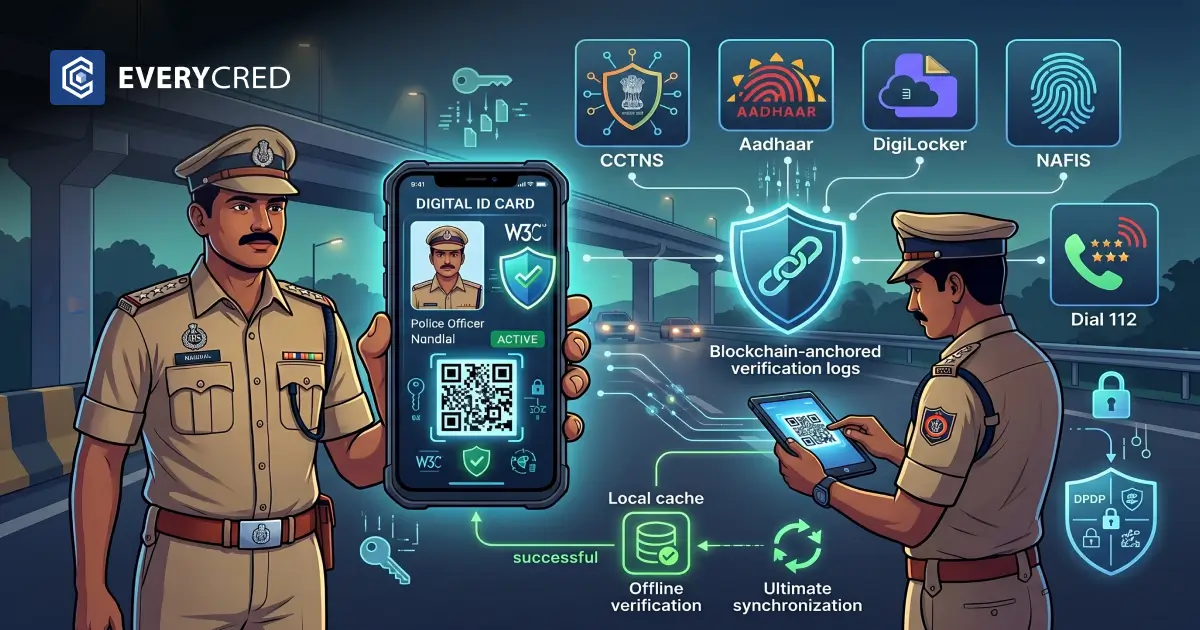
- Why Laminated IDs Are Now a Liability for Indian Police Forces
- The 5-Phase Police Digital ID Deployment Blueprint
- What Every Law Enforcement Digital ID Vendor Must Deliver
- How Offline Verification Actually Works at a Checkpoint
- Connecting Digital IDs to India's Policing Infrastructure
- The Compliance Layer: What Indian Law Requires
- How EveryCRED Supports Police Digital ID Deployment at Scale
- Conclusion
- FAQs


Police departments across Indian states still verify officer identity using laminated cards and manual registers. These systems fail during night operations, inter-district coordination, and large-scale events. The Indian Cyber Crime Coordination Centre recorded over 7.4 lakh cybercrime complaints in the first four months of 2024, with a significant share involving impersonation of police officials.
A structured police digital ID deployment closes these gaps. Here, we have covered the steps a State Police IT team or Home Ministry technology unit needs to follow, along with the technical requirements every law enforcement digital ID vendor must meet.
Why Laminated IDs Are Now a Liability for Indian Police Forces
Physical officer identity card systems carry three structural weaknesses.
- No real-time status check. A printed card stays valid-looking after suspension, transfer, or retirement.
- No audit trail. Physical ID presentations create no record for post-incident accountability.
- No integration. Printed IDs exist outside CCTNS and Aadhaar. Every verification requires a phone call.
Digital ID cards solve these problems by embedding cryptographic proof, real-time status, and verifiable data into a mobile-accessible credential.
The 5-Phase Police Digital ID Deployment Blueprint
Deploying digital ID cards at scale requires a phased approach. The following phases apply whether the deployment covers one district or an entire state.
Phase 1: Infrastructure and Risk Audit (Week 1 to 4)
- Map existing officer identity card system workflows: issuance, renewal, verification, revocation
- Identify high-risk zones where impersonation or verification delays cause problems
- Assess network coverage at stations, checkpoints, and field locations
- Audit IT systems for API readiness (CCTNS, state HR databases)
Phase 2: Vendor Selection and PoC Design (Week 5 to 10)
- Issue a requirements document based on the vendor checklist below
- Request a working Proof of Concept from shortlisted vendors
- Test with 50 to 100 officers across urban and rural stations
Phase 3: Pilot Deployment (Week 11 to 20)
- Run the police digital ID deployment across one full district or commissionerate
- Train issuance officers, verification staff, and field personnel
- Test revocation workflows by simulating suspension and transfer scenarios
Phase 4: Statewide Rollout (Week 21 to 36)
- Expand to remaining districts using pilot learnings
- Launch public-facing verification (citizen QR scan for officer authentication)
- Run awareness campaigns for officers and the public
Phase 5: Post-Deployment Monitoring (Ongoing)
- Track monthly metrics: verification volume, failed scans, revocation response time
- Conduct quarterly security audits of the credential issuance infrastructure
What Every Law Enforcement Digital ID Vendor Must Deliver
State Police IT directors need a clear technical checklist when evaluating a law enforcement digital ID vendor. These requirements are non-negotiable.
Standards Compliance
- Full alignment with the W3C Verifiable Credentials Data Model 2.0, published as a W3C Recommendation in May 2025
- Authentication assurance levels mapped to NIST SP 800-63 Revision 4 guidelines
- Compliance with the Digital Personal Data Protection Act 2023 and Rules 2025 for handling officer personal data
Offline and Online Verification
- Cached cryptographic signature verification that works without internet connectivity
- QR code and NFC-based scanning for field use
- Automatic sync when connectivity is restored
This is the most critical requirement. Police operations in rural beats, border areas, and disaster zones happen in low-connectivity environments. Any officer identity card system requiring constant internet access will fail in the field.
Integration Readiness
- REST API architecture for integration with CCTNS and state police databases
- Aadhaar-based identity binding for officer onboarding
- DigiLocker compatibility for credential storage
Real-Time Credential Lifecycle Management
- Instant issuance of verifiable digital credentials upon officer onboarding
- Real-time revocation within seconds of a status change (suspension, transfer, retirement)
- Complete audit trail for every issuance, verification, and revocation event
Security and Data Residency
- End-to-end encryption for credential data in transit and at rest
- Data hosting within Indian territory on government-approved infrastructure
- Tamper-proof blockchain-anchored verification logs
How Offline Verification Actually Works at a Checkpoint
The most common concern from police IT teams is signal availability. Here is the exact flow:
- The issuing authority pushes a cryptographically signed credential to the officer’s mobile wallet.
- At a checkpoint without connectivity, the verifier scans the QR code or taps via NFC.
- The verifier’s app checks the signature against a locally cached issuer key.
- When the device reconnects, it syncs with the central system to confirm revocation status.
This dual-mode architecture ensures police digital ID deployment works from a Mumbai commissionerate to a remote district with no signal.
Connecting Digital IDs to India’s Policing Infrastructure
A standalone system that does not connect to existing platforms creates data silos. The law enforcement digital ID vendor must demonstrate integration with:
- CCTNS: Officer credentials verifiable against the Crime and Criminal Tracking Network
- NAFIS: Biometric cross-referencing during high-security operations
- Dial 112: Responding officers verified by the coordination centre
- State HR Systems: Automatic credential updates on postings, promotions, or disciplinary actions
- DigiLocker: Officers store and present credentials through a government-backed digital wallet
BPR&D has emphasized interoperable police technology under the Smart Policing initiative. Vendors operating in isolation from this ecosystem create long-term technical debt.
The Compliance Layer: What Indian Law Requires
Three regulatory frameworks govern how digital ID cards for police must handle data.
Digital Personal Data Protection Act, 2023
Officer biometric data and personal identifiers fall under the DPDP Act. Vendors must implement purpose limitation, storage limitation, and officer rights to correction and erasure. Full compliance is mandatory by May 2027.
IT Act, 2000
Digital credential infrastructure must meet reasonable security practices under Section 43A until the DPDP Act provisions fully replace them.
State Police Act Provisions
Each state has its own police act governing officer records. The system must accommodate state-specific data fields, rank structures, and administrative hierarchies.
How EveryCRED Supports Police Digital ID Deployment at Scale
We built and deployed India’s first fully digital police identity system with Raigad Police, Maharashtra. That deployment reduced verification time from 30 minutes to under 10 seconds and cut administrative overhead by 85%.
Our platform issues W3C-compliant verifiable credentials with offline verification, QR and NFC scanning, real-time revocation, and direct integration with DigiLocker and Aadhaar. We serve multiple law enforcement and public sector organizations, including Navi Mumbai Police and the Government of Maharashtra.
For teams evaluating a law enforcement digital ID vendor, we offer a structured PoC program with live deployment simulation, integration testing, and a measurable pilot.
Request a PoC and deployment consultation here.
Conclusion
Police forces operating with physical ID cards accept preventable risks: impersonation, verification delays, zero accountability trails, and no integration with national systems. A structured police digital ID deployment backed by a compliant vendor eliminates these risks.
The deployment blueprint, vendor checklist, and integration architecture in this guide give IT decision-makers a concrete starting point. The next step is a Proof of Concept with real officers, real field conditions, and measurable outcomes.
FAQs
What are digital ID cards for police?
Digital ID cards are cryptographically signed, verifiable credentials that confirm an officer’s identity, rank, and active status in real time.
Can police digital ID deployment work in areas without internet?
Yes. Offline verification uses cached cryptographic signatures stored locally on the device, enabling field checks without connectivity.
What standards should a law enforcement digital ID vendor follow?
Vendors must comply with W3C Verifiable Credentials 2.0, NIST SP 800-63 Rev 4, and India’s DPDP Act 2023.
How does an officer identity card system integrate with CCTNS?
Through REST APIs that connect the credential platform to CCTNS databases for real-time officer data synchronization and verification.
How long does a full police digital ID deployment take?
A phased deployment from audit to statewide rollout typically takes 36 weeks, with a functional pilot ready by week 20.