23rd July, 2026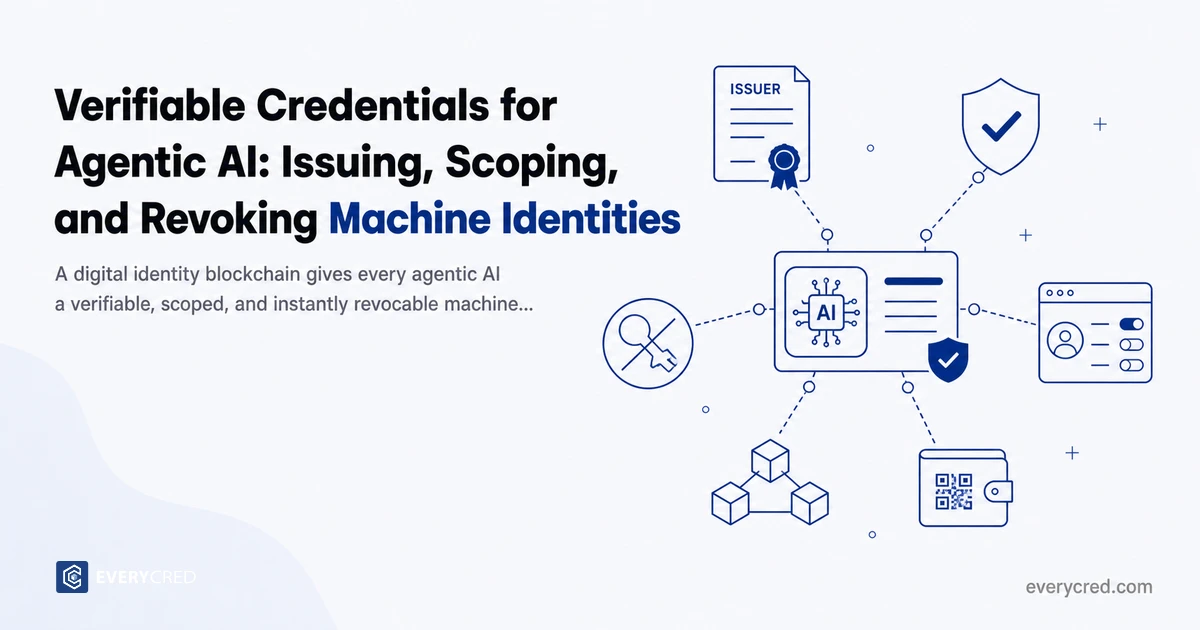
- Agentic AI Runs on Identities Nobody Can Revoke
- Why a Digital Identity Blockchain Fits Machine Identity
- Issuing and Scoping a Verifiable Machine Identity
- Revoking Agents and the Credential Lifecycle
- Building Agentic AI Governance on a Digital Identity Blockchain
- Deploy Verifiable Machine Identities With EveryCRED
- Conclusion
- Frequently Asked Questions


A digital identity blockchain gives every agentic AI a verifiable, cryptographically signed machine identity that can be issued, scoped, and revoked on demand. Most organizations do not run agents this way. They spin up AI agents on long-lived, over-privileged service accounts with static API keys and no verifiable identity. When an agent is compromised or retired, revoking its access is slow, manual, and incomplete.
Verifiable credentials change the model. Each agent holds a signed credential that states who issued it, what it may do, and when it expires. Verification takes milliseconds and needs no callback to the issuer. This article explains how to issue, scope, and revoke machine identities for agentic AI, and what enterprise architects should put in place before their agent fleet outgrows their controls.
Key Takeaways
- Agentic AI multiplies non-human identities faster than service-account controls can track, scope, or revoke them.
- A digital identity blockchain issues each agent a signed verifiable credential with a decentralized identifier, verifiable in milliseconds without a central lookup.
- Selective disclosure and short credential lifetimes scope an agent to exactly the access it needs, and nothing more.
- Real-time revocation invalidates a compromised agent credential in seconds, and every action stays on an immutable audit trail.
- EveryCRED already runs this credential lifecycle in production, revoking government field credentials in seconds since 2025.
Agentic AI Runs on Identities Nobody Can Revoke
Agentic AI systems act on their own. They call APIs, move data, trigger workflows, and spawn sub-agents without a human in the loop. Each action needs an identity, and most teams reuse what they already have: a service account with a static API key.
Service accounts were built for a handful of long-running integrations, not thousands of short-lived agents. They accumulate broad permissions, they rarely expire, and they leave no clear record of which agent did what. Security teams call these non-human identities, and they now outnumber human identities in most enterprises.
Consider a platform security lead named David at a mid-size fintech. His team runs 150 AI agents across support, reconciliation, and fraud review, all under one shared service account with write access to production. When a single agent starts behaving strangely, David cannot revoke it without breaking the other 149. The blast radius is the whole fleet.
Why a Digital Identity Blockchain Fits Machine Identity
A digital identity blockchain solves this by providing every agent with its own verifiable identity, rather than a shared account. The model uses three W3C standards: a decentralized identifier names the agent, a verifiable credential states what it can do, and a blockchain anchor makes the credential tamper-evident.
The difference is practical. A service account queries a central directory to verify whether a key is still valid. A verifiable credential carries its own cryptographic proof. Any verifier checks the issuer signature against the public key resolved from the identifier, in milliseconds, without a callback. The same blockchain digital identity primitives that EveryCRED deploys for people work for machines.
The W3C Verifiable Credentials Data Model 2.0 defines this credential format, so an agent credential stays interoperable across systems rather than locked to one vendor. For enterprise architects, that means one identity layer for staff, workloads, and agentic AI, governed by a single digital identity blockchain rather than a patchwork of key stores.
Issuing and Scoping a Verifiable Machine Identity
Two problems from the service-account era disappear when each agent gets its own credential: you can tell agents apart, and you can limit each one precisely. This is where the machine identity model earns its place in agentic AI governance.
Issue one credential per agent
At creation, the issuer generates a decentralized identifier for the agent and signs a credential that binds it to its owner, its purpose, and an expiry time. EveryCRED anchors that credential with SHA-512 hashing, so any later tampering breaks the signature and fails verification.
Issuance is programmatic. A platform team calls the issuer at spin-up and receives a credential that the agent presents on every request. Short lifetimes matter here. A credential that expires in hours, not years, shrinks the window in which a leaked identity stays useful.
Scope access with selective disclosure
Scoping decides what an agent may prove, and therefore what it may do. Selective disclosure using zero-knowledge proofs lets an agent present only the claim a verifier needs, such as authorization for read-only reconciliation, without exposing its full permission set.
This is the opposite of a broad service account. An agent proves the minimum required for each call, which keeps the machine identity aligned with least privilege by design. The same selective disclosure behind cybersecurity credential verification for people applies directly to agents.
Revoking Agents and the Credential Lifecycle
Revocation is where verifiable credentials beat service accounts most clearly. When an agent is compromised, retired, or simply finished, its credential is revoked in seconds by the issuer, and every subsequent verification returns invalid, even for a credential the agent already holds.
Return to David’s fintech. With per-agent credentials, revoking the one misbehaving agent is a single action. The other 149 keep working. Credential revocation is immediate, scoped, and logged, and the blast radius shrinks from the whole fleet to one identity.
Revocation is one stage of a full credential lifecycle: issue, present, verify, renew, and revoke. Each event, including every action an agent takes, writes to an immutable audit trail. When an AI governance officer asks which agent accessed a record, when, and under what authority, the answer is a cryptographic record, not a guess. Managing this credential lifecycle across thousands of agents is the core discipline of agentic AI security.
Building Agentic AI Governance on a Digital Identity Blockchain
Enterprise architects do not need a standard to fully settle before acting. The building blocks for a digital identity blockchain, verifiable credentials, decentralized identifiers, and revocation registries, are production-ready today.
Three moves put an agent fleet on solid ground. First, inventory every non-human identity and map its permissions, because most teams underestimate how many agents already run. Second, replace shared service accounts with one credential per agent, issued programmatically with a short lifetime. Third, wire revocation and audit into the deployment pipeline so scoping and shutdown are automatic, not manual tickets.
An AI governance officer named Maya at a healthcare network did exactly this. She required every new agent to receive a scoped verifiable credential before it could touch a patient system. Within a quarter, her team could answer any access question from the audit trail and revoke any agent in seconds. A digital identity blockchain turned agentic AI from a governance liability into a controlled, verifiable machine identity system.
Deploy Verifiable Machine Identities With EveryCRED
We built EveryCRED to issue, scope, and revoke verifiable credentials at scale, and the same platform applies to agentic AI. For Raigad Police, we deployed credentials that verify in under 10 seconds and revoke in seconds, with offline verification and an immutable audit trail. Those primitives, issuance, selective disclosure, real-time revocation, and SHA-512 anchoring, map directly onto machine identity. Integration uses our REST API, so agents receive credentials at spin-up with no change to your existing stack. Book a demo to see a per-agent credential lifecycle running on a digital identity blockchain.
Conclusion
Agentic AI is scaling faster than service-account security can follow. Static keys and shared accounts leave agents over-privileged and make it nearly impossible to revoke one at a time. Verifiable credentials fix this at the identity layer.
A digital identity blockchain gives each agent a signed, scoped, and revocable machine identity. Issuance is programmatic, scoping uses selective disclosure, revocation takes seconds, and the full credential lifecycle stays on an immutable audit trail. Enterprise architects who adopt this model now will govern thousands of agents with the same confidence they expect for human staff.
The organizations that treat every agent as a first-class identity, not a shared account, will scale agentic AI safely. The standards are ready. The next step is deployment.
Frequently Asked Questions
What is a machine identity for an AI agent?
A machine identity is a verifiable credential proving which agent is acting, what it may do, and who issued it.
How do you revoke an AI agent’s access quickly?
Issue each agent its own credential, then revoke that single credential in seconds, so every future verification returns invalid.
Why is a digital identity blockchain better than service accounts?
A digital identity blockchain gives each agent a signed, scoped, revocable identity, unlike shared service accounts that rarely expire.
What is the credential lifecycle for agentic AI?
The credential lifecycle covers issuing, presenting, verifying, renewing, and revoking an agent credential, with every event on an immutable audit trail.
Can verifiable credentials scope what an AI agent can do?
Yes, selective disclosure lets an agent prove only the permission a task needs, keeping machine identity aligned with least privilege.