8th April, 2026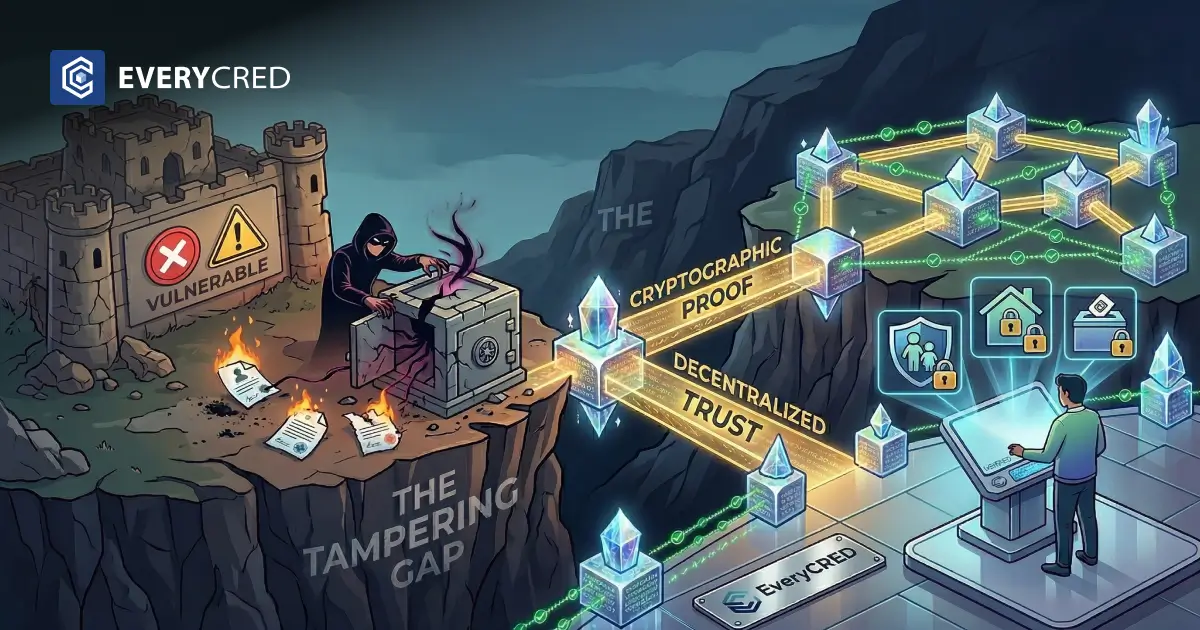
- Why Government Records Are a Prime Target for Tampering
- How Digital Identity Blockchain Secures Government Records
- The Blockchain Credentials Public Registries Actually Need
- What Compliance Looks Like for US Public Agencies
- Deploying Tamper-Proof Record Storage: A Practical Path for Agencies
- EveryCRED Gives Public Agencies the Infrastructure to Issue Government-Grade Credentials
- Conclusion
- FAQs


Public registries hold some of the most consequential records in existence. Birth certificates. Property deeds. Voter registrations. Marriage licenses. These records define legal identity, ownership, and civil rights. Yet most agencies store them in centralized databases built for access, not integrity.
Data tampering is not a theoretical risk. In 2025, data compromise incidents in the United States reached a record 3,322, with 70 percent of breach notices failing to explain how the breach occurred. When attackers reach a government database, they can alter records silently. Traditional systems rarely detect the change.
Digital identity blockchain changes the underlying architecture. It replaces the assumption of trust with cryptographic proof. Here, we have discussed how it works, what blockchain credentials look like in a public registry context, and what agencies need to do to implement it correctly.
Why Government Records Are a Prime Target for Tampering
Centralized databases create a single point of failure. One compromised administrator account, one misconfigured API, or one insider action can alter a record permanently. Traditional systems rely on audit logs, but logs can be edited, too.
The specific risks for public registries include:
- Property fraud: Altered deed records that transfer ownership without the owner’s knowledge
- Identity fabrication: Modified birth or identification records used to build fraudulent identities
- Voter roll manipulation: Unauthorized additions or deletions in registration databases
- Benefits fraud: Changed eligibility records in social welfare systems
The 2024 National Public Data breach exposed 2.9 billion records from a single centralized repository. Public registries face the same structural vulnerability. Digital identity verification built on blockchain addresses this at the architectural level, not just at the perimeter.
How Digital Identity Blockchain Secures Government Records
A digital identity blockchain stores records across a distributed network of nodes. No single server holds the complete dataset. Each record is cryptographically hashed, and any change to that record breaks the hash. Every node in the network detects the inconsistency automatically.
NIST defines blockchain as a collaborative, tamper-resistant ledger where each block connects to the previous one through a unique identifier based on the previous block’s data. Any change to one block is visible across all subsequent blocks.
For government records, this produces three core guarantees:
- Immutability: Once a birth certificate or property deed is written to the blockchain, no party can alter it without detection
- Permanent audit trail: Every issuance, update, and access event is logged with a timestamp that cannot be overwritten
- Distributed trust: No single administrator holds unilateral control over the data
This is the foundational value of the digital identity blockchain for public registries. It makes tampering mathematically detectable, not just policy-prohibited.
The Blockchain Credentials Public Registries Actually Need
Blockchain credentials are cryptographically signed digital documents. A government agency signs a credential using its private key. The verifier uses the agency’s public key to confirm the signature is valid and the document has not been altered.
This is different from a scanned PDF or a record stored in a government portal. A PDF can be edited in seconds. A blockchain credential cannot be altered without breaking the cryptographic proof. Verifiable credential use cases in public registries cover a specific set of record types:
- Vital records: Birth, death, and marriage certificates issued as blockchain credentials
- Property records: Land titles and deeds anchored to an immutable ledger
- Licensing and permits: Professional licenses with real-time revocation capability
- Voter eligibility proofs: Identity confirmation tied to registration without exposing centralized personal data
These blockchain credentials follow the W3C Verifiable Credentials 2.0 standard, which became a full W3C Recommendation in May 2025. The W3C VC 2.0 standard is recognized as a foundational framework for governments and policymakers to build interoperable, privacy-respecting digital trust at scale.
Each credential is tied to a Decentralized Identifier (DID), which gives the issuing agency a verifiable identity on the network. The agency’s DID is public. The citizen’s underlying data stays private unless selectively disclosed.
What Compliance Looks Like for US Public Agencies
Federal agencies operate under NIST Special Publication 800-63, the Digital Identity Guidelines. Revision 4, finalized in 2025, explicitly includes digital wallets, mobile credentials, and verifiable credentials as accepted mechanisms for identity proofing and authentication.
The guidelines set Identity Assurance Levels (IAL) and Authentication Assurance Levels (AAL). Blockchain credentials issued through compliant platforms satisfy federal requirements for high-assurance identity verification at the state and federal levels.
Key compliance requirements for public registries adopting digital identity blockchain:
- Credentials must carry cryptographic proof of the issuing agency’s identity
- The system must support real-time revocation of credentials when status changes
- Citizens must control their credentials from their own devices, not centralized portals
- Data minimization must be enforced: citizens share only the attributes the verifier requires
Utah enacted H.B. 470 in 2023, becoming the first US state to mandate recommendations for blockchain-verifiable government records, including county permits and non-primary identification documents. The public sector credentialing framework that follows positions agencies as trusted issuers in a verified ecosystem rather than sole custodians of centralized data.
Deploying Tamper-Proof Record Storage: A Practical Path for Agencies
Agencies moving to blockchain-based record storage follow a structured implementation process. Full system replacement is not required. Agencies connect existing infrastructure to modern credential issuance pipelines through APIs.
Establish the Agency as a Trusted Issuer
The agency generates a cryptographic key pair. It publishes its public key through a Decentralized Identifier. This DID becomes the agency’s verifiable identity on the network. Citizens and partner agencies can confirm the issuer’s identity before accepting any credential.
Connect Legacy Databases via API
Most public registries run on SQL or similar database architectures. REST APIs connect these existing systems to the credential issuance engine. When a clerk updates a citizen’s status in the primary database, the connected system automatically generates the corresponding blockchain credential. This is the core approach covered in the government credentials deployment process for agencies that need to modernize without full infrastructure replacement.
Issue, Revoke, and Verify
Citizens receive their blockchain credentials in a secure digital wallet on their mobile device. They control which credentials they share and with whom. Government databases do not log when or where the citizen presents the credential, which satisfies federal data minimization standards.
Any authorized verifier checks the credential using the agency’s public DID. If a single byte of data has changed since issuance, the cryptographic signature breaks and verification fails automatically. This level of blockchain-based verification removes the dependency on manual document inspection and the errors that accompany it.
EveryCRED Gives Public Agencies the Infrastructure to Issue Government-Grade Credentials
EveryCRED is built for public sector agencies that require tamper-proof digital identity blockchain infrastructure at scale. The platform uses the EVRC DID method and Merkle proof security to generate tamper-evident credential records. Agencies can issue, manage, revoke, and verify blockchain credentials through a unified dashboard without building or maintaining internal cryptographic key infrastructure.
EveryCRED’s Trust Method allows agencies to publish their decentralized identifiers, sign credentials, and manage the full credential lifecycle from a single interface. The platform connects directly to existing legacy databases via REST APIs and supports real-time revocation, automated verification, and cross-department interoperability. All issued credentials comply with W3C Verifiable Credentials 2.0 and align with NIST SP 800-63 requirements for federal identity assurance.
If your agency manages vital records, property registries, or licensing data, schedule a demo to see how EveryCRED works in a live public registry environment.
Conclusion
Public registries cannot secure records by adding security layers to a flawed centralized architecture. As long as a single access point controls all data, that point will remain a target.
Digital identity blockchain removes that structural vulnerability. Blockchain credentials give government agencies a mathematically verifiable way to issue, store, and confirm records. The standards are finalized. The federal compliance framework is in place. The implementation path is practical and does not require rebuilding existing systems from scratch.
Public registries that adopt blockchain-based record storage build a system where every record carries its own proof of integrity, and every change leaves an immutable trace.
FAQs
What is digital identity blockchain for government records?
It is a decentralized system that stores government records with cryptographic proof, making unauthorized changes immediately detectable by all network nodes.
How does blockchain prevent data tampering in public registries?
Each record is hashed and linked to prior entries, so any alteration breaks the chain and is automatically flagged across every node in the network.
What are blockchain credentials for government services?
They are cryptographically signed digital documents that citizens store in digital wallets and present to verify identity or eligibility without manual document checks.
Is blockchain-based digital identity compliant with US federal standards?
Yes. NIST SP 800-63 Revision 4 includes verifiable credentials and digital wallets as approved mechanisms for high-assurance government identity proofing.
How do public registries implement tamper-proof record storage?
Agencies connect legacy databases via API, establish a decentralized issuer identity, and issue blockchain credentials directly to citizens through a managed platform.