2nd July, 2026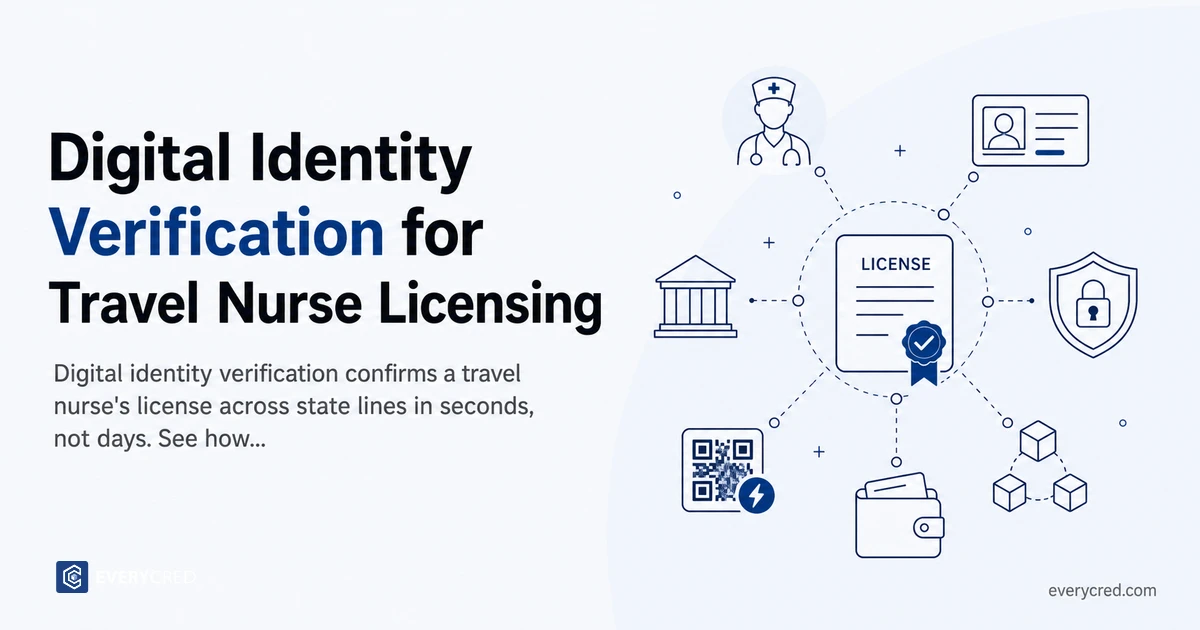
- Why Travel Nurse Licensing Hits the Compact Wall
- What Digital Identity Verification Actually Changes
- License Verification in Seconds, Not Days
- The Real Cost of Re-Verifying Every Placement
- How Health Systems Deploy Digital Identity Verification
- Run a Travel Nurse Credentialing Pilot With Us
- Conclusion
- FAQs


Digital identity verification lets a health system confirm a travel nurse’s license in seconds, across both compact and non-compact states, without repeating primary source checks at every placement. The real bottleneck in travel nurse licensing is not the Nurse Licensure Compact. It is the manual re-verification that runs each time a nurse crosses a state line. A multistate nurse compact license does not cover non-compact states, so credentialing teams re-collect documents and re-run license verification again and again.
This guide is written for staffing directors, credentialing managers, and workforce compliance leads. It explains how portable, cryptographically signed credentials replace repeated checks, keep license status current in real time, and stop a lapsed license from pulling a nurse off the schedule mid-assignment.
Key Takeaways
- Manual license verification costs $15 to $25 per check. Cryptographic verification costs under $0.10 and returns a result in seconds.
- A multistate nurse compact license does not cover non-compact states such as California and New York, so travel nurses still need separate single-state license verification.
- Real-time revocation flips a credential to invalidate the moment a license lapses or is suspended, so every verifier sees the current status.
- EveryCRED issues W3C Verifiable Credentials 2.0 that connect to existing credentialing and staffing systems through REST API, with no front-end changes.
Why Travel Nurse Licensing Hits the Compact Wall
The Nurse Licensure Compact lets a nurse hold one multistate license and practice in more than 40 compact states. It was built to reduce licensing friction, and for compact-to-compact moves, it works well. The gap appears at the edges of the compact.
Non-compact states set their own rules. According to the National Council of State Boards of Nursing, states such as California and New York require their own single-state license, which a compact credential does not replace. A travel nurse moving into one of these states needs fresh license verification before the first shift.
Consider a nurse who accepts a 13-week assignment in California. Her multistate license does not transfer, so the agency must verify a separate California license before her start date. Hospital accreditation and federal payer rules require primary source verification of licensure at each placement, so the same nurse gets re-verified by every new employer. When a credential lapses or a disciplinary action surfaces mid-assignment, she comes off the schedule. That is the compact bottleneck in travel nurse licensing.
What Digital Identity Verification Actually Changes
Digital identity verification replaces document inspection with cryptographic proof. The issuer, a licensing board or credentialing body, signs a credential. The nurse holds it in a secure wallet. Any verifier checks the signature against the issuer’s public key and gets a definitive answer.
This is the verify-once, trust-everywhere model. A credential issued for one assignment stays valid for the next, so the nurse is not re-proofed from scratch by every employer. For a deeper primer, EveryCRED covers the mechanics in its guide to digital identity verification.
The approach fits healthcare credentialing because it removes the issuer from the verification step. A hospital does not call the board or wait in a queue. It reads the credentials and confirms authenticity locally. EveryCRED applies the same method across verifiable credentials in healthcare, from medical licenses to nurse compact registrations and continuing education certificates.
License Verification in Seconds, Not Days
A verifier scans a QR code or opens the credential, and the system validates the cryptographic signature in under 10 seconds. The check also queries a revocation registry, so the result reflects license status at that exact moment, not the day the document was issued.
This solves the lapsed-mid-assignment problem directly. If a board suspends a license on Monday, the credential reads as invalid on Tuesday. A staffing team running instant verification sees the change before the nurse reports for a shift.
Two more properties matter for travel nurse licensing. Offline verification works from a cached signature, so checks hold up at rural sites and during network outages. Selective disclosure lets a nurse share only a license number and active status, not a full record, which supports the data minimization that hospitals already practice.
The Real Cost of Re-Verifying Every Placement
Manual license verification is slow and expensive. Each primary source check costs $15 to $25 and can take days when it waits on board callbacks or document re-collection. Across hundreds of placements a year, that spend and delays compound quickly.
Delay is the hidden line item. A nurse who cannot start on day one is an unbilled bed and a unit running short. Every day of credentialing lag is revenue that a health system never recovers.
Fraud raises the stakes further. AI-generated forged documents grew 311% from the first quarter of 2024 to the first quarter of 2025, and the entry cost for a convincing fake now sits under $30. EveryCRED maps the gap between manual checks and automated license verification in its detailed breakdown. Manual reviewers cannot reliably catch this class of forgery, while a cryptographic check rejects any altered credential automatically.
How Health Systems Deploy Digital Identity Verification
Digital identity verification deploys as a layer over existing systems, not a replacement. EveryCRED connects through REST API to credentialing platforms, vendor management systems, and applicant tracking tools, with no front-end changes for recruiters or verifiers.
The platform issues W3C Verifiable Credentials 2.0 and Decentralized Identifiers, and it meets the identity assurance levels in NIST SP 800-63-4 that U. S. federal agencies follow and many health systems adopt. Selective disclosure keeps personal data exposure to a minimum; each check requires.
Scale is proven in the field. EveryCRED’s deployment for Raigad Police cut credential verification from 30 minutes to under 10 seconds and reduced administrative overhead by 85%, with field officers verifying credentials offline. The same engine supports healthcare credentials for licenses, registrations, and staff onboarding. Public health systems, the VA, and university hospitals can procure through Carahsoft on NASA SEWP V and ITES-SW2, which removes a new competitive bid from the deployment timeline.
Run a Travel Nurse Credentialing Pilot With Us
We built EveryCRED so a credential verified once stays verifiable everywhere, which is exactly what multi-state travel nurse licensing needs. Our platform issues tamper-proof, W3C-compliant credentials, checks them in seconds, and revokes them in real time the moment a license status changes. We connect through REST API to your credentialing and staffing systems, and public health systems can deploy through Carahsoft on NASA SEWP V and ITES-SW2. Start with a focused pilot on your next round of cross-state assignments, or download our credential verification guide to map the rollout first. Book a demo to watch digital identity verification handle a live multi-state placement.
Conclusion
Travel nurse licensing slows down at the compact edge, where a multistate license stops and manual checks begin. The fix is not another database to call. It is a portable credential that the nurse carries, and any employer can verify on the spot.
Digital identity verification cuts license verification from days to seconds, keeps status accurate through real-time revocation, and removes the repeated re-proofing that delays start dates. It closes the nurse compact gap without replacing the boards, the compact, or the systems’ credentialing teams already run. As staffing demand keeps crossing state lines, the health systems that adopt portable credentials will fill assignments faster than those still verifying on paper.
FAQs
Does a nurse compact license cover every U. S. state?
No. A multistate compact license covers only compact states; non-compact states like California still require a separate single-state license.
How does digital identity verification speed up travel nurse licensing?
It lets verifiers confirm a cryptographically signed license in seconds, removing repeated primary source checks at each new placement.
What happens if a travel nurse’s license lapses mid-assignment?
Real-time revocation marks the credential as invalid instantly, so the next license verification shows the lapse before the nurse works.
Can verifiable credentials integrate with our existing credentialing system?
Yes. EveryCRED connects through REST API with no front-end changes to your VMS, credentialing, or staffing system.
Are these digital credentials accepted across state lines?
Yes. W3C Verifiable Credentials follow open standards, so any verifier can confirm authenticity regardless of the issuing state.