10th February, 2026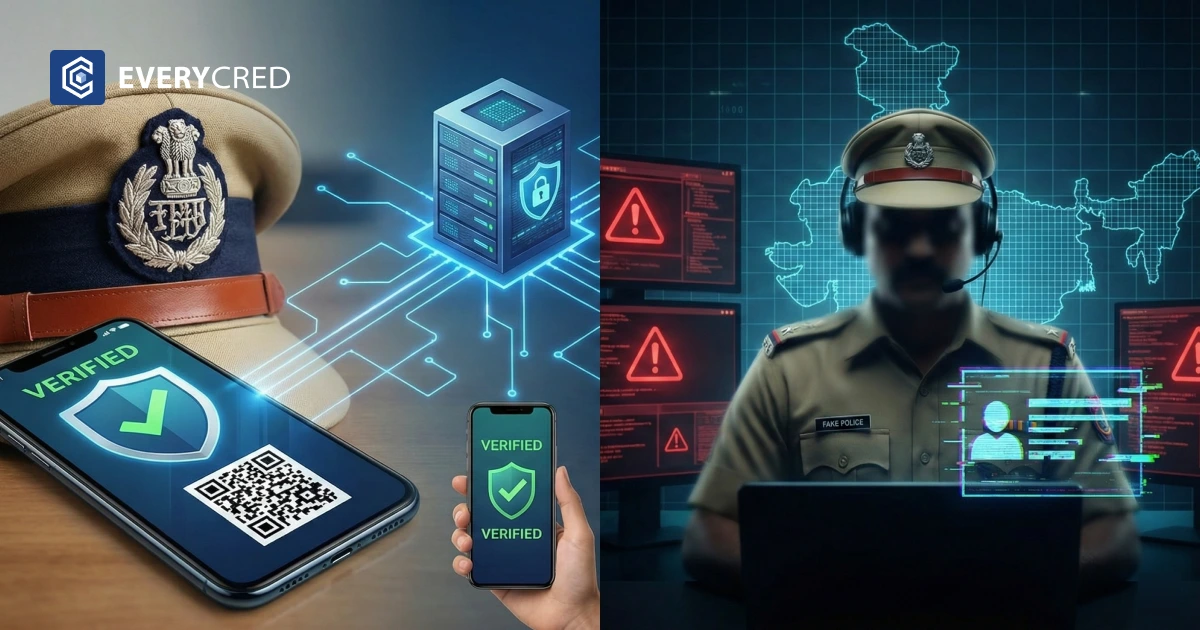


The Indian public faces a significant and growing threat from cybercriminals impersonating law enforcement officials. This issue severely undermines public trust in legitimate authority.
The primary driver of this current crisis is the rise of the “digital arrest” scam. These complex frauds rely entirely on the inability of citizens to distinguish between a real officer acting remotely and a criminal using a fake police identity.
Implementing robust digital police identity verification systems is no longer an optional upgrade; it is an operational necessity for modern policing in India.
Here, we will discuss the identity fraud targeting law enforcement, the role of verifiable credentials as a solution, and real-world applications already underway in India.
Cases of Digital Arrest Scams Are on the Rise
The Ministry of Home Affairs and various state police forces have flagged the “digital arrest” as a major cybercrime threat. In these scenarios, fraudsters use video calling platforms like Skype or WhatsApp. They wear professional police uniforms and sit against elaborate fake backgrounds resembling police stations, CBI headquarters, or Narcotics Control Bureau offices.
They use forged documents, such as FIRs and arrest warrants carrying official-looking seals, to intimidate victims into transferring large sums of money to “verify” their assets or avoid immediate arrest.
The success of a digital arrest hinges on visual deception. The criminals leverage the authority associated with police uniforms and official rhetoric. A recent high-profile case saw the chairman of the Vardhman Group defrauded of ₹7 crores by individuals posing as CBI officials via video call. The scale of this problem is immense.
The Indian Cyber Crime Coordination Centre (I4C) reported that between January and April 2024, Indians lost over ₹120 crore due to digital arrest scams alone.
The current inability of a citizen to instantly and reliably verify an officer’s credentials over a digital channel creates a permissive environment for fake police to operate with impunity.
The Legal and Operational Vulnerability
The transition to digital policing tools in India has outpaced the development of secure identity infrastructure. The new Bharatiya Nyaya Sanhita (BNS) allows for the service of electronic summons. This is a necessary step towards modernization. However, legal experts highlight a critical gap: there is no current statutory mandate for how these electronic interactions must be authenticated.
This asymmetry leaves citizens vulnerable. They cannot verify if a video call interrogation is a legitimate police procedure or the work of a criminal with a fake police identity. Without a standardized, government-issued digital ID for police, citizens default to suspicion. This erosion of public trust hinders genuine investigations.
Officers on the ground also face friction during routine duties because their physical badges are known to be easily counterfeited by criminals. For a deeper dive into the mechanics of these credentials, read our analysis on digital identity verification for law enforcement.
Verifiable Digital Credentials Can Be the Best Solution
The solution to this identity crisis lies in moving beyond static physical ID cards or simple PDF documents, which are easily forged. Modern digital police identity verification requires cryptographically secure, verifiable credentials (VCs). These are decentralized identities often anchored on a blockchain ledger.
Unlike a photograph of a badge, a VC cannot be altered via Photoshop or generative AI without breaking its digital signature. A verifiable digital ID for police allows an officer to present a dynamic QR code or a secure digital link.
The citizen scans this code using a standard smartphone camera. The system instantly confirms the officer’s current rank, unit number, and active duty status directly against the official police database.
Crucially, if an officer is suspended, retired, or transferred, the police department can revoke the digital credential immediately. The next time someone scans that officer’s QR code, it will show as invalid. This real-time validation capability is impossible with traditional physical badges. This immediate verification is essential for rebuilding trust in public services.
Check our analysis of verifiable credentials in digital lockers, which explains the technical synergy of these integrations.
Case Study: Raigad Police and DigiLocker Integration
On August 15, 2025, the Raigad Police in Maharashtra became the first law enforcement agency in India to fully digitize its officer identification system. This project addressed the systemic risks of fake police identity and lost physical credentials. Working with EveryCRED, the department issued secure, blockchain-backed digital ID for police to all personnel.
The system integrates directly with DigiLocker, the official government document wallet. This ensures that every digital police identity verification is anchored to a verified Aadhaar record. Citizens scan a QR code on an officer’s mobile device to see their name, rank, and status. This process reduced verification times from 30 minutes to under 10 seconds.
Beyond field verification, the system automates administrative tasks. Updates for promotions appear in the digital credential in real-time. This prevents the misuse of outdated credentials by a fake police actor.
The initiative also included “Nyaya Sarthi,” an AI tool for drafting FIR-ready complaints. Since implementation, administrative workloads for ID management decreased by 85%, increasing public trust.
Read the full case study here: Raigad Police Goes Digital: India’s First DigiLocker-Integrated Police ID System
Critical Use Cases for Law Enforcement
Implementing a digital ID for police extends beyond preventing digital arrest scams. It improves efficiency across various operational scenarios.
- Secure Digital Communications: When officers must conduct initial inquiries via video or phone, they can provide a verifiable link beforehand. This proves their identity before the interaction begins, neutralizing the fake police identity threat vector used by scammers.
- On-Street Verification: During traffic stops, checkpoints, or public interactions, citizens can verify an officer’s authority instantly. This reduces friction during encounters and builds public trust.
- Inter-Agency Cooperation: When officers from different state cadres or central agencies (like the CBI, NIA, or ED) collaborate on joint task forces, rapid mutual identity verification is crucial. A standardized digital police identity verification system facilitates seamless joint operations.
- HR and Recruitment: Verifiable credentials streamline internal department processes. Departments can issue secure, unforgeable credentials for training completions, firearms certifications, promotions, and specialized authorizations.
The EveryCRED Approach to Secure Identity
The deployment of high-security credentials requires infrastructure designed specifically for government standards. EveryCRED provides the necessary technological backbone for issuing and managing decentralized, tamper-proof identities. The platform ensures that credentials are cryptographically secure and instantly verifiable without relying on manual checks.
For law enforcement agencies fighting the growing menace of fake police, EveryCRED offers “Govt-Grade” security capabilities. The platform is designed to integrate with existing national frameworks. This allows departments to issue a digital ID for police that is both secure and easily accessible to authorized personnel.
By utilizing EveryCRED’s infrastructure, police forces can deploy a system that actively prevents digital arrest scenarios by arming officers with unforgeable proof of identity. Learn more about our specific public sector solutions.
Conclusion
The reliance on easily forged physical badges is unsustainable in the current digital threat landscape. The prevalence of fake police identity cases and the high financial costs of digital arrest scams demand immediate modernization of police identification systems. Adopting verifiable digital police identity verification is the only viable path forward. It secures police operations, protects citizens from fraud, and is essential for restoring and maintaining public trust in Indian law enforcement institutions. We’re backed by AI company who build enterprise level government solutions for public