20th January, 2026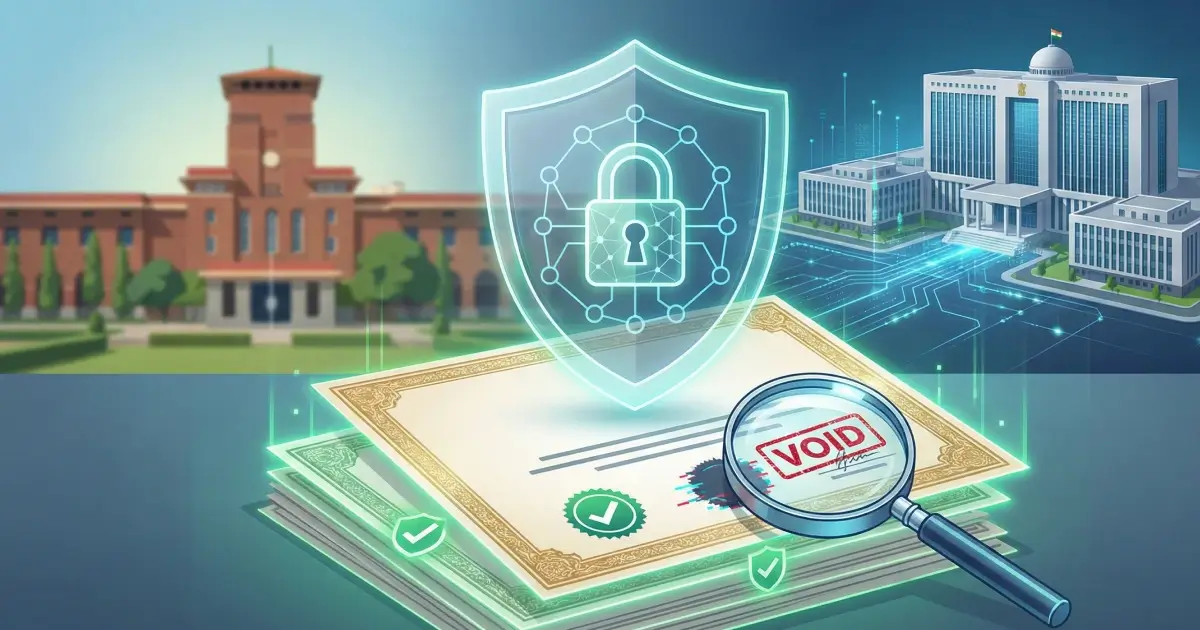
- The Current State of Credential Fraud in India
- Why Traditional Verification Fails
- Adopt Verifiable Credentials for Government Recruitment
- Strengthen Education Sector Integrity
- Technical Foundation of Trustless Verification
- Implement EveryCRED for Fraud Prevention
- Economic Impact of Fraud-Driven Leads
- Conclusion


The prevalence of fraudulent academic records in India presents a significant challenge for government bodies and educational institutions.
Recent data indicates that approximately 28% of job applicants in India submit documents with some form of educational discrepancy. For high-stakes recruitment in government and education sectors, the presence of unverified candidates compromises organizational integrity and public safety.
Implementing a robust system for fake degree verification India is no longer optional. Organizations must transition from manual document checks to a digital ecosystem centered on verifiable credentials.
The Current State of Credential Fraud in India
Educational fraud in India has evolved from simple physical forgeries to sophisticated digital manipulations. Major scandals, such as the Manav Bharti University case involving the sale of over 36,000 fake degrees, highlight the scale of the issue. According to the Enforcement Directorate (ED), the proceeds from this specific scam amounted to approximately ₹387 crore.
Employers frequently encounter candidates who present certificates from non-existent institutions or “diploma mills” that mimic the names of recognized universities. This environment necessitates a shift toward credential verification processes that provide instant, tamper-proof results.
Why Traditional Verification Fails
Manual credential verification relies on physical document inspection, email correspondence with registrars, and third-party background check agencies. These methods are prone to several failures:
- Time Inefficiency: Traditional verification can take between 15 to 45 days, delaying critical hiring decisions in government departments.
- Administrative Burden: Educational institutions spend significant resources responding to verification requests, diverting staff from core academic duties.
- Susceptibility to Forgery: High-quality digital scanners and editing software allow fraudsters to create near-perfect replicas of official seals and holograms.
- Lack of Real-time Updates: A degree verified five years ago may not reflect recent revocations or disciplinary actions.
To address these vulnerabilities, EveryCRED provides a blockchain-based platform for issuing verifiable credentials that eliminate the possibility of tampering.
Adopt Verifiable Credentials for Government Recruitment
The Indian government is increasingly adopting decentralized technology to secure public records. The National Blockchain Framework (NBF) has already enabled the secure verification of over 34 crore documents.
Government recruitment agencies must prioritize fake degree verification India to ensure that only qualified individuals enter the public workforce. By utilizing EveryCRED’s technology, departments can issue appointment letters and certifications as verifiable credentials. This ensures that every document is anchored to a secure ledger, allowing for instant authentication by any authorized party.
| Feature | Manual Verification | EveryCRED Blockchain Verification |
| Verification Speed | 15–45 Days | Under 5 Seconds |
| Data Integrity | Vulnerable to editing | Tamper-proof Hashing |
| Cost per Check | High (Labor intensive) | Low (Automated) |
| User Control | Limited | Decentralized Identity (DID) |
Implementing these systems aligns with the top 5 benefits of verifiable credentials in higher education by streamlining administrative workflows and enhancing the value of legitimate degrees.
Strengthen Education Sector Integrity
Educational institutions are the primary issuers of academic records. When a university’s credentials are easy to forge, the brand value of the institution diminishes. Universities must adopt a digital-first approach to credential verification to protect their graduates and reputation.
By integrating EveryCRED’s issuance API, universities can provide students with digital versions of their degrees. These verifiable credentials reside in a secure digital wallet, allowing graduates to share their achievements with employers instantly. This method removes the need for students to request “transcript verification” repeatedly.
Our guide on blockchain digital credentials: secure document solutions 2025 explains how these systems create a permanent, immutable link between the issuer and the recipient. This technological layer effectively eliminates the market for fake degree verification India by making fraudulent documents impossible to validate against the official ledger.
Technical Foundation of Trustless Verification
EveryCRED utilizes Decentralized Identifiers (DIDs) and cryptographic hashing to secure data. When an institution issues a degree, the system generates a unique hash of the document. This hash is stored on a permissioned blockchain.
When an employer performs credential verification, the platform compares the presented document against the stored hash. If even a single character in the document has been altered, the verification fails. This process ensures that verifiable credentials remain the most secure method for identity and achievement management.
The shift toward this technology is visible in public safety initiatives as well. For example, the Raigad Police Force Case Study demonstrates how government entities can use secure digital IDs to improve operational efficiency and public trust.
Implement EveryCRED for Fraud Prevention
To effectively reduce the risk of fraud, organizations must integrate verification into the initial stages of the hiring funnel. Waiting until the final background check phase often results in wasted time and resources on fraudulent candidates.
- Step 1: Digital Issuance: Universities issue degrees as verifiable credentials at the time of graduation.
- Step 2: Instant Authentication: Employers use a QR-code scanner or API link to perform fake degree verification India during the first interview round.
- Step 3: Permanent Records: The verification status is logged, creating a transparent audit trail for compliance and regulatory requirements.
By focusing on digital identity verification with verifiable credentials, organizations can build a “Trust Ecosystem” where credentials move seamlessly between issuers, holders, and verifiers.
Economic Impact of Fraud-Driven Leads
Fraudulent applications cost Indian businesses millions in lost productivity, legal fees, and re-hiring expenses. In the government sector, the cost includes the risk to public infrastructure and services. High-intent organizations are now seeking solutions that provide immediate ROI through the elimination of manual processing fees.
EveryCRED’s platform serves as a primary tool for credential verification, reducing the operational expenditure of HR departments by up to 80%. When organizations use verifiable credentials, they remove the friction from the recruitment process. This speed is critical for government departments that need to fill thousands of positions across various states simultaneously.
Conclusion
The rise of digital document manipulation requires a corresponding rise in digital defense. Relying on paper-based systems or traditional email checks is insufficient to stop professional degree rackets.
For government agencies and educational institutions, the path forward involves the mass adoption of verifiable credentials. This technology provides the only definitive solution for fake degree verification India, ensuring that certificates are genuine, tamper-proof, and instantly verifiable.
By choosing EveryCRED, institutions take a proactive step in protecting the integrity of the Indian education system. Our credential verification solutions empower employers to hire with confidence and students to own their academic identity.
Connect with us today and set up a complimentary consultation call with our experts.