20th February, 2026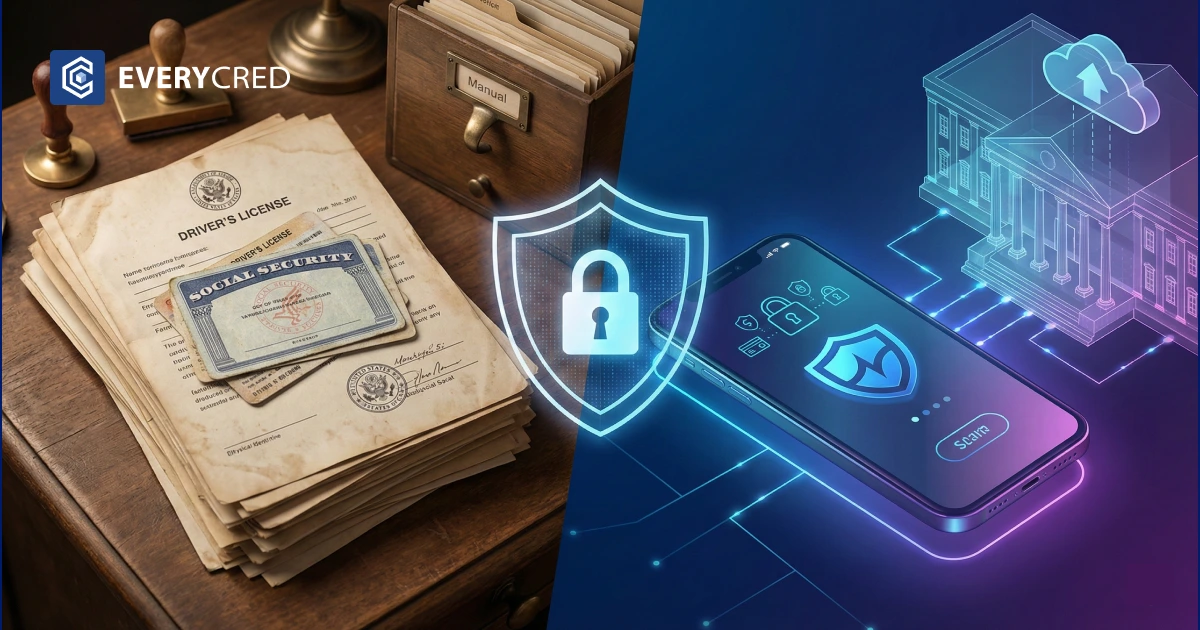


The U.S. Government Accountability Office (GAO) estimates that the federal government loses between $233 billion and $521 billion annually to fraudulent payments. These financial losses affect programs across the entire government, from pandemic-related relief to mandatory spending categories.
At the consumer level, the Federal Trade Commission recorded more than $10 billion in reported fraud losses in recent annual data. Policy leaders face a clear mandate to update infrastructure. Effective identity fraud prevention government strategies require an immediate shift away from legacy verification methods.
Criminal networks increasingly use stolen data to bypass traditional security measures. Fraudsters open synthetic accounts, claim public benefits, and exploit agency vulnerabilities. Government portals that rely on physical document review or static knowledge-based authentication cannot match the speed of modern cybercrime. AI-assisted tools allow bad actors to generate synthetic identities at scale.
The 2025 Identity Fraud Report by Entrust documented a 244% year-over-year increase in digital document forgeries. These statistics demonstrate that manual oversight fails against automated attacks. Agencies must adopt cryptographic systems to secure constituent data and taxpayer funds.
Why Legacy Systems Fail Modern Security Tests
Centralized databases store massive amounts of citizen information in a single location. When attackers breach these systems, they expose millions of sensitive records simultaneously. Agencies that rely on these centralized repositories take on immense liability.
Furthermore, physical documents like paper birth certificates or plastic driver’s licenses lack secure digital validation mechanisms. Agency employees often cannot visually distinguish a high-quality forgery from an authentic document.
The transition to digital credentials solves this vulnerability. Digital credentials represent the digital equivalent of physical identification documents. An issuer, such as a state department of motor vehicles, signs the digital credential with a cryptographic key. The citizen stores this data in a secure digital wallet on their mobile device.
When a citizen applies for a public service, the receiving agency checks the cryptographic signature to confirm authenticity. This mathematical proof eliminates the need for manual document inspection. Agencies can instantly verify that the data came from a trusted source and remains unaltered.
The Architecture of Tamper-Proof Verification
To achieve interoperability across different state and federal departments, agencies must use verifiable credentials. Verifiable credentials follow specific technical standards established by the World Wide Web Consortium (W3C). These standards ensure that a credential issued by one government body can be read and trusted by another. This framework creates a decentralized trust model.
When policy leaders design an identity fraud prevention government framework, they must prioritize decentralization. Decentralized systems do not store personal data on a single government server. Instead, citizens hold their own verifiable credentials on their devices. This structure removes the central target that hackers typically exploit. By distributing data storage to the end-users, governments significantly reduce the risk of mass data breaches.
Adopting blockchain digital credentials provides the immutable ledger required to track the issuance and revocation of these cryptographic keys. The blockchain does not store the citizen’s personal data. It only stores the public keys necessary to validate the digital credentials. This mechanism ensures that if a citizen loses their license, the issuing agency can revoke the credential on the ledger. Any subsequent agency checking that credential will immediately see its invalid status.
Implement Zero-Knowledge Proofs for Citizen Privacy
Privacy concerns often delay the implementation of digital identity systems. Citizens worry that government agencies will track their behavior or store unnecessary personal details. Zero-knowledge proofs address these privacy concerns directly. A zero-knowledge proof allows a citizen to prove a specific fact without revealing the underlying data.
For example, a citizen applying for a senior citizen benefit must prove they are over 65 years old. Using traditional methods, the citizen provides their full date of birth. The agency stores that exact date in its database. Using verifiable credentials equipped with zero-knowledge proofs, the citizen’s digital wallet generates a cryptographic statement confirming they meet the age requirement. The agency receives a simple validation confirmation. The agency never sees or stores the actual date of birth.
This data minimization approach limits agency liability. When public services do not store excess citizen data, they reduce the severity of potential breaches. Digital identity solutions for government must incorporate zero-knowledge proofs to comply with strict privacy regulations and maintain public trust. This technology gives citizens control over their data while providing agencies with the absolute certainty they need to process applications.
Financial and Operational Implications for Agencies
Legacy identity verification creates severe financial burdens for government agencies. Manual document review requires extensive human labor. Employees spend thousands of hours reading physical mail, checking scanned documents, and making phone calls to verify applicant information. These manual tasks delay the distribution of critical public services.
Automated verification systems solve these operational inefficiencies. When a citizen submits verifiable credentials, software validates the cryptographic signature in milliseconds. The system instantly accepts authentic claims and rejects forged data. This automation allows government employees to focus on complex cases rather than routine administrative tasks. Agencies experience lower operational costs and higher accuracy rates.
These operational delays also impact the citizens who require assistance. When families apply for housing support, unemployment benefits, or nutritional assistance, long processing times create significant hardship. Automated processing ensures that citizens receive rapid responses to their applications. Additionally, error rates drop significantly. Human reviewers inevitably make mistakes when verifying thousands of records daily. A cryptographic system removes human error from the authentication process. The digital signature either matches the public key on the ledger or it does not. This binary outcome provides absolute certainty for both the agency and the applicant.
Furthermore, eliminating synthetic identity fraud directly protects the federal budget. Every fraudulent claim paid out represents a direct loss to the taxpayer. By requiring mathematically verifiable digital credentials, governments close the vulnerabilities that organized crime rings exploit. This approach ensures that public funds reach the intended recipients.
Build a Resilient Identity Infrastructure
Policy leaders must establish clear roadmaps for upgrading verification systems. The first step involves modernizing the issuance process. State and federal agencies must develop the capability to issue digital credentials alongside physical documents. They must also define the specific technical standards they will use. Using open standards ensures that verifiable credentials remain readable across different jurisdictions and software platforms.
The second step requires integrating automated government verification systems into existing public service portals. Manual background checks cause severe bottlenecks in service delivery. Automated systems process verifiable credentials instantly. This efficiency reduces operational costs and speeds up benefit distribution for eligible citizens. Policy makers should mandate that all new digital portals support W3C-compliant digital credentials by default.
Third, governments must invest in public education. Citizens need clear instructions on how to download digital wallets, accept digital credentials, and use them to access services. Agencies should provide secure, accessible options for individuals who lack access to modern smartphones. A successful identity fraud prevention government strategy requires high adoption rates among the general public.
Finally, agencies must continuously monitor the threat landscape. Fraudsters will attempt to exploit the devices holding the credentials or the processes used to issue them initially. Robust identity proofing at the point of issuance remains critical. If an agency issues valid digital credentials to a synthetic identity, the entire trust framework collapses. Therefore, agencies must combine cryptographic verification with advanced biometric checks during the initial onboarding phase.
Secure the Future of Public Service Access
The transition to cryptographic verification represents a necessary structural change for public administration. The financial losses associated with identity theft drain critical resources from government programs. Relying on outdated methods ensures continued vulnerability to sophisticated cybercrime rings. Policy leaders have a responsibility to secure public systems using the most reliable mathematical models available.
The core element of this modernization effort is the adoption of verifiable credentials. Why verifiable credentials are essential becomes clear when analyzing the reduction in application processing times and the elimination of forged documents. They provide a unified, interoperable standard for proving identity claims across all levels of government.
Agencies require reliable infrastructure to manage the issuance and verification of these digital assets. EveryCRED provides a W3C-compliant platform designed to generate, issue, and verify cryptographic digital credentials at scale. The platform automates the verification process, eliminates manual document review, and supports zero-knowledge proofs for citizen privacy.
By integrating EveryCRED’s capabilities, public sector organizations can establish a tamper-proof identity architecture that meets stringent 2026 security standards and fully protects public resources.
Connect with our team at admin@everycred.com.
Conclusion
Identity fraud prevention government initiatives cannot rely on temporary software patches. The volume and sophistication of modern fraud require a fundamental upgrade to digital verification processes. By adopting decentralized architectures, government agencies can mathematically prove data authenticity. This approach protects taxpayer funds, reduces operational bottlenecks, and secures citizen privacy. Policy leaders who implement these systems today will build a resilient framework capable of withstanding automated threats.