1st July, 2026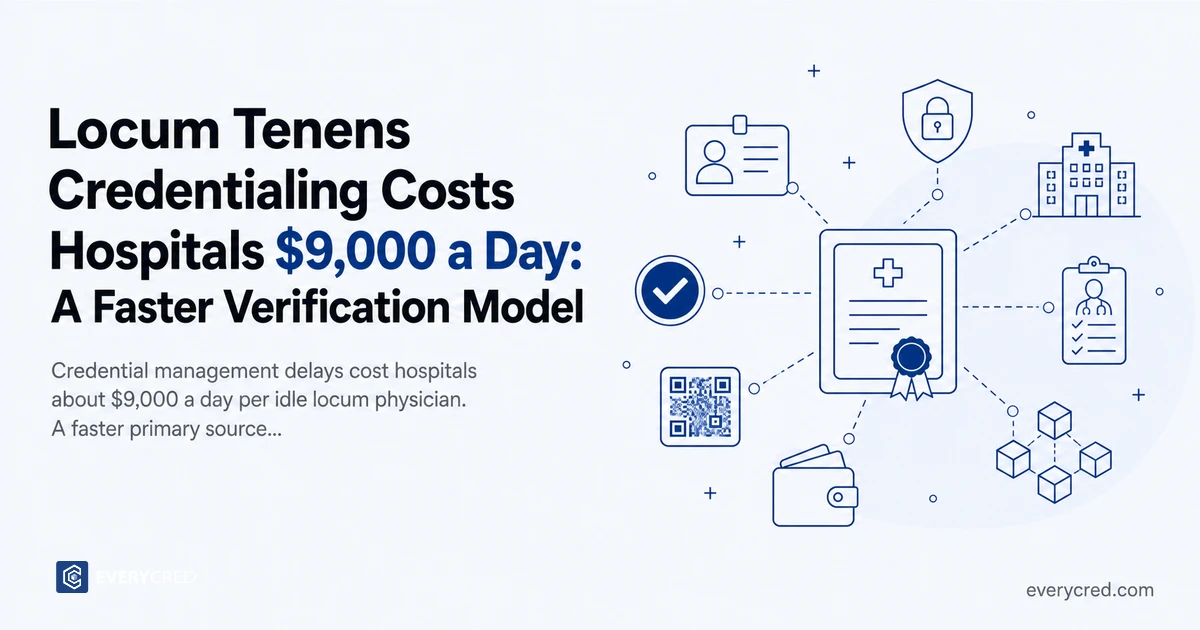
- Why Manual Credential Management Stalls Locum Tenens Onboarding
- What a $9,000-a-Day Onboarding Delay Really Costs
- Why Primary Source Verification Repeats at Every Facility
- A Faster Credential Management Model for Locum Physicians
- How Health Systems Deploy Portable Provider Credentials
- Cut Locum Credentialing Delays With EveryCRED
- Conclusion
- FAQs


Hospitals lose roughly $9,000 a day in net revenue for every locum tenens physician who cannot work while credentialing runs its course. The process drags 60 to 120 days, and most of that delay sits inside manual credential management and repeated primary source verification. The fix is a verification model that issues a provider’s credentials once and lets any facility confirm them in seconds.
This guide explains why locum tenens credentialing takes so long and what slow provider onboarding actually costs. It then shows how verifiable credentials cut the timeline from months to days. It is written for medical staff offices, credentials verification organizations, and the health system leaders who carry the cost of idle providers.
Key Takeaways
- Hospitals lose about $9,000 a day in net revenue per locum physician who cannot work during credentialing.
- Manual locum tenens credentialing runs 60 to 120 days, largely because primary source verification repeats at every facility and state.
- Manual verification costs $15 to $25 per check; verifiable credentials confirm in seconds for under $0.10 per check.
- Cryptographically signed credentials are verified once and trusted everywhere, with revocation in seconds when a license status changes.
- EveryCRED meets W3C VC 2.0 and NIST SP 800-63-4 and integrates through a REST API, with no rip-and-replace.
Why Manual Credential Management Stalls Locum Tenens Onboarding
Locum tenens credentialing is slow because every fact about a provider is checked by hand against the source that issued it. A typical file requires verification of several items at once:
- Medical school and residency or fellowship training.
- Current state medical licenses, often in several states at the same time.
- Board certification status and DEA registration.
- Work history, malpractice history, and prior hospital privileges.
Each item moves at the speed of the slowest responder. One state board or training program that takes three weeks to reply sets the timeline for the entire file.
For a locum physician, this repeats at every assignment. The same credentials verified in one state last month are re-verified from scratch in another this month. The reason is that credential management lives in separate systems that do not trust each other.
What a $9,000-a-Day Onboarding Delay Really Costs
The cost of slow provider onboarding is not abstract. A physician working a full schedule represents roughly $9,000 a day in net billings. A hospital forfeits that revenue while the file sits in review.
Stretch that across a 90-day credentialing cycle, and a single delayed locum can represent several hundred thousand dollars in deferred revenue. Multiply it by a roster of temporary physicians covering gaps, and the number scales quickly.
Consider a 250-bed health system that brings in a locum hospitalist to cover a staffing shortage. If onboarding runs 75 days instead of 15, the facility loses about 60 days of billable coverage. It also pays agency premiums to hold the physician in place.
Slow credentialing also forces clinical trade-offs. Existing staff absorb extra shifts, departments cap admissions, and patient access narrows while the file clears. The cost lands on every healthcare credential management team that still runs verification by hand.
Why Primary Source Verification Repeats at Every Facility
Primary source verification is the core of credentialing. It confirms a credential directly with the body that issued it, rather than trusting a copy the provider supplies.
The problem is that the result stays locked inside one organization. When the same physician applies to a new hospital, that hospital cannot reuse the prior check and starts over.
Paper and PDF documents make this worse. AI-generated forged documents grew 311% from the first quarter of 2024 to the first quarter of 2025. A convincing fake now costs under $30 to produce.
So every facility re-runs primary source verification to protect itself, and locum physicians pay for it in repeated onboarding across states. Automated license verification removes most of that duplicated manual effort.
A Faster Credential Management Model for Locum Physicians
A faster model issues each provider credential once as a verifiable credential, then lets any facility confirm it instantly. The credential is signed by the issuing source and anchored to a blockchain record. Any tampering breaks the signature and shows up at verification.
Verification takes seconds and costs under $0.10 per check, against $15 to $25 for a manual check. A verifier scans a QR code, the signature validates, and the result is logged to an immutable audit trail.
The model rests on open standards. EveryCRED follows the W3C Verifiable Credentials Data Model 2.0 and meets NIST SP 800-63-4 identity assurance, so credentials stay valid and portable across systems.
Two capabilities matter most in healthcare. Revocation takes effect in seconds when a license is suspended, and selective disclosure lets a hospital confirm an active license without exposing the provider’s full record. This is modern verifiable credentials in healthcare applied to staffing.
How Health Systems Deploy Portable Provider Credentials
Adoption does not require replacing the credentialing systems a medical staff office already runs. EveryCRED adds a verifiable credential layer through a REST API, so existing workflows and databases stay in place.
State medical boards, training programs, and health systems act as issuers. Each signs the credentials it already controls, such as a license, a board certification, or a privilege grant.
Providers hold those credentials in a secure wallet and present them at any new facility. A locum physician licensed in four states carries one verified set of credentials instead of restarting provider onboarding at every site. EveryCRED’s approach to portable credential verification is built for exactly this movement.
The result is a credential management process that compresses onboarding from months to days while keeping a complete, audit-ready record of every verification.
Cut Locum Credentialing Delays With EveryCRED
We built EveryCRED to remove the verification delay that keeps locum physicians idle. Credentials are issued once as verifiable credentials, then confirmed at any facility in seconds for under $0.10 per check, with revocation in seconds when a license status changes.
The platform meets W3C VC 2.0 and NIST SP 800-63-4. It integrates with existing credentialing systems through a REST API, and it is proven in live government deployments at scale.
US health systems can procure through Carahsoft on NASA SEWP V and ITES-SW2, with no new competitive bid. Book a demo to scope a locum credentialing pilot.
Conclusion
Locum tenens credentialing does not have to take 60 to 120 days. The delay comes from manual primary source verification that repeats at every facility, and the bill arrives as roughly $9,000 a day in lost revenue per idle provider.
Verifiable credentials change the economics. A provider’s credentials are verified once, signed cryptographically, and confirmed anywhere in seconds. That turns provider onboarding from a quarter-long project into a days-long step.
Health systems that modernize credential management now will fill coverage gaps faster, protect revenue, and keep an audit-ready trail of every check. The verification layer already exists; the next step is putting it to work.
FAQs
How long does locum tenens credentialing usually take?
Manual locum tenens credentialing typically takes 60 to 120 days because primary source verification repeats at every facility.
How much does a credentialing delay cost a hospital?
Hospitals lose roughly $9,000 a day in net revenue for each locum physician who cannot work during credentialing.
What is primary source verification in provider credentialing?
Primary source verification confirms a credential directly with the body that issued it, not a copy the provider supplies.
Can verifiable credentials speed up provider onboarding?
Yes. Credentials verified once are confirmed at any facility in seconds, cutting provider onboarding from months down to days.
Does EveryCRED replace our existing credentialing system?
No. EveryCRED adds a verifiable credential layer through a REST API, so existing credentialing workflows and databases stay in place.