31st March, 2026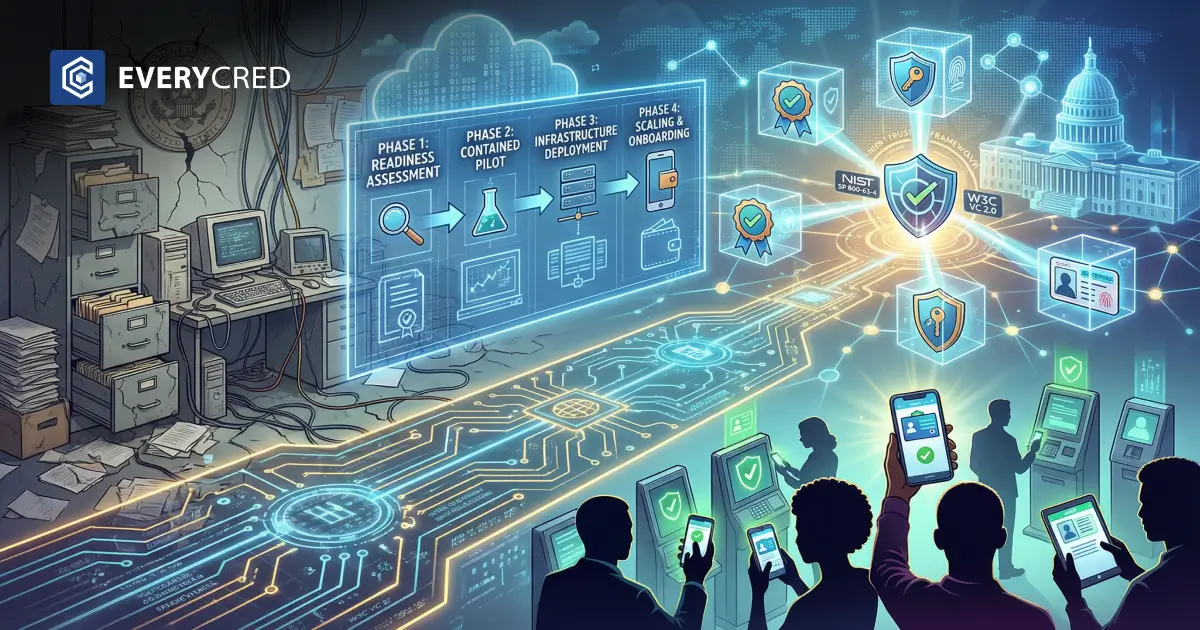
- Federal IT Has a $100 Billion Legacy Problem It Cannot Ignore
- Verifiable Credentials Are a Technical Standard, Not a Concept
- Two Finalized Federal Standards Make Deployment Possible Right Now
- The Deployment Blueprint: Four Phases That Build on Each Other
- Cross-Department Interoperability Is What Separates a Pilot from a Scaled System
- Vendor Lock-In Is a Real Procurement Risk. Here Is How to Prevent It.
- EveryCRED Provides the Credential Infrastructure Built for Government IT Teams
- Conclusion


Federal and state IT teams face a specific, documented problem. Government systems handle billions of citizen interactions each year. Most of the infrastructure supporting those interactions was built decades ago.
The result is slow service delivery, persistent document fraud, and IT budgets consumed by maintenance rather than modernization. Digital government transformation requires a concrete technical path forward. Verifiable credentials provide that path, and the standards to deploy them are now finalized.
Here, we have discussed what federal and state IT decision-makers need to move from legacy document workflows to a functioning, standards-compliant credential system.
Federal IT Has a $100 Billion Legacy Problem It Cannot Ignore
The U.S. government spends over $100 billion on IT annually. According to a 2025 GAO report, most of that budget maintains aging legacy systems that are costly to secure and difficult to upgrade. Many federal agencies lack documented modernization plans, which increases the likelihood of cost overruns and project failure.
The operational failures these systems produce are well documented:
- Different departments store citizen data in isolated databases that cannot share information with each other
- Citizens submit the same information repeatedly to different agencies
- Manual document inspection fails to detect sophisticated forgeries
- Centralized data storage creates high-value targets where a single breach compromises millions of records at once
Digital government transformation slows when agencies treat modernization as a full system replacement. The more practical approach is to deploy new credential infrastructure alongside existing systems and scale from specific, high-impact workflows.
Verifiable Credentials Are a Technical Standard, Not a Concept
A verifiable credential is a tamper-evident digital record. The issuing authority signs it using a cryptographic private key. Any system receiving the credential confirms its authenticity using the corresponding public key without querying a central database.
For government IT, this resolves three direct operational problems:
- Instant verification: The cryptographic check completes in milliseconds with no manual review required
- Tamper resistance: Any modification to the credential automatically invalidates the cryptographic signature
- Selective disclosure: Citizens share only the specific data points a transaction requires, keeping unrelated personal information protected
Government agencies currently issue driver’s licenses, professional permits, and benefit allocations as static files or physical documents. Converting these to verifiable credentials removes the manual verification step and makes document fraud technically impractical. The model applies broadly across public sector services including identity cards, property records, law enforcement credentials, and contractor access clearances.
Two Finalized Federal Standards Make Deployment Possible Right Now
Government IT teams do not need to wait for regulatory clarity. The foundational standards are published and in effect.
In July 2025, NIST released the final version of SP 800-63, Revision 4. The NIST SP 800-63-4 guidelines formally incorporate verifiable credentials and digital wallets into the federal identity assurance model. NIST explicitly recognizes digital wallets as signed assertion mechanisms with assurance levels equivalent to traditional federated identity providers.
In May 2025, the W3C published Verifiable Credentials 2.0 as an official Web Standard. The specification defines how credentials are structured, cryptographically secured, and verified across different systems. It also includes Bitstring Status List, a privacy-preserving mechanism for managing credential revocation in real time.
Decentralized identity infrastructure built on these two frameworks qualifies under the GSA FICAM governance model, which governs federal access management policy. Agencies have the compliance basis they need. The remaining question is how to deploy.
The Deployment Blueprint: Four Phases That Build on Each Other
The most common mistake in government modernization is scoping a complete identity system replacement in a single project cycle. The correct model adds verifiable credential capability to specific workflows first, then expands.
Phase 1: Readiness Assessment
- Audit existing identity databases and map every service that depends on manual verification
- Identify services with the highest fraud exposure or the most citizen friction
- Document current key management practices and data access policies
- Define the Level of Assurance required per service type under NIST SP 800-63-4
Phase 2: Contained Pilot Program
- Select one specific use case: employee ID issuance, contractor access credentials, or professional license verification
- Set measurable targets for verification speed, error rate, and failure rate before launch
- Test issuance, presentation, and revocation under controlled conditions with a small user group
- Measure results directly against the legacy verification process the pilot replaces
Phase 3: Infrastructure Deployment
- Deploy issuer and verifier engines connected to existing databases via standard REST APIs
- Build a revocation registry that updates credential status in real time across all verification points
- Run load tests before public launch, specifically covering peak service demand periods
- Operate the verifiable credential layer in parallel with existing OAuth or SAML flows during transition
Phase 4: Scaling and Citizen Onboarding
- Release digital wallet applications across major mobile platforms
- Build device recovery procedures into the rollout plan before any public launch
- Expand the credential set incrementally using infrastructure already in place
- Track adoption metrics and adjust citizen-facing communications based on real feedback data
The full decentralized identity implementation roadmap provides detailed technical specifications for each of these phases.
Cross-Department Interoperability Is What Separates a Pilot from a Scaled System
A credential issued by a state health department must be readable by a federal benefits agency. That requires both systems to use the same open standards consistently.
The W3C Verifiable Credentials specification and ISO/IEC 18013-5 for mobile driver’s licenses are the two dominant formats in active government deployment. Key interoperability requirements include:
- W3C-compliant credential schemas used consistently across all issuing agencies
- OpenID for Verifiable Credential Issuance (OID4VCI) protocol for secure wallet delivery to citizens
- A shared trust registry that all verifying agencies can query to confirm credential validity in real time
Decentralized identity architecture eliminates the central database synchronization problem entirely. Each agency operates its own issuer node. Credentials travel with the citizen. This is where digital government transformation moves beyond individual agency pilots to a connected, state-to-federal credential ecosystem. A streamlined credentials verification process across departments removes redundant submissions and cuts processing time measurably.
Vendor Lock-In Is a Real Procurement Risk. Here Is How to Prevent It.
Government contracts frequently create long-term vendor dependency. To prevent this during procurement:
- Require W3C VC 2.0, NIST SP 800-63-4, and FIDO compliance in all RFP documents
- Confirm the agency retains full ownership of cryptographic keys, issuer profiles, and credential schemas at all times
- Distribute infrastructure nodes across multiple cloud providers and on-premise government servers
- Reject proprietary credential formats that independent verifier software cannot read
Decentralized identity architecture reduces vendor dependency by design. The standardized data format is separable from the software that processes it. Defining a trust framework policy before procurement also establishes which departments can issue which credential types, which prevents scope conflicts during contract negotiation. For structured procurement criteria, the public sector platform buyer guide covers the key evaluation points government IT teams should use.
EveryCRED Provides the Credential Infrastructure Built for Government IT Teams
EveryCRED is a W3C-compliant digital trust platform built for government-grade issuance, verification, and lifecycle management of verifiable credentials. The platform integrates with existing legacy databases through standard REST APIs, so agencies add credential capability without dismantling current systems.
Key platform capabilities relevant to government deployment:
- Cryptographically signed credential issuance delivered directly to citizen digital wallets
- Real-time revocation registry that propagates status changes across all verification points immediately
- One-click credential verification for field officers and agency staff via QR scan
- Open-standard schemas that support cross-department interoperability out of the box
- Immutable audit logs for every issuance and verification event for full regulatory compliance
For agencies running large-scale fraud prevention programs or managing contractor and vendor access within a single compliance framework, EveryCRED handles both use cases through one trust infrastructure. Government IT teams can schedule a technical assessment with EveryCRED to define a pilot scope and evaluate deployment fit against current agency infrastructure.
Conclusion
Verifiable credentials are a deployment-ready technology for digital government transformation. Federal and state agencies have the policy frameworks in place: NIST SP 800-63-4, W3C VC 2.0, and the GSA FICAM governance model.
The deployment path is clear. Assess current infrastructure. Run a contained pilot. Integrate through open APIs. Expand using standards-compliant credential schemas. Prevent vendor lock-in through RFP requirements. Decentralized identity architecture supports each of these steps without requiring agencies to remove existing systems in a single project cycle.
Agencies that act on this now will build the operational foundation that public service delivery will depend on for the next decade.