31st July, 2026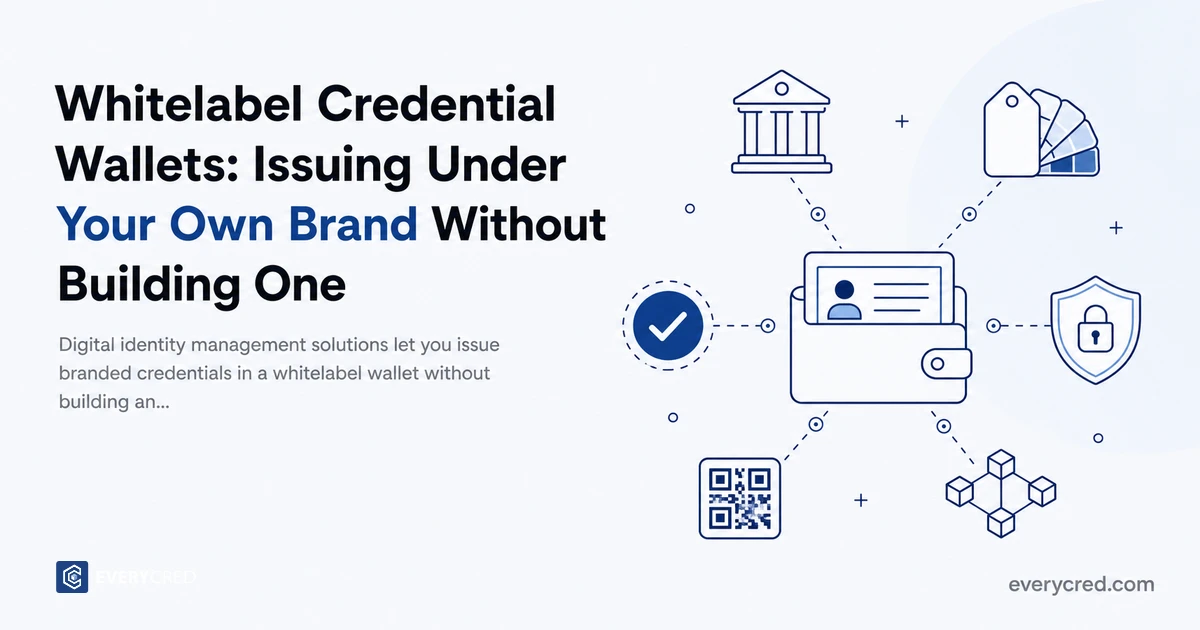
- What a Whitelabel Credential Wallet Actually Is
- Why Building a Holder App In-House Rarely Pays Off
- How Whitelabel Digital Identity Management Solutions Work
- Where Branded Credentials Deliver the Most Value
- Choosing Digital Identity Management Solutions: A Buyer's Checklist
- Deploy a Branded Wallet with EveryCRED
- Conclusion
- FAQs


Digital identity management solutions now let organizations issue credentials in a branded wallet without building a mobile app from scratch. A whitelabel wallet reskins an existing, standards-compliant holder app with your logo, name, and colors. Citizens or employees download your wallet, not a vendor’s.
For government program owners and enterprise HR heads, the problem is familiar. You want people to hold your credentials in an app that carries your brand. You cannot justify the cost, timeline, and security burden of building that app yourself. This guide explains how a whitelabel wallet solves that problem. It covers what branded credentials need underneath and how to evaluate digital identity management solutions before you commit.
Key Takeaways
- A whitelabel wallet gives you a branded holder app in weeks, not the 12 to 18 months an in-house build typically takes.
- Branded credentials still run on open standards such as W3C VC 2.0 and DID v1.1, so they stay verifiable outside your app.
- Building a wallet in-house means funding app store maintenance, cross-platform engineering, and recurring security audits for the life of the program.
- EveryCRED deploys a whitelabel wallet under your brand and connects issuance through a REST API with no front-end changes.
- Manual credential checks cost $15 to $25 each; wallet-based verification runs under $0.10 per check.
What a Whitelabel Credential Wallet Actually Is
The verifiable credentials model has three parties. The issuer creates and signs a credential, the holder stores it, and the verifier checks it. The holder needs somewhere to keep those credentials. That place is a holder app, usually a mobile wallet on iOS and Android.
A whitelabel wallet is a holder app, published under your brand instead of the vendor’s. The screens, icons, app name, and store listing carry your organization’s identity. Underneath, the wallet runs proven credential infrastructure you did not have to write.
Branded credentials work the same way. Each credential displays your seal, colors, and issuing authority, while the cryptographic signature and revocation logic sit beneath the surface. The verifier sees a tamper-proof W3C credential.
EveryCRED ships a standard wallet on both app stores and a white-label wallet that deploys under a client’s own brand. Holders get a secure credential wallet that looks like yours, and you skip the part where you build one. The brand is yours. The engineering is not.
Why Building a Holder App In-House Rarely Pays Off
Building a credential wallet looks simple until you scope it. A production holder app needs native iOS and Android builds, secure key storage, and W3C-compliant credential handling. It also needs DID resolution, offline verification, and a revocation check on every presentation. Each of those is a specialized discipline.
Then it never stops. Apple and Google change store rules and operating systems every year. Cryptographic libraries need patching, and security audits recur. A wallet is not a project you finish. It is software you staff for as long as the program runs.
Consider a state workforce agency that wants to issue occupational licenses in its own app. Public-sector teams researching state government digital wallets hit the same wall. The build estimate covers engineering, not the multi-year maintenance tail, the penetration testing, or the standards work that keeps credentials interoperable. Most program budgets cannot absorb that.
This is why branded credentials are almost always a buy decision, not a build one. What matters to citizens is your brand on the wallet, not the code beneath it. Whitelabel digital identity management solutions let you own the brand and outsource the engineering.
How Whitelabel Digital Identity Management Solutions Work
Modern digital identity management solutions separate the brand layer from the credential engine. You supply brand assets and issuance rules. The provider configures a wallet that already implements the hard parts.
A typical deployment follows a clear path:
- You provide your logo, color palette, app name, and store metadata.
- The provider configures and publishes the whitelabel wallet to the App Store and Google Play.
- Your systems issue credentials through a REST API, with no change to your existing portals.
- Holders receive branded credentials in their wallet and present them by QR code.
- Verifiers confirm authenticity in seconds, online or offline.
The credentials themselves follow open standards. Because they conform to the W3C Verifiable Credentials Data Model 2.0, they remain verifiable by anyone, even outside your app. That standards base is what separates a real credential wallet from a closed PDF viewer.
EveryCRED delivers this as a configured product, not a custom code project. It offers white-label credentials across the issuer, holder, and verifier roles. A branded holder app that would take a year to build in-house deploys in a fraction of that time.
Where Branded Credentials Deliver the Most Value
A branded wallet matters most where trust and recognition drive adoption. Three sectors see the clearest return.
Government. Agencies issue licenses, benefits eligibility, and workforce IDs that citizens must recognize instantly. A wallet carrying the agency seal earns trust that a generic app cannot. Raigad Police deployed digital officer IDs that field officers verify in under 10 seconds, down from 30 minutes. The system works offline, with no network connection. State and federal teams can apply the same model through proven multi-agency identity management. That approach avoids a new build for each department.
Enterprise. HR teams issue employee credentials, training certificates, and contractor compliance records. A branded wallet reinforces the company brand and cuts verification costs from $15 to $25 per manual check to under $0.10. Every credential event is logged to an immutable audit trail.
Across all three, branded credentials do the same job. They put your name on the credential and open standards underneath.
Choosing Digital Identity Management Solutions: A Buyer’s Checklist
Not every whitelabel wallet is equal. Before you choose a provider, confirm these points.
- Open standards: Credentials must follow W3C VC 2.0 and DID v1.1, so they outlive the app and the vendor.
- Store publishing: The provider should handle App Store and Google Play submission under your brand, including reviews and updates.
- Integration: Issuance should run over a REST API with no front-end changes to your existing systems.
- Offline verification: Field and rural use needs cached cryptographic checks that work without a network.
- Revocation: You must be able to invalidate a credential in seconds, and every subsequent check must reflect it.
- Procurement fit: For US agencies, availability on existing contract vehicles avoids a new competitive bid.
These criteria separate durable digital identity management solutions from a thin skin over a fragile app. HR and procurement teams comparing vendors can pressure-test each point against a detailed enterprise identity buyer’s guide. The goal is simple: a branded holder app you control, on infrastructure you did not have to build.
Deploy a Branded Wallet with EveryCRED
We deploy whitelabel wallets that carry your brand while running on W3C-compliant infrastructure, which EveryCRED already maintains. Issuance connects to your existing systems through a REST API. Credentials verify in seconds, online or offline, and holders store branded credentials in an app that looks like yours, not ours. US agencies can procure through Carahsoft on NASA SEWP V and ITES-SW2, with no new competitive bid. The same standards that ran field verification for Raigad Police protect every credential you issue. Book a demo to see a whitelabel wallet configured for your program.
Conclusion
A branded wallet used to mean a mobile app project with a multi-year budget and a permanent maintenance team. That tradeoff no longer holds. Whitelabel digital identity management solutions let government and enterprise issuers put their name on a credential wallet while a provider runs the standards, the app stores, and the security work underneath.
The decision comes down to what you need to own. You need your brand on the wallet, your credentials verifiable anywhere, and your systems integrated without disruption. You do not need to write and maintain the wallet yourself. A whitelabel wallet delivers branded credentials and a holder app in weeks, on open standards that keep every credential verifiable long after issuance.
FAQs
What is a whitelabel credential wallet?
A whitelabel wallet is a branded holder app that stores verifiable credentials while running on a provider’s proven credential infrastructure.
Do I need to build a mobile app to issue branded credentials?
No. A whitelabel wallet gives you branded credentials in your own app without building or maintaining the app yourself.
Are credentials in a whitelabel wallet still verifiable outside the app?
Yes. Credentials follow W3C VC 2.0 standards, so any verifier can confirm them without your specific holder app.
How long does it take to launch a white-label wallet?
A configured whitelabel wallet deploys in weeks, compared with the many months an in-house holder app typically requires.
Can US government agencies buy digital identity management solutions through existing contracts?
Yes. EveryCRED is available through Carahsoft on NASA SEWP V and ITES-SW2, avoiding a new procurement process.