26th February, 2026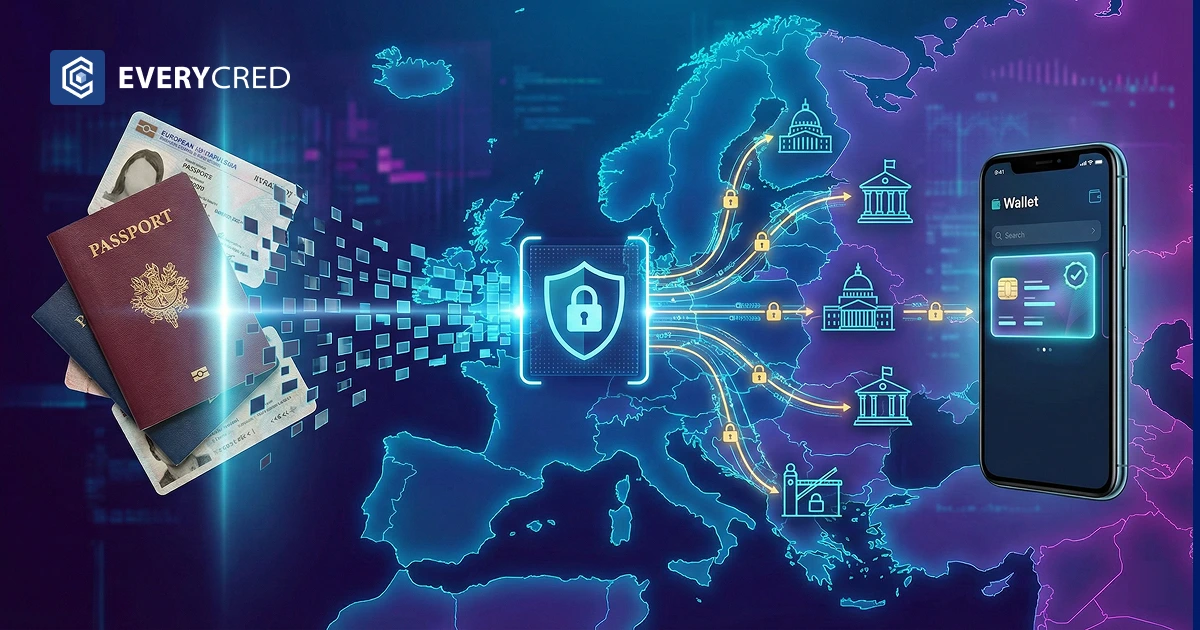


European border authorities process millions of administrative records annually. Criminal networks exploit physical documentation to bypass border controls and access social programs. Document fraud prevention in the EU government requires a shift from visual inspections to mathematical verification protocols. Let’s discuss the technical standards required to secure public sector operations.
The Growing Crisis of Fake Documents in the EU Government Services
Physical Security Weaknesses
Administrative clerks rely on physical security features like holograms to authenticate identities. Criminal organizations replicate these features accurately. The Frontex Risk Analysis Network reports border authorities intercepted 22,395 fraudulent documents at external borders in 2023. Individuals use fake documents in the EU government services to claim benefits and bypass travel restrictions.
Inefficiencies of Manual Checks
When personnel inspect physical items, they use visual judgment. Visual judgment introduces human error. When a clerk encounters fake documents in the EU government services, they must contact the issuing agency to verify the data. This manual process delays service delivery. Stopping fake documents in the EU government services requires automated verification systems. Relying on visual cross-referencing allows fake documents in the EU government services to enter the system undetected.
eIDAS 2.0 and the Shift to Digital Credentials
The EUDI Wallet Mandate
The European Commission introduced the eIDAS 2.0 regulation to standardize identity verification. Member states must provide a European Digital Identity (EUDI) Wallet to citizens by 2026. This wallet securely stores digital credentials on a mobile device.
Standardizing Cross-Border Verification
These electronic files replace physical cards and printed licenses. Government agencies issue digital credentials directly to citizens. Citizens present these files to access services. The transition to digital credentials removes physical vulnerabilities. Agencies need secure platforms to issue digital credentials at high volumes. Standardizing digital credentials ensures cross-border interoperability.
How Verifiable Credentials Eliminate Forgery
Public Key Infrastructure
The eIDAS 2.0 framework relies on cryptographic standards. Government agencies use verifiable credentials to achieve data security. Verifiable credentials operate on public key infrastructure (PKI).
The Verification Process
The process involves three distinct parties:
- Issuer: A government agency compiles citizen data and signs it with a private cryptographic key. This creates verifiable credentials.
- Holder: The citizen receives the file and stores it in their digital wallet.
- Verifier: The receiving agency uses the issuer’s public key to check the digital signature.
This mathematical check proves the specific agency issued the file. It also proves no one altered the data. Implementing verifiable credentials eliminates forgery because attackers cannot replicate the private key. The European Commission’s digital strategy documentation outlines the technical requirements for integrating verifiable credentials into workflows.
Upgrade the Legacy Credential System
Overcoming Fragmented Databases
Government IT departments currently operate fragmented, localized databases. This fragmentation creates security gaps. Upgrading an outdated credential system requires significant planning. A modern credential system must process cryptographic signatures instantly. Legacy servers lack the API architecture to connect with the EUDI Wallet framework. Policy teams must evaluate their current credential system against new technical requirements.
Data Minimization and Compliance
Replacing a legacy credential system involves migrating historical records into encrypted formats. A compliant credential system must adhere to the General Data Protection Regulation (GDPR). The system must support data minimization.
Implementation Steps for Public Sector Policy Teams
Policy teams must coordinate action across government tiers to deploy these technologies.
- Conduct Infrastructure Audits: Evaluate existing databases for API compatibility.
- Establish Key Management: Create secure facilities to store cryptographic keys.
- Standardize Data Schemas: Define formatting rules for electronic documents.
- Deploy Revocation Registries: Build automated systems to invalidate files instantly.
| Verification Method | Security Mechanism | Forgery Risk | Verification Speed |
| Physical Documents | Visual inspection of holograms. | High. Susceptible to counterfeiting. | Slow. Requires manual database checks. |
| Digital Files (PDFs) | Visual inspection of text. | High. Easily altered with software. | Slow. Requires manual database checks. |
| Cryptographic Checks | Mathematical validation of keys. | Zero. Signatures cannot be forged. | Instant. Automated via protocols. |
As European mandates take effect, public sector agencies must transition to infrastructure capable of handling cryptographically secure data. Document fraud prevention in EU government requires enterprise-grade architecture.
Upgrading to a comprehensive Digital Trust Platform for Regulated Industries, such as EveryCRED, ensures interoperability, compliance, and security against modern forgery. EveryCRED integrates directly with existing government databases to automate the issuance process.
Secure the Future of European Public Services
The threat of document forgery severely compromises the integrity of public services and national borders. Upgrading verification protocols is a direct operational necessity for all member states. By replacing physical cards with cryptographically signed files, government agencies eliminate the vulnerabilities exploited by criminal networks.
Document fraud prevention in the EU government must become a mathematical certainty. Policy teams must prioritize the deployment of interoperable, secure infrastructure to meet regulatory deadlines and protect citizen data. Modernizing these systems ensures efficient, secure, and reliable public administration across the European Union.
Connect with us at admin@everycred.com.