10th June, 2026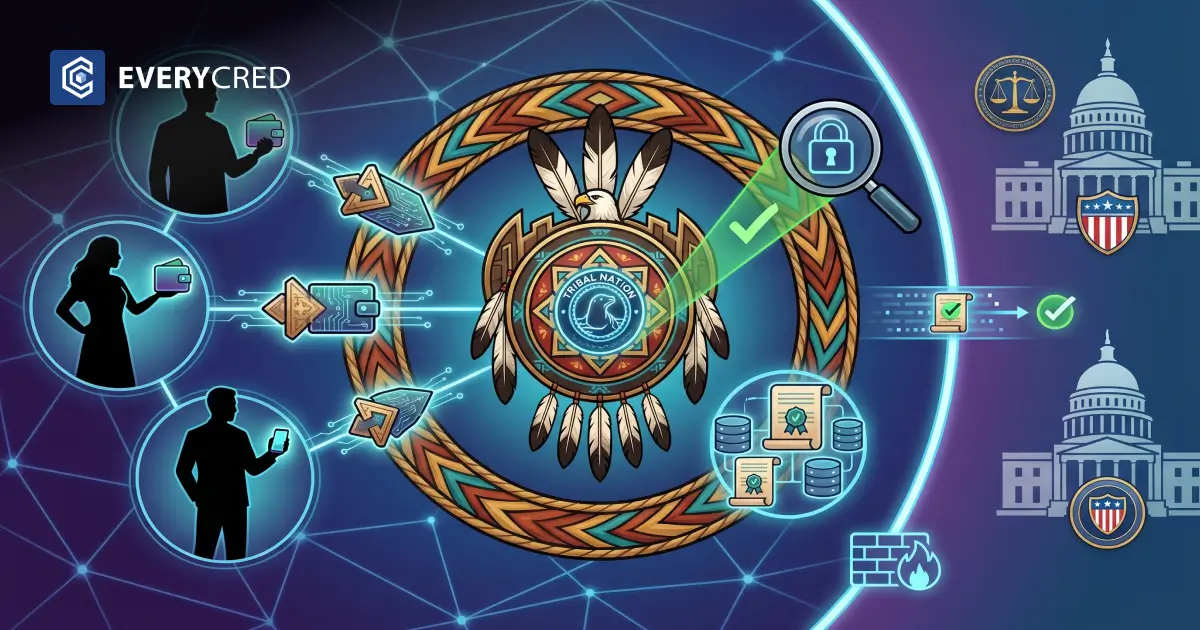
- Why Federal Acceptance Has Cost Tribal Nations Their Data
- How Decentralized Identity Keeps the Nation in Control
- Selective Disclosure and the CARE Principle of Authority to Control
- A Nation-to-Nation Identity Model Federal Systems Already Accept
- Building a Sovereign Decentralized Identity Program
- How EveryCRED Supports Sovereign Tribal Identity Programs
- Conclusion
- FAQs


A decentralized identity model lets a Tribal Nation issue credentials that federal and state systems accept while keeping member records under tribal control. The Nation signs each credential, the member holds it, and an outside agency verifies it cryptographically. No tribal database is handed over, and no enrollment roll is pooled into a system the Nation does not govern.
That distinction matters. For decades, federal and state acceptance of tribal identity has often meant surrendering data to outside databases. By contrast, a decentralized identity approach reverses that trade. This guide lays out the issuer, holder, and verifier model that preserves tribal sovereignty while enabling federal and state recognition. It is written for Tribal IT Directors, Council technology chairs, and BIA programme partners evaluating a sovereign identity program.
Key Takeaways
– A decentralized identity model makes the Tribal Nation the issuer, the member the holder, and a federal or state agency the verifier, with no database access required.
– Selective disclosure lets a member prove enrollment without exposing blood quantum, enrollment number, or the full record.
– Tribal IDs and Enhanced Tribal Cards are already federally accepted by TSA, establishing precedent for nation-issued credentials.
– The model aligns with the CARE Principles for Indigenous Data Governance, specifically Authority to Control.
– NIST SP 800-63-4, finalized July 2025, brings subscriber-controlled wallets and verifiable credentials into the federal model.
Why Federal Acceptance Has Cost Tribal Nations Their Data
Federal and state systems have historically accepted tribal identity on their own terms. In most cases, acceptance required a Nation to feed its member data into an outside database. Moreover, that database sits under federal or state governance, not tribal governance.
This is a direct sovereignty problem. Tribal enrollment data is the foundation of a Nation’s existence and the basis for federal funding allocations. As a result, when the data leaves tribal control, the Nation loses authority over how it is used and retained.
The risk compounds over time. For instance, pooled tribal enrollment records can be queried, cross-referenced, and repurposed without the need for tribal consent. A model built for secure government data sharing should let agencies confirm a fact without taking custody of the underlying records. Therefore, tribal sovereignty requires that the Nation, not an external system, remains the authoritative source for member identity.
How Decentralized Identity Keeps the Nation in Control
Decentralized identity is an identity model where credentials are issued, held, and verified without a central database storing the holder’s records. First, the issuer signs a credential cryptographically. Then the holder stores it. Finally, any verifier confirms it against the issuer’s public key, without contacting the issuer or querying a database.
Mapped to a Tribal Nation, the three roles are clear:
- Issuer: The Tribal Nation issues a credential signed with its own cryptographic key.
- Holder: The enrolled member stores the credential in a digital wallet they control.
- Verifier: A federal or state agency confirms the credential is authentic and current.
The verifier never calls a tribal database. It checks the signature and the revocation status, then returns a valid or invalid result. Instead, the Nation keeps its enrollment rolls in-house. As a result, decentralized identity preserves nation-to-nation identity in a way that federated database models cannot.
Selective Disclosure and the CARE Principle of Authority to Control
Selective disclosure lets a member prove one specific fact without revealing the rest of the credential. A member can prove enrollment in a Nation, or eligibility for a specific benefit, without exposing blood quantum, enrollment number, or date of birth.
This is enforced cryptographically through zero-knowledge proofs. As a result, the verifier learns only the answer to the question asked. In addition, everything else stays private and under the holder’s control.
That capability maps directly to the CARE Principles for Indigenous Data Governance, which define Collective Benefit, Authority to Control, Responsibility, and Ethics. Specifically, Authority to Control means the Nation and its members decide what data is shared and with whom. A privacy-first credentialing approach satisfies this principle by design, as the member discloses only the minimum required information, and the Nation never surrenders the full dataset. Data minimization stops being a policy promise and becomes a property of the system.
A Nation-to-Nation Identity Model Federal Systems Already Accept
Federal acceptance of tribal identity is not theoretical. The Transportation Security Administration accepts photo IDs issued by federally recognized Tribal Nations, including Enhanced Tribal Cards, as valid identification for air travel. There are 575 federally recognized Tribal Nations, and each is a sovereign issuer.
That precedent extends naturally to a decentralized identity model. A Nation that already issues a recognized physical card can issue the same identity as one of its public sector credentials. The credential can then carry into benefit programs, service eligibility checks, and digital interactions, not just airport checkpoints.
Consider a practical scenario. A Tribal Council member named Joseph Tallchief needs to confirm benefit eligibility with a state agency. Under a pooled-database model, the agency would query a shared system holding his full record. By contrast, under a decentralized identity model, Joseph presents a credential issued by his Nation. The agency verifies the signature in seconds and confirms eligibility, without ever accessing the Nation’s enrollment roll. The Nation preserves nation-to-nation identity while the state gets the assurance it needs. A BIA partnership can formalize this acceptance across federal programs, giving agencies a consistent verification method that respects tribal data governance.
Building a Sovereign Decentralized Identity Program
A sovereign identity program starts with governance, not technology. The Nation defines its data governance authority before issuing a single credential. This sequencing keeps tribal sovereignty at the center of the deployment.
The phased model runs in three stages:
- Govern. Establish a tribal data governance office and a verifiable data registry under tribal control. Decide which credentials the Nation will issue and what each one proves.
- Pilot. Issue a limited credential set to a defined member group. Test holder wallets, selective disclosure, and revocation before scaling.
- Onboard verifiers. Bring federal and state agencies in as verifiers, supported by a BIA partnership where federal acceptance is the goal.
Federal alignment is built in. NIST SP 800-63-4, finalized in July 2025, introduces subscriber-controlled wallets and verifiable credentials into the federation model. As a result, a tribal-issued credential built to that standard is structurally acceptable to federal verifiers. The Nation can also connect issuance and verification to existing systems through multi-agency identity management infrastructure, using a REST API without replacing current portals. Tribal enrollment officers retain control of issuance throughout, and the decentralized identity layer never moves enrollment data out of tribal custody.
How EveryCRED Supports Sovereign Tribal Identity Programs
We deployed an issuer, holder, and verifier model for a government law enforcement client, reducing field verification from 30 minutes to under 10 seconds and cutting administrative overhead by 85%. Similarly, the same architecture supports sovereign tribal identity programs. We issue credentials signed with the issuing authority’s own key, enable selective disclosure through zero-knowledge proofs, and support offline verification with no database call. Tribal Nations keep enrollment data in-house while federal and state agencies verify cryptographically. Our Trust Method product manages decentralized identity and credential issuance for public sector deployments. Download our sovereignty model guide or request a nation-to-nation consultation to map this to your program.
Conclusion
A decentralized identity model resolves the long-standing trade-off between federal acceptance and tribal data control. The Nation issues credentials, members hold them, and agencies verify them cryptographically, without pooling enrollment records into outside systems. In addition, selective disclosure keeps sensitive attributes private and satisfies the CARE Principle of Authority to Control.
The precedent already exists. For example, federally recognized tribal IDs are accepted today, and NIST SP 800-63-4 brings verifiable credentials into the federal model. A phased program that starts with governance allows a Nation to preserve its sovereignty while extending recognition. For Tribal IT leaders, the path forward protects tribal enrollment data and strengthens nation-to-nation identity at the same time.
FAQs
What is decentralized identity for Tribal Nations?
It is an identity model where the Nation issues credentials, members hold them, and agencies verify them cryptographically without accessing tribal databases.
Does a decentralized identity model require sharing tribal enrollment data?
No. Verifiers confirm credentials against the Nation’s public key, so tribal enrollment records stay under tribal control and are never pooled externally.
Are tribal-issued IDs accepted by federal agencies?
Yes. The TSA accepts photo IDs from federally recognized Tribal Nations, including Enhanced Tribal Cards, establishing precedent for nation-issued credentials.
How does selective disclosure protect tribal sovereignty?
Members prove a single fact, such as enrollment, without revealing blood quantum or enrollment number, keeping authority to control data with the Nation.
How does a BIA partnership support a sovereign identity program?
A BIA partnership can formalize federal acceptance of tribal-issued credentials, giving agencies a consistent verification method that respects nation-to-nation identity.