24th April, 2026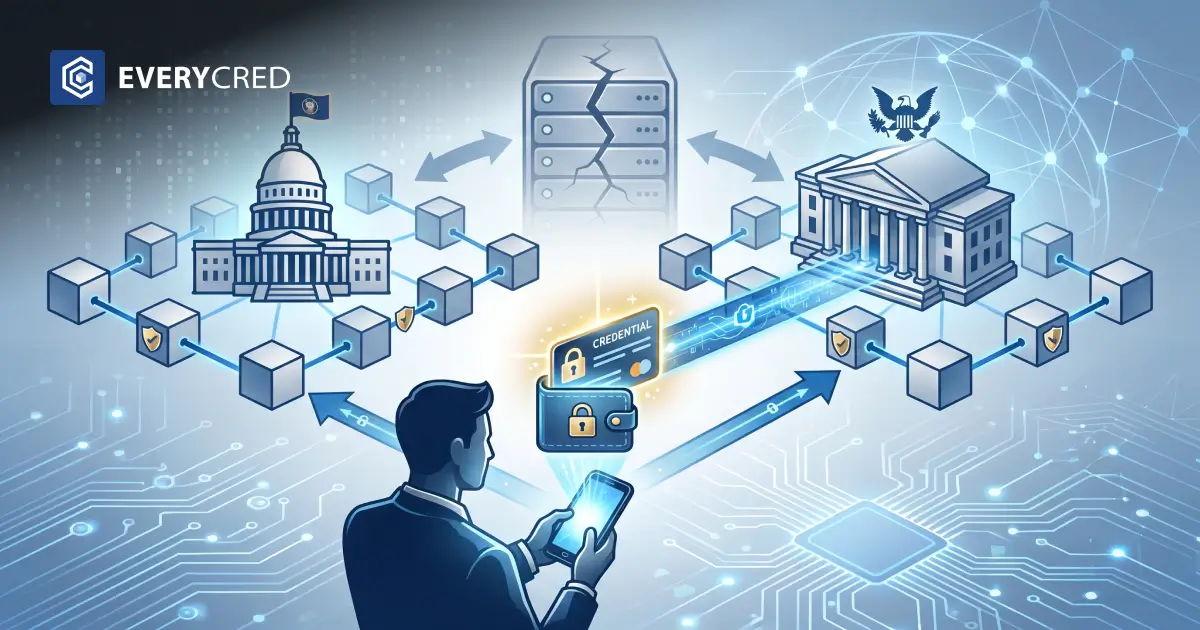
- Legacy Databases Fail State and Federal Security Requirements
- Cryptographic Architecture Ensures Strict Regulatory Compliance
- Interoperability Protocols Connect Fragmented Jurisdictions
- Technical Layers of Distributed Government Systems
- Resolving Data Ownership Issues in Public Administration
- Establish Compliant Government Frameworks
- Conclusion
- FAQs


Government agencies require secure data exchange protocols to manage citizen information. Departments at the state and federal levels frequently need to verify official records. Centralized databases create significant vulnerabilities.
A compromised central server exposes millions of citizen records to unauthorized entities. Government bodies are adopting decentralized identity frameworks to resolve these structural vulnerabilities.
This technology allows agencies to verify information without storing redundant copies of sensitive citizen data. A digital identity blockchain provides the underlying infrastructure to authenticate these credentials securely.
Legacy Databases Fail State and Federal Security Requirements
Information silos exist across different levels of government administration. A state transport department operates an independent database from a federal tax authority. When these agencies share data, they duplicate records across multiple servers. This duplication increases the risk of unauthorized access and violates the core regulatory principles of data minimization. Citizens lose visibility into how different agencies use their data. This creates severe data ownership issues.
Governments must reduce reliance on centralized databases to protect public records. Administrators must transition away from legacy databases to meet modern compliance standards. A digital identity blockchain eliminates the need for redundant data storage. Agencies issue verifiable credentials directly to citizens.
The citizen holds the credential in a digital wallet application on their mobile device. When another agency needs verification, the citizen presents a cryptographic proof. The receiving agency verifies the proof on the ledger. They do not access a central repository of information.
Cryptographic Architecture Ensures Strict Regulatory Compliance
Regulators demand strict oversight of data sharing mechanisms. Privacy laws require systems to collect only necessary information. Decentralized identity meets these rigorous requirements through selective disclosure protocols.
Data Minimization Protocols
Citizens share specific attributes instead of entire documents. A person can prove they reside in a specific state without revealing their exact street address. This process utilizes mathematical proofs to verify claims without exposing the underlying data points.
Instant Revocation Capabilities
Issuing authorities maintain control over the validity status of the credential. Administrators can revoke credentials instantly if a citizen’s legal status changes. The ledger updates the revocation registry immediately.
Immutable Audit Trails
The digital identity blockchain records the issuance and verification events. It does not record the personal data itself. This provides a clear timeline of data access for regulatory audits.
This foundational architecture satisfies regulators who monitor cross-jurisdiction data transfers.
The technical implementation of these systems follows established global standards.
This standardization guarantees that different government departments can read and verify the same credentials securely.
Interoperability Protocols Connect Fragmented Jurisdictions
Data exchange often crosses regional and national borders. A citizen moving between jurisdictions requires their official records to remain valid and verifiable. Different government entities use different software vendors and database structures.
Decentralized identity establishes a common verification layer. Trust frameworks define the rules for accepting credentials from external issuers. This structured approach builds functional digital trust ecosystems. When systems interoperate, agencies can verify foreign or out-of-state credentials immediately. This capability supports cross-border interoperability for regulatory bodies monitoring international or interstate mobility.
Technical Layers of Distributed Government Systems
A secure data exchange infrastructure relies on three distinct technical layers. Government IT departments configure these layers to maintain absolute control over the issuance process while ceding data custody to the user.
The Public Ledger Layer
The bottom layer is the digital identity blockchain itself. This network does not store any personally identifiable information. It stores decentralized identifiers and public cryptographic keys. Government nodes operate this ledger to ensure high availability and consensus. The ledger acts as a public registry where agencies publish their digital signatures.
The Agent and Wallet Layer
Citizens and government agencies interact through software agents. These agents manage the cryptographic keys. Citizens use mobile wallet applications to store their verifiable credentials securely. Agencies use enterprise agents to issue credentials and request proofs. This separation of software guarantees that the issuer does not track the citizen’s daily usage of the credential.
The Credential Exchange Layer
This top layer handles the actual secure data exchange. It dictates how an agency requests information and how the citizen’s wallet formulates the response. The communication happens over encrypted connections. The data travels directly from the citizen to the requesting agency. It never passes through a central intermediary.
Practical Mechanisms for Secure Government Data Exchange
Government administrators apply decentralized identity to several core public sector functions. These applications resolve the friction of traditional paper processes and insecure digital portals.
Identity Issuance and Lifecycle Management
Government departments act as the root of trust. Agencies issue birth certificates, tax identification numbers, and business licenses as verifiable credentials. This process helps secure official records against forgery. The citizen takes custody of these credentials immediately upon issuance.
Regulated Sector Verification
Many government agencies oversee highly regulated industries. Health departments must manage medical licenses and facility certifications. Implementing these protocols assists in protecting sensitive citizen data and ensuring only qualified practitioners operate within the system.
Procurement and Vendor Management
Federal supply chains require rigorous background checks and certifications. Vendors can present verifiable credentials to prove their compliance with government contracting standards. This accelerates the procurement cycle and guarantees vendor authenticity. Administrators can explore broader applications of this technology across municipal and federal operations.
Resolving Data Ownership Issues in Public Administration
Data ownership issues arise when citizens have no control over the digital records that define their legal status. Centralized systems classify citizens as subjects within a database. Decentralized identity reclassifies citizens as the legal owners of their digital information.
Cryptographic Custody
Citizens hold the private keys to their digital wallets. These keys provide exclusive control over the stored credentials. A government agency cannot access the wallet remotely. They cannot view the citizen’s data without explicit, cryptographic consent.
Consent-Based Sharing
When a federal agency requires data, they send a presentation request to the citizen. The citizen reviews the request on their device. The request specifies exactly which attributes the agency needs. The citizen must actively approve the transfer. This mechanism enforces user consent at every stage of the secure data exchange.
Balancing Authority and Ownership
Agencies retain authority over the validity of the credential. A transport department dictates whether a driving license is valid or suspended. The citizen owns the digital representation of that license. This separation balances the government’s need for regulatory authority with the citizen’s right to digital ownership.
Establish Compliant Government Frameworks
EveryCRED provides the technical infrastructure required for secure data exchange. We build compliant systems that resolve data ownership issues for public sector entities. Our platform enables government agencies to issue, manage, and verify credentials across different jurisdictions seamlessly.
We integrate decentralized identity frameworks directly into existing government workflows and legacy applications. Administrators use our tools to maintain regulatory compliance, automate verification processes, and protect citizen data from centralized breaches.
Contact our technical team to establish your secure credentialing network today.
Conclusion
Government data management requires modernization to meet current security and privacy standards. Centralized databases fail to protect citizen information from large-scale breaches and violate strict data minimization principles. Transitioning to distributed cryptographic systems solves these fundamental data ownership issues. By adopting verifiable credentials, regulatory bodies and public agencies can ensure secure data exchange across all levels of administration. This approach protects citizens, satisfies compliance mandates, and builds a resilient digital infrastructure for public services.
FAQs
What is decentralized identity in government administration?
It is a framework where citizens control their digital data and share it securely with agencies.
How does a digital identity blockchain function?
It uses distributed ledgers to verify credential authenticity without storing sensitive personal information centrally.
Why is secure data exchange critical today?
Secure exchange prevents unauthorized access and ensures strict regulatory compliance during interagency information transfers.
How do agencies solve data ownership issues?
Governments implement verifiable credentials to give individuals direct control over their personal records and attributes.
What makes digital government credentials highly secure?
Cryptographic signatures ensure the information remains unaltered from the moment the issuing authority creates it.