15th June, 2026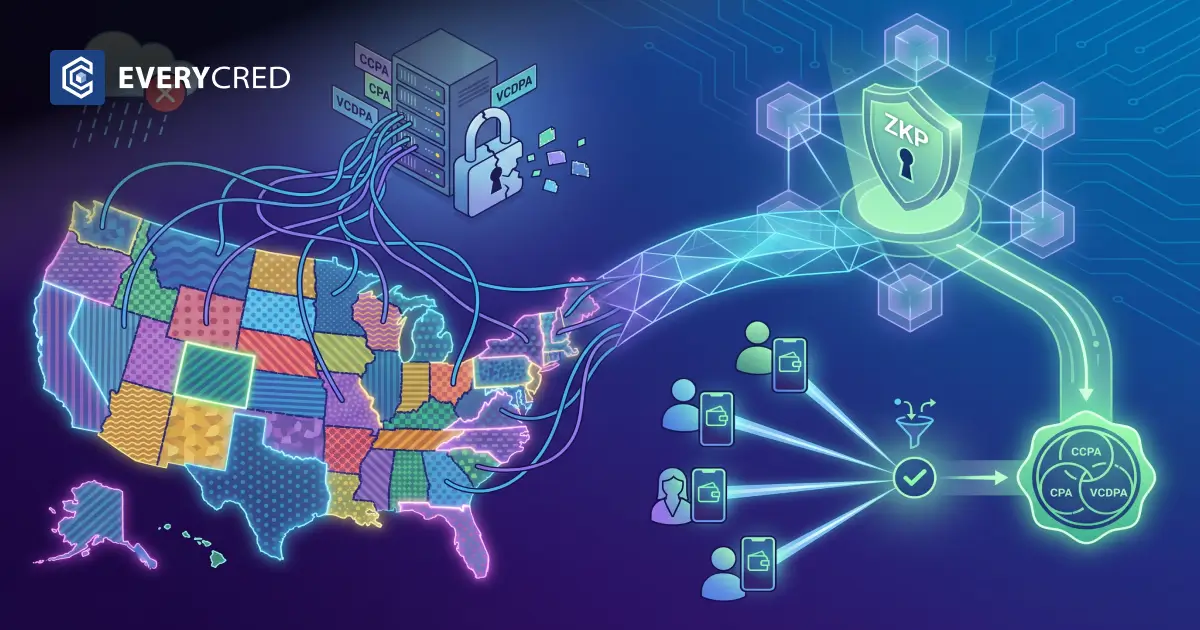
- Why the State Privacy Patchwork Breaks Per-State Identity Programs
- Data Minimization Is the Common Thread Across CCPA, CPA, and VCDPA
- How a Scorecard Maps Digital Identity Management Solutions to State Laws
- What State CIOs Should Require From Digital Identity Management Solutions
- Build One Multi-State Program With EveryCRED
- Conclusion
- FAQs


One decentralized, data-minimizing architecture lets digital identity management solutions satisfy CCPA, CPA, and VCDPA at the same time, without a per-state rebuild. State CIOs who design for the common requirement across these laws, rather than for each statute separately, stop maintaining parallel identity programs that never scale.
The multi-state privacy patchwork is the problem. By 2026, roughly 20 states will enforce comprehensive consumer privacy laws, and each defines consent, data subject rights, and minimization differently. Agencies that operate across state lines rebuild identity controls for every new statute. That approach burns budget and still leaves audit gaps.
This article maps the common ground across the major state regimes, then shows the control architecture and scorecard a multi-state program needs to comply with once and prove it everywhere.
Key Takeaways
– Roughly 20 U.S. states will enforce comprehensive privacy laws by 2026, each with different consent and data subject rules.
– CCPA, CPA, and VCDPA converge on data minimization, the single requirement that lets one architecture serve all three.
– Selective disclosure using zero-knowledge proofs proves a claim without exposing the underlying data, satisfying minimization by design.
– Holder-held credentials remove the central PII store, the asset that drives the $10.22 million average U.S. data breach.
– A control-mapping scorecard shows state CIOs which technical control answers which statute, replacing per-state rebuilds.
Why the State Privacy Patchwork Breaks Per-State Identity Programs
A multi-state identity program fails when it is built statute by statute. CCPA grants California residents rights to access, delete, and limit the use of personal data. Colorado’s CPA adds universal opt-out and data protection assessments. Virginia’s VCDPA establishes its own consent and sensitive data rules. The obligations overlap, but the definitions and triggers differ.
Consider Maria, a CIO at a multi-state benefits agency. Her team stood up an identity system tuned to CCPA in 2024. When operations expanded into Colorado and Virginia, each new regime triggered a separate data-mapping project, a separate consent workflow, and a separate audit. Within 18 months, she ran three identity programs that did the same job.
That is the scaling failure multi-state privacy creates. Every state added is a fixed cost, not a marginal one. The fix is not more compliance staff. It is an architecture designed for what the statutes share. Strong multi-agency identity management starts from the common denominator, not the differences.
Data Minimization Is the Common Thread Across CCPA, CPA, and VCDPA
Data minimization is a requirement shared by every major state privacy law. CCPA limits collection to what is reasonably necessary. Colorado’s CPA requires purpose limitation and minimization in plain text. VCDPA restricts processing to what is adequate and relevant for a disclosed purpose. Design for minimization, and you answer the core of all three at once.
Most legacy identity systems do the opposite. They collect full identity records, store them centrally, and expose the whole profile at each verification. That model multiplies privacy exposure with every state law it touches.
Verifiable credentials invert that pattern. The holder keeps the credential. The verifier confirms a single claim through selective disclosure, using a zero-knowledge proof, without ever seeing the underlying data. A verifier can confirm that a person is an enrolled beneficiary without receiving their date of birth, address, or case number. The U.S. NIST SP 800-63-4 guidelines, finalized in July 2025, treat this kind of minimization as a baseline for federated identity. Designing for it positions a state CIO ahead of both the privacy statutes and the federal assurance standard.
How a Scorecard Maps Digital Identity Management Solutions to State Laws
A control-mapping scorecard shows which technical control satisfies which state law, so one architecture answers the whole patchwork. Instead of asking “what does VCDPA require,” the CIO asks “which control already covers VCDPA, CPA, and CCPA together?” The table below is the core of that multi-state compliance map.
| Technical control | What it does | CCPA | CPA | VCDPA |
|---|---|---|---|---|
| Selective disclosure (ZKP) | Shares only the claim required | Yes | Yes | Yes |
| Holder-held credentials | No central PII store to breach | Yes | Yes | Yes |
| Real-time revocation | Honors deletion and status change | Yes | Yes | Yes |
| Immutable audit trail | Proves who verified what, and when | Yes | Yes | Yes |
| Consent at presentation | Holder approves each disclosure | Yes | Yes | Yes |
Each control maps to a shared obligation, so a single deployment carries across state lines. The data-minimization scorecard then rates a program on each control, giving the CIO a defensible compliance position for an audit in any of these states. This is how digital identity management solutions move from per-state rebuilds to one auditable architecture.
Take James, a privacy officer at a state licensing board. He replaced four state-specific consent forms with one holder-controlled presentation step. Each disclosure now logs to an immutable record, and the same evidence satisfies CCPA, CPA, and VCDPA examiners alike. His audit prep dropped from weeks to a single export.
What State CIOs Should Require From Digital Identity Management Solutions
A state CIO evaluating digital identity management solutions for multi-state operation should require a specific control set, not a feature list. The architecture, not the marketing, determines whether one program scales across the multi-state privacy patchwork.
- NIST SP 800-63-4 alignment: The platform should map to defined Identity Assurance Levels, so state and federal expectations are met with the same controls.
- Holder-held, decentralized credentials: No central identity database means no single store of personal data to breach, which directly lowers exposure under every state law.
- Selective disclosure by default: Zero-knowledge proofs should be standard, so minimization is built in rather than configured per statute.
- Real-time revocation and audit trail: Deletion requests and status changes must propagate in seconds, with every event logged to a permanent record.
- Procurement-vehicle availability: The platform should be purchasable through existing contracts, so deployment does not wait on a new competitive cycle.
These requirements also describe how a program earns durable public sector credentials trust. State CIOs’ planning can pair this control set with state government digital wallets to give residents direct control. A model built on privacy-first credentials keeps verification working without phoning home to a central server.
Build One Multi-State Program With EveryCRED
We built EveryCRED on holder-held verifiable credentials and selective disclosure using zero-knowledge proofs, so a single deployment satisfies data minimization across CCPA, CPA, and VCDPA. In our Raigad Police deployment, the same architecture cut verification time from 30 minutes to under 10 seconds and reduced administrative overhead by 85%, proving the model holds at government scale.
- One architecture, many statutes: Selective disclosure and holder-held credentials answer the shared minimization requirement across state laws.
- No central PII store: Decentralized credentials remove the breach target behind the $10.22 million average U.S. data incident.
- Procurement-ready: Available through NASA SEWP V and ITES-SW2, with no new competitive cycle required.
Download our multi-state compliance map, or book a demo to scope a multi-state program for your agency.
Conclusion
The U.S. state privacy patchwork punishes identity programs built statute by statute. CCPA, CPA, and VCDPA differ in detail, but they converge on data minimization, and that convergence is the design target. A state CIO who builds for the shared requirement deploys once and complies across state lines.
Holder-held credentials, selective disclosure, real-time revocation, and an immutable audit trail map to the obligations every major state law shares. The control-mapping scorecard turns that overlap into a single, auditable architecture. As more states pass privacy laws through 2026 and beyond, digital identity management solutions designed for the multi-state privacy common denominator will be the only ones that scale without a rebuild for each new statute.
FAQs
What digital identity management solutions work across multiple state privacy laws?
Solutions built on holder-held verifiable credentials and selective disclosure satisfy CCPA, CPA, and VCDPA with one data-minimizing architecture.
How does data minimization help with CCPA, CPA, and VCDPA compliance?
All three laws require minimization, so selective disclosure that shares only the needed claim answers the core obligation of each at once.
Why do per-state identity rebuilds fail for multi-state agencies?
Each statute defines consent and rights differently, so statute-by-statute builds create parallel programs with fixed costs that do not scale.
What should a state CIO require from a digital identity platform?
NIST SP 800-63-4 alignment, holder-held credentials, selective disclosure, real-time revocation, an audit trail, and procurement-vehicle availability.
How do holder-held credentials reduce data breach risk under state privacy laws?
They remove the central personal-data store, so there is no single database to breach, lowering exposure under every state privacy regime.