24th June, 2026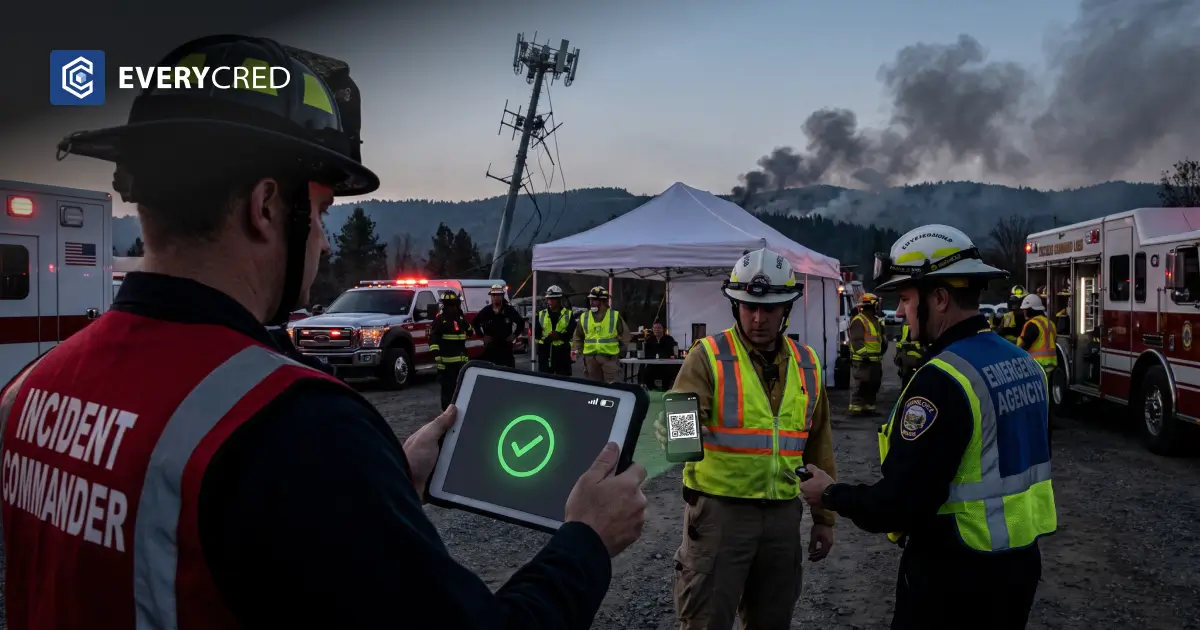
- Why Mutual-Aid Scenes Break Standard Credentials Verification
- How Offline Verification Works Without a Signal
- First Responder Credentialing Across State Lines: NIMS and EMAC
- Instant Revocation When an EMS Certification Lapses
- What to Require for Mutual Aid Verification in the Field
- How We Deploy Field-Ready Credentials Verification
- Conclusion
- FAQs


Incident commanders can run credentials verification on out-of-jurisdiction first responders at a disconnected disaster scene using cached cryptographic signatures, with no network and no phone call to the home agency. The credential validates on the device in under 10 seconds, and a lapsed clearance fails the check immediately.
Mutual-aid and disaster scenes are where standard verification falls apart. Responders arrive from dozens of jurisdictions, and the cell network in the disaster footprint is often down when the check matters most. This guide explains how offline credentials verification works in the field, how it maps to NIMS and EMAC, and what to require before you deploy it.
Key Takeaways
- Offline verification uses cached cryptographic signatures, so credentials are validated at the scene with zero connectivity.
- A revoked or expired credential, including a lapsed EMS certification, fails verification the instant the holder presents it.
- Cross-jurisdiction first responder credentialing works when credentials follow W3C VC 2.0 and align with NIST SP 800-63-4.
- Raigad Police cut field verification from 30 minutes to under 10 seconds using offline QR verification in 2025.
- Every verification event is logged to an immutable audit trail, giving incident command provable accountability.
Why Mutual-Aid Scenes Break Standard Credentials Verification
A mutual-aid response pulls people together faster than any shared database can track them. Standard credentials verification assumes a central system that the verifier can reach. At a disaster scene, that assumption fails on three fronts.
- No shared database at the scene. Responders arrive under NIMS and EMAC from agencies that do not share an identity system. The incident commander has no live roster to query.
- Connectivity is the single point of failure. Cell towers, fiber, and power are often down inside the disaster footprint. A verification method that needs a server cannot run.
- The accountability gap. Without an audit trail, command cannot prove who was cleared, for what task, and whether the clearance was valid at that moment.
When a wildfire jumped a county line in 2025, Incident Commander Dana Reyes received 40 strike-team members from four agencies in under an hour. Her staging area had no cell signal. She had laminated cards and verbal assurances, and no way to confirm any of it. That gap is the operational problem that first responder credentialing must solve.
Want to see how field-grade verification handles this? Our offline credential verification tools validate a credential on the device, without a lookup.
How Offline Verification Works Without a Signal
Offline verification works because the proof travels with the credential, not with a server. Each credential carries a cryptographic signature from the issuing agency. The verifier device holds the issuer’s public key and the current revocation status, both cached in advance. Validation happens locally in milliseconds.
A verifiable credential is a cryptographically signed digital record that proves a claim about a person. Any change to the credential breaks the signature, so the verifier detects tampering automatically. The verifier needs only a scanner, not a database connection, and not a call to the issuer.
This is the same model EveryCRED proved in the field. Offline verification using cached signatures was deployed operationally for Raigad Police field officers in 2025, not as a future capability. The approach mirrors the privacy-first credentialing method that removes the need to phone home for every check.
First Responder Credentialing Across State Lines: NIMS and EMAC
First responder credentialing across jurisdictions only works when every agency speaks the same credential format. NIMS already defines the qualification framework. The Emergency Management Assistance Compact (EMAC) already governs how states share resources during a declared emergency. What has been missing is a credential that any incident commander can verify on the spot.
According to FEMA’s NIMS guidance, the National Qualification System sets the typing and credentialing standards for deployed personnel. A credential built on W3C VC 2.0 and aligned with NIST SP 800-63-4 carries those qualifications in a machine-readable, signed format.
The result is interoperability. A paramedic credentialed in one state presents a credential that an incident commander in another state verifies in seconds, without a shared system. This is the same problem solved by cross-agency verification, applied to the disaster scene. Legacy laminated cards and PDF rosters cannot do this, because they offer no offline verification and no instant revocation.
Instant Revocation When an EMS Certification Lapses
Revocation is where paper credentials fail most dangerously. A laminated card shows the same face whether the holder is current or suspended. An EMS certification that expired last week still looks valid on a printed badge.
With signed digital credentials, status travels with the check. When an agency revokes a clearance or an EMS certification lapses, the revocation registry updates. The next verification fails immediately, even on a credential already cached in the holder’s wallet. Document fraud makes this urgent: AI-forged documents grew 311% from Q1 2024 to Q1 2025, and the entry cost for a convincing forgery is under $30.
Consider Captain Marcus Hale, an EMS branch director at a hurricane shelter. A volunteer presents an EMS certification that expired during the deployment. On the old system, Hale would have no way to know. With credential-status checks built into verification, the scan returns “not valid,” and Hale reassigns the task before a patient is ever at risk. That is the difference instant revocation makes for mutual aid verification.
What to Require for Mutual Aid Verification in the Field
Before you adopt a platform for mutual aid verification, hold it to a field-operations standard. A demo on office Wi-Fi proves nothing about a scene with no signal. Require the following.
- True offline verification. Cached cryptographic signatures must validate with the network fully down, not degraded.
- Cross-jurisdiction interoperability. Credentials must follow W3C VC 2.0 and align with NIST SP 800-63-4 so any agency can verify them.
- Instant revocation and audit trail. A lapsed or revoked credential must fail at once, and every check must log who verified what and when.
- Procurement readiness. The platform should be available on existing vehicles such as NASA SEWP V and ITES-SW2, so no new competitive cycle is required.
- API integration with no front-end change. It must connect to your existing systems through a REST API without re-platforming.
These five requirements separate a credentials verification platform built for disaster operations from one built for an office lobby. The same field discipline appears in our field deployment guide for police identity programs.
How We Deploy Field-Ready Credentials Verification
We deployed digital officer credentials for Raigad Police with offline QR verification for field officers, reducing verification time from 30 minutes to under 10 seconds and cutting administrative overhead by 85%. The system validates credentials with no network connection and revokes a lapsed clearance in seconds. It integrates through a REST API with no front-end changes, and US agencies can procure it through existing vehicles, including NASA SEWP V and ITES-SW2. Emergency management directors and fire and EMS chiefs can run the same model for mutual-aid response. Request an emergency management pilot to see offline credentials verification at a simulated scene.
Conclusion
Disaster and mutual-aid scenes break standard credentials verification because there is no shared database and often no signal. Offline verification using cached cryptographic signatures solves both problems, validating out-of-jurisdiction first responder credentialing in under 10 seconds. Instant revocation closes the gap that paper cards leave open, so a lapsed EMS certification fails the check on the spot. Built on W3C VC 2.0 and aligned with NIST SP 800-63-4, these credentials make mutual aid verification interoperable across state lines. The agencies that deploy this now will have provable accountability on the worst day, when the network is down, and the responders are strangers.
FAQs
How do you verify first responder credentials with no internet at a disaster scene?
A verifier device uses cached cryptographic signatures and public keys to validate the credential locally, with no network or issuer call required.
What is offline verification for emergency responders?
Offline verification validates a signed credential directly on the device using stored cryptographic proof, so it works with zero connectivity in the disaster footprint.
Can a lapsed EMS certification be caught during field verification?
Yes. The revocation registry marks the credential invalid, so a lapsed EMS certification fails verification immediately, even if cached in the holder’s wallet.
How does first responder credentialing work across state lines?
Credentials built on W3C VC 2.0 and aligned with NIST SP 800-63-4 carry NIMS qualifications in a signed format that any jurisdiction can instantly verify.
Can government agencies buy a credentials verification platform through existing contracts?
Yes. EveryCRED is available through Carahsoft on NASA SEWP V, ITES-SW2, NASPO ValuePoint, and OMNIA Partners, with no new procurement cycle.