19th June, 2026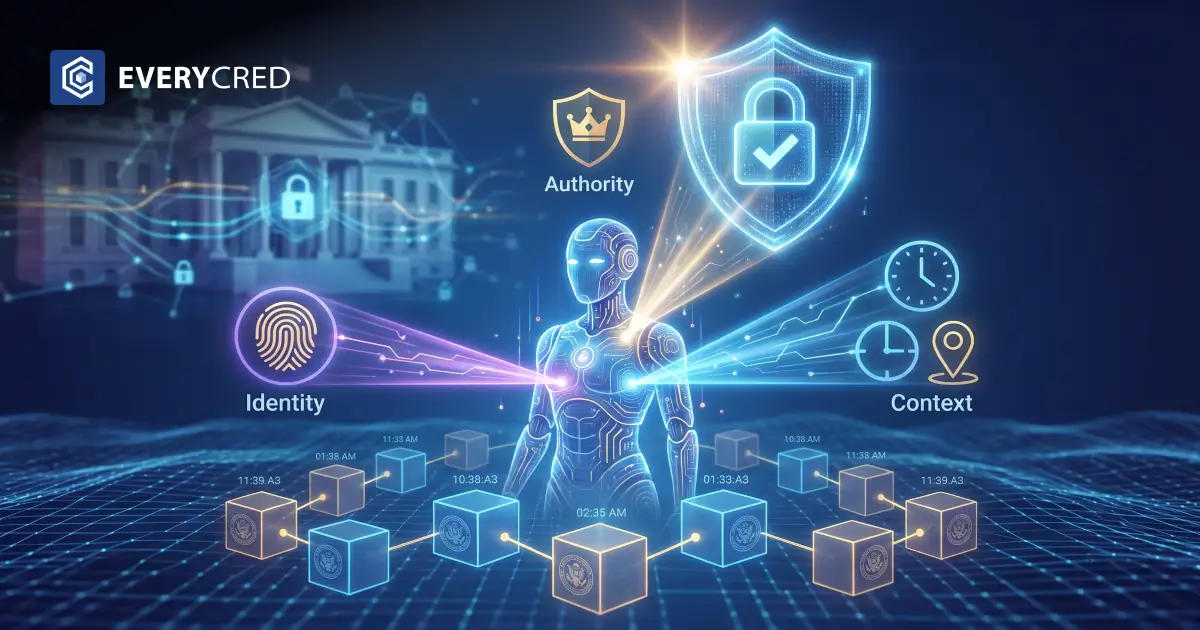
- What Is AI Agent Digital Identity Verification?
- The Trust Problem: Why Traditional Authentication Falls Short
- The Core Elements of AI Agent Identity Verification
- Static Tokens vs Verifiable Credentials for AI Agents
- How AI Agent Identity Verification Works in Practice
- Securing Agentic AI: Threats and How Verification Prevents Them
- Cross-Domain Verification: Making Agents Trusted Everywhere
- How Digital Identity Verification Enables Safe Autonomous Decisions
- Where Agencies Deploy Verified AI Agents
- Designing a Verification Layer for AI Agents
- How EveryCRED Secures Identity for AI Agents
- Conclusion
- FAQs


Agencies trust an AI agent’s decisions by proving two things at once. First, the cryptographic identity of the agent. Second, the scoped authority a human delegated to it. Digital identity verification does both when the agent carries a verifiable credential that records who authorized it, what it may do, and for how long.
Without that proof, an autonomous agent acting on your behalf is an unaccountable actor inside your systems. This matters now because agencies are deploying AI agents faster than they are governing them. Non-human identities already outnumber human identities in many enterprises by ratios as high as 144 to 1. When an agent approves a payment, files a record, or grants access, someone must answer for that decision in an audit. This guide explains what AI agent digital identity verification is, why traditional authentication falls short, and how verifiable credentials and decentralized identity make every agent decision provable.
Key Takeaways
- Identity alone is not enough. Digital identity verification for AI agents proves both the agent’s identity and the human-delegated authority behind each action.
- NIST is setting the baseline. Its AI Agent Identity and Authorization initiative, launched in February 2026, targets gaps that OAuth alone cannot close.
- Multi-hop delegation is the open gap. When one agent calls another, no native standard proves the authority chain, which creates accountability risk for agencies.
- Verifiable credentials carry the mandate. Each credential records who authorized the agent, the scope it holds, and when that authority expires.
- Speed and auditability come together. EveryCRED verifies a credential in under 10 seconds and logs every decision to an immutable audit trail.
What Is AI Agent Digital Identity Verification?
AI agent digital identity verification confirms an autonomous agent’s identity, its origin, and the scope of authority it was granted before it acts. It answers three questions for every decision. Which agent acted? Who authorized it? Was the action inside the approved boundary? For agencies, that proof is the basis of accountability.
Why verification matters for autonomous agents
An AI agent decides without a human in the loop at each step. It can approve, file, route, or grant access in milliseconds. One ungoverned agent can take thousands of actions before anyone reviews a single one. Strong digital identity verification lets the agency trace and defend every one of those decisions.
How digital identity verification differs for agents vs. humans
Human identity verification confirms a person once and trusts the session. Agents need continuous, per-action proof. Their behavior adapts to new context and tool outputs, so the next action is hard to predict. Verification for agents binds identity to a specific delegated authority, not to a login.
Key components of AI agent identity
Agent identity rests on three parts. A unique cryptographic identifier names the agent. A signed credential records its delegated authority. A permanent log captures every action. Decentralized identity supplies the identifier, verifiable credentials carry the authority, and an audit trail records the outcome.
The Trust Problem: Why Traditional Authentication Falls Short
Traditional authentication was built for human users and static services. It breaks when applied to autonomous agents. It can confirm that a system connected. It cannot prove that a specific decision was authorized. That gap is the core trust problem for agentic AI.
Shared credentials and API keys create blind trust
Many agents run on shared service accounts or static API keys. These identify a system, not a delegated decision-maker. They cannot be tied to a single action. An attacker who steals the key inherits every permission attached to it. The cost of that exposure is real: the average US data breach now runs to $10.22 million.
Lack of attribution in autonomous decision-making
When an agent files a grant approval, the agency must attribute that decision to an authorized source. Static tokens carry no record of the human principal or the scope behind the action. Without attribution, an audit cannot reconstruct who authorized what. That gap matters when GAO estimates US federal fraud between $233 billion and $521 billion a year.
Why agentic AI requires provable delegation
The unsolved case is multi-hop delegation. NIST describes it directly: Agent A spawns Agent B, which calls Agent C. No widely adopted standard proves the authority chain across those hops. Accountability for the final decision breaks down without a signed delegation record.
The Core Elements of AI Agent Identity Verification
Four elements turn agent autonomy into provable trust. Each maps to a question an auditor will ask. A digital trust platform built on open standards supplies all four. Together they make a decision defensible, not merely logged.
Cryptographic proof of agent origin and integrity
A digital signature proves the agent and its issuer are genuine and unaltered. EveryCRED anchors each credential with SHA-512 and the W3C Verifiable Credentials Data Model 2.0. Any change to the credential breaks the signature and fails verification instantly.
Verifying delegated authority from a user or organization
A signed mandate records the human principal, the permitted actions, and the resources in scope. The verifier checks that the agent’s attempted action sits inside that boundary. An action outside the mandate fails automatically.
Verifiable credentials as portable trust tokens
The credential travels with the agent and verifies anywhere. No shared database or central directory is required. Google’s Agent Payments Protocol, announced in September 2025 with more than 60 partners, already carries signed Intent, Cart, and Payment mandates as W3C verifiable credentials and uses decentralized identifiers for issuer keys.
Audit trails and non-repudiation for autonomous actions
Every issuance, presentation, and verification writes to an immutable record. Each entry carries a timestamp and actor identity. That trail gives the agency non-repudiation: the agent cannot later deny an action it signed. It also produces audit-ready credentials for compliance reviews.
Static Tokens vs Verifiable Credentials for AI Agents
Most agents today run on static API keys or shared service accounts. That model cannot prove a delegated decision. The table below compares the two approaches across the capabilities agencies need for accountability.
| Capability | Static API keys / service accounts | Verifiable credentials |
|---|---|---|
| What it identifies | A system or account | The specific agent and its issuer |
| Proof of delegated authority | None | Signed mandate naming the human principal |
| Scope enforcement | All-or-nothing permissions | Per-action, on named resources |
| Revocation | Manual and slow | Seconds, checked at every verification |
| Cross-domain use | Requires a shared database | Resolves via a decentralized identifier |
| Audit trail | Partial and editable | Immutable record per decision |
The pattern is clear. Static tokens identify a connection. Verifiable credentials prove an authorized decision. Only the second model gives an agency something it can defend in an audit.
How AI Agent Identity Verification Works in Practice
Digital identity verification for an AI agent follows five steps, from issuance to logging. The sequence binds identity to authority and records the result. Each step produces evidence the agency can later present.
- The agency issues the agent a decentralized identifier and a credential that names its issuer.
- A human principal delegates scoped authority, signed into a mandate credential with an expiry.
- The agent presents its credential and mandate when it attempts an action.
- The verifier resolves the identifier, checks the signature, and confirms the action is in scope.
- The system logs the decision to an immutable audit trail for compliance and dispute resolution.
Consider a concrete gap. In March 2026, a state benefits office piloted an agent that flagged duplicate applications. The team could authenticate the agent. They could not prove the scope behind each flag. When an applicant appealed, staff had no defensible record. A signed mandate plus a verification log closes exactly that gap.
Securing Agentic AI: Threats and How Verification Prevents Them
Agent verification maps directly to the threats agencies face when machines act autonomously. Each threat has a countermeasure rooted in cryptographic identity and scoped authority. Verification turns a vague risk into a check that either passes or fails.
Impersonation and agent spoofing
An attacker can spoof an agent that relies on a shared key. A decentralized identifier and signature make impersonation detectable. The verifier resolves the agent’s public key and rejects any unsigned actor.
Privilege escalation and over-permissive agents
Static tokens often carry more permission than a task needs. A scoped mandate limits the agent to named actions on named resources. An attempt outside the boundary fails verification automatically.
Compromised agents acting outside approved scope
A compromised agent is rejected the moment its action falls outside the signed mandate. Real-time revocation strengthens this. EveryCRED cancels authority within seconds, so a credential valid this morning cannot act this afternoon.
Shadow agents executing actions without traceability
Shadow agents run without authorization and leave no clear trail. They hold no valid credential. They cannot present provable authority, so verification stops them before they act.
Cross-Domain Verification: Making Agents Trusted Everywhere
Agents increasingly act across organizational and system boundaries. Trust must travel with them. Cross-domain verification lets an agent prove identity to a counterparty that does not share the agency’s database. Decentralized identity makes this portability possible without central infrastructure.
How agents prove identity across systems without shared databases
A verifier confirms an agent by resolving its decentralized identifier to a public key. It then checks the signature. No shared login is required, which removes a single point of compromise. This is the same model behind secure multi-agency identity management.
Trust portability for payments, APIs, and multi-agent systems
A credential issued in one system verifies in another because the standard is open. This portability matters for agencies that exchange decisions across agencies, contractors, and APIs. One verification holds everywhere the public key resolves.
Why interoperability is essential for multi-agent workflows
Multi-agent workflows fail when each system speaks a different identity language. Open standards like W3C verifiable credentials and decentralized identifiers give every participant a common proof format. Interoperability is what lets one agent trust another it has never met.
How Digital Identity Verification Enables Safe Autonomous Decisions
Digital identity verification converts agent autonomy into governance agencies can defend. It ensures an agent acts only within its authorized role. It makes every decision reconstructable after the fact. That is the difference between automation an agency tolerates and automation it can certify.
Ensuring agents act only within authorized roles
The signed mandate is the boundary. The verifier enforces it on every action, not once per session. An agent cannot drift outside its role without failing a check.
Making autonomous decisions defensible and auditable
A digital trust platform records every signed mandate and verification event. When a regulator or partner questions an action, the agency presents the proof on demand. The audit trail is what makes an automated decision court-admissible. For the verification lifecycle in depth, see our identity verification guide.
Enabling regulators and partners to trust AI-driven actions
External parties do not have to trust the agency’s word. They verify the credential and the mandate themselves. That independent check is what lets partners accept AI-driven decisions across a boundary.
Where Agencies Deploy Verified AI Agents
AI agents are already moving into core government workflows. Each use case carries a decision an agency must defend later. Verified agent identity makes that decision traceable to a human principal and a signed scope.
Grant and benefit eligibility
Agents screen applications, flag duplicates, and route approvals at high volume. A signed mandate proves the agent was authorized to approve within set limits. This adds accountability to government grant programs without slowing them down.
Procurement and contractor access
Agents validate vendor documents and grant system access during onboarding. A scoped credential limits each agent to the exact contracts and resources it should touch. Real-time revocation closes that access the moment a contract ends.
Inter-agency data exchange
Agents increasingly request records across agency boundaries. A decentralized identifier lets the receiving agency verify the requesting agent without a shared login. Every cross-agency request resolves to a provable identity and a recorded scope.
Designing a Verification Layer for AI Agents
Agencies should design agent verification as identity-first infrastructure, not a bolt-on after deployment. NIST’s AI Agent Identity and Authorization initiative, launched in February 2026, is building the standards baseline. Procurement can align to it now. A digital trust platform that supports verifiable credentials and decentralized identity gives agencies that layer today.
Identity-first design for autonomous workflows
Give every agent a decentralized identifier before it runs, not after. Bind each task to a scoped credential at the point of delegation. Identity becomes the first gate, not a later patch.
The importance of revocation and dynamic authority updates
Authority that cannot be cancelled in seconds becomes a liability the moment a task ends. Real-time revocation closes that window. EveryCRED checks the revocation registry at every verification, so stale authority never passes.
Aligning agent verification with existing IAM and security policies
Agent identity should extend current identity and access management, not replace it. EveryCRED integrates via REST API with no front-end changes. It also maps to NIST SP 800-63-4 assurance levels, which agencies already cite in policy.
How EveryCRED Secures Identity for AI Agents
We built EveryCRED to issue, verify, and revoke cryptographically signed credentials at machine speed, which is exactly what AI agent delegation requires. Our digital trust platform anchors each credential with SHA-512 and the W3C VC 2.0 standard, so a verifier confirms an agent’s identity and scope in under 10 seconds without calling a database. In our Raigad Police deployment, the same approach cut verification time from 30 minutes to under 10 seconds and reduced administrative overhead by 85%. Every issuance and verification writes to an immutable audit trail. US agencies can procure the platform through NASA SEWP V, ITES-SW2, and NASPO ValuePoint. To apply our public sector credentials to agent governance, request a demo.
Conclusion
AI agents now make decisions agencies must answer for, and authentication alone cannot establish that accountability. Digital identity verification closes the gap. It binds each agent to a decentralized identifier and a signed credential that records who authorized it and what scope it holds. NIST’s 2026 initiative confirms that delegation and authorization, especially across multiple agents, are the open problems to solve. Agencies that require verifiable credentials, real-time revocation, and an immutable audit trail today will deploy autonomous agents without surrendering accountability. The agencies that treat agent identity as infrastructure, not an afterthought, will trust the decisions made on their behalf.
FAQs
What is AI agent digital identity verification?
It confirms an autonomous agent’s identity, origin, and delegated authority before it acts, so every decision can be traced and defended.
How do agencies verify an AI agent’s identity?
Agencies resolve the agent’s decentralized identifier and check the cryptographic signature on its delegation credential against the approved scope.
Why are verifiable credentials necessary for AI agents?
A verifiable credential carries a signed mandate stating the human principal, permitted actions, scope, and expiry of the agent’s authority.
How does verification prevent AI agent impersonation?
A decentralized identifier and signature make spoofing detectable, because a verifier rejects any actor that cannot present valid cryptographic proof.
What is multi-hop delegation and why does it matter?
Multi-hop delegation is one agent calling another; without a signed authority chain, accountability for the final decision breaks down.
How quickly can an agency revoke an AI agent’s authority?
Revocation happens within seconds, and every verification after that point shows the agent’s authority as invalid.