26th March, 2026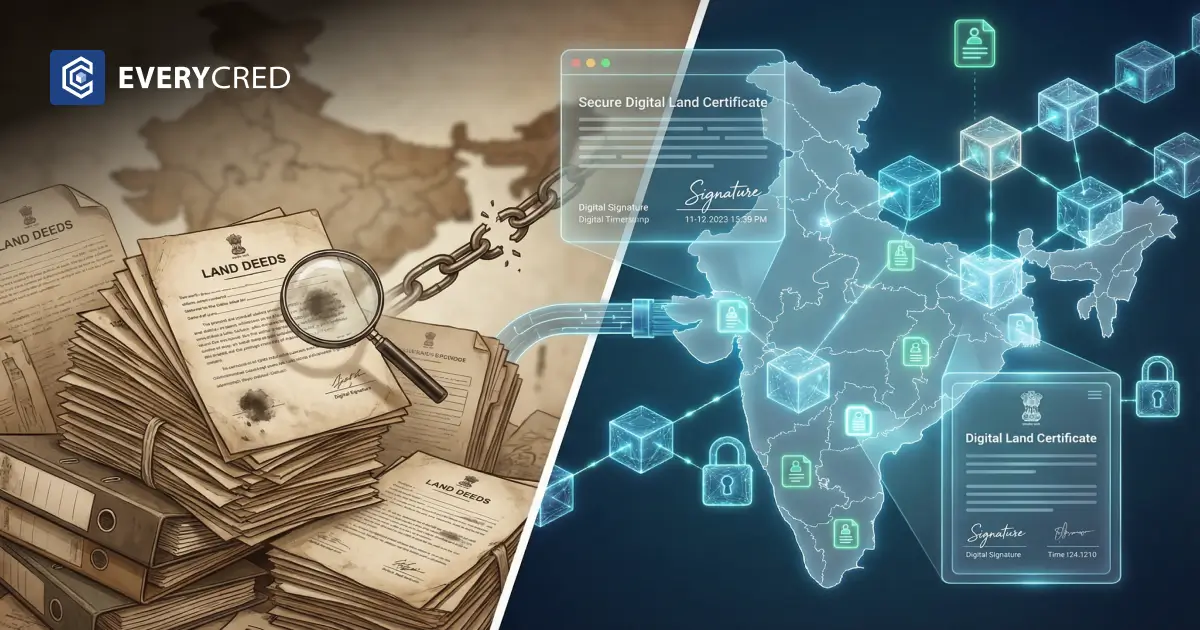
- India's Record Fraud Problem Is a Design Problem
- What Blockchain Credentials Actually Change
- The Countries That Moved First
- India Is Moving, But Scale Demands a Unified Framework
- What a Working Implementation Looks Like in Practice
- The Accountability Gap That Blockchain Credentials Close
- EveryCRED Is the Ultimate Solution
- The Architecture Is Ready. The Decision Is Governance.


On February 9, 2026, Rajya Sabha MP Raghav Chadha stood before Parliament with a specific proposal: a National Blockchain Property Register to replace India’s fragmented land record system. He backed it with hard numbers, 66% of India’s civil disputes involve land, 45% of properties lack clear titles, and 6.2 crore documents remain undigitized. Simple property sales take 2 to 6 months. Dispute resolution averages 7 years.
His argument was structural. India’s record-keeping system is vulnerable not because of poor intention, but because of poor architecture. Physical documents get altered. Centralized databases get manipulated. Scanned PDFs carry no cryptographic proof of authenticity.
Blockchain credentials address this at the infrastructure level, before documents are forged, not after fraud is detected.
India’s Record Fraud Problem Is a Design Problem
The vulnerability in government records is not random. It is built into how records are stored and verified. A physical land certificate can be altered with basic tools. A centralized database entry can be changed by anyone with sufficient access. A scanned document looks identical whether it is genuine or forged. Verification requires contacting the issuing authority, creating delays, corruption opportunities, and inconsistencies.
The numbers Chadha cited in Parliament confirm the scale:
- India ranks 133rd out of 190 countries in property registration efficiency
- 66% of civil court cases are land-related
- 6.2 crore property documents remain undigitized
- Average court resolution for a property dispute: 7 years
Decentralized records solve this structurally. When a record is issued as a blockchain credential, it is cryptographically signed. Any change to that record, any character, field, or date, invalidates the signature. Tampering becomes detectable without human review.
What Blockchain Credentials Actually Change
A blockchain credential is a digitally signed document whose integrity anyone can verify at any time without contacting the issuing authority. When a government department issues a land title, birth certificate, or professional license as a verifiable credential, the record contains:
- The issuer’s decentralized identifier (DID)
- The subject’s identity claims
- A cryptographic signature from the issuing authority
- A timestamp anchored to the blockchain
If any field is changed after issuance, the signature becomes invalid. This is what makes blockchain credentials structurally different from a scanned document or a database row.
The W3C finalized the Verifiable Credentials Data Model as an international standard. Credentials issued on one platform can be verified by another, across departments, states, and countries, without manual coordination. One verified land title should be reusable for tax filing, court proceedings, and service applications without resubmission. Decentralized records built on open standards make that possible.
The Countries That Moved First
Estonia is the most documented example of government-scale blockchain implementation. Over 99% of public services run on digital infrastructure secured by the KSI (Keyless Signature Infrastructure) blockchain.
Every government record, healthcare, property, business registry, succession is anchored via cryptographic hashing. If any record changes, the hash changes and the tamper is detected immediately. According to PricewaterhouseCoopers, Estonia saves 1,400 years of working time annually through this model.
Decentralized identity infrastructure at national scale removes the single point of failure that centralized databases create. There is no master database to corrupt. Verification does not require the issuing authority to be online or available.
Dubai moved in the same direction with an explicit government mandate, migrating all official documents to blockchain, targeting an 85% reduction in document processing time. Both implementations share one feature: verification happens at the point of use, not weeks later through manual review.
India Is Moving, But Scale Demands a Unified Framework
India’s policy infrastructure for blockchain credentials is developing rapidly. In February 2026, MeitY launched the Blockchain India Challenge with an ₹8.80 crore prize pool, implemented by C-DAC. Its objective: promote secure, transparent, and tamper-proof governance using permissioned blockchain, specifically for land records, healthcare, public distribution, and document verification.
Pilots are already active:
- Chandigarh and Telangana have tested blockchain for land records
- Dantewada adopted Avalanche blockchain for property records in 2025
- Maharashtra has piloted verifiable credentials for official government records
The challenge now is scaling. Individual pilots do not equal a national framework. Government agencies evaluating this infrastructure need a clear path from physical and centralized records to a system that integrates with existing software and supports cross-department use.
What a Working Implementation Looks Like in Practice
When blockchain credentials are deployed correctly, three functions become automated:
Issuance
- The citizen receives a digitally signed credential directly into a digital wallet
- The issuing authority signs it with their DID, creating an immutable audit trail
- No physical document is required; the credential is the proof
Verification
- Any authorized verifier, another department, a border post, or a service counter queries the credential
- The system validates the cryptographic signature against the blockchain in real time
- No manual review, no call to the issuing authority
Revocation
- When a license expires or is suspended, the status updates across all verification points in real time
- The credential returns as invalid when queried, no recall process required
This verify-once, reuse-everywhere model is what the 2026 digital identity framework describes as the baseline for modern public services. One issued verifiable credential serves multiple departments without the citizen resubmitting documents.
The Accountability Gap That Blockchain Credentials Close
Traditional government records have no built-in accountability chain. A database entry can be altered with no automatic detection. An official can reissue a document with a modified date. Physical records can be destroyed.
Blockchain credentials change this. Every issuance, verification, and revocation event is logged in an immutable trail. Regulators, auditors, and courts can verify the full history of any credential without relying on the issuing department.
A 2025 security analysis by the Belfer Center found that centralized, editable systems with insufficient access controls are the common factor in public sector identity fraud, which increased over 40% in five years. Decentralized records remove that vulnerability at the foundation, not through policy, but through cryptographic architecture.
EveryCRED Is the Ultimate Solution
EveryCRED’s public sector infrastructure supports the full credential lifecycle, issuance, real-time verification, and revocation, built on W3C-compliant verifiable credentials and anchored on blockchain.
Government of Maharashtra, Raigad Police, and Navi Mumbai Police already use the platform. Integration works via REST APIs alongside existing ERP and legacy systems, with no full replacement required.
For departments evaluating blockchain credential infrastructure, schedule a demo to see how your department’s records migrate to tamper-proof, independently verifiable credentials.
The Architecture Is Ready. The Decision Is Governance.
Raghav Chadha’s parliamentary proposal matters not because it introduced a new idea, but because it confirms that government leadership in India recognizes the structural problem. The technology is not experimental. The W3C standards are ratified. The international precedents are documented.
The question is no longer whether governments should adopt blockchain credentials. It is how quickly they can move from isolated pilots to connected, interoperable systems that serve citizens at national scale. Decentralized records are not a future state. For the governments that have committed to them, they are already the present.