10th April, 2026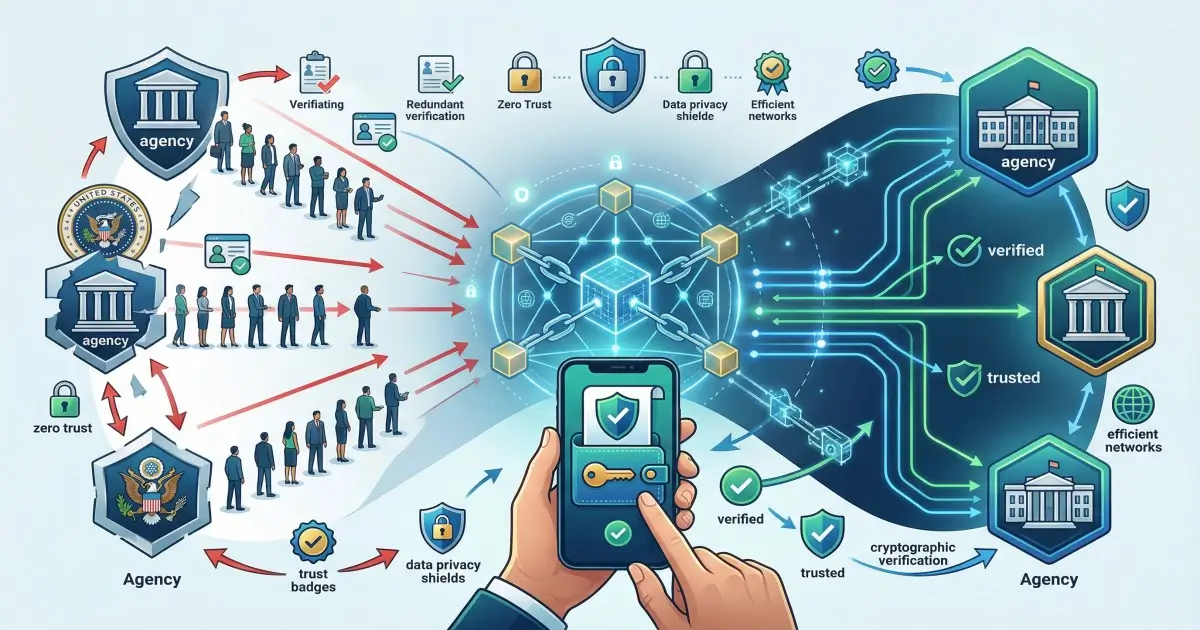
- Federal Agencies Verify the Same Person Multiple Times: Here Is the Real Cost
- Why Current Identity Systems Cannot Solve an Inter-Agency Problem
- How Blockchain Identity Solutions Work Across Agency Boundaries
- NIST SP 800-63-4 Sets a New Baseline: What Federal IT Teams Must Now Address
- Decentralized Identity Eliminates the Need to Re-Verify the Same Person Twice
- The Privacy Case That Federal Security Leaders Cannot Overlook
- EveryCRED Provides the Infrastructure Federal Agencies Need Right Now
- Conclusion
- FAQs


When a veteran applies for healthcare benefits, the Department of Veterans Affairs requests identity documents. When that same person files for Social Security, the Social Security Administration asks again.
When they access a federal employment portal, the process repeats. Each agency maintains its own identity database. None of them share verification results. The same person proves the same identity multiple times to different parts of the same government.
This is the cross-agency verification problem. It costs time, budget, and creates security risks at every duplicate entry point. Blockchain identity solutions address this directly. They allow a credential verified by one agency to be trusted by another, without duplicating the data or compromising privacy.
Federal Agencies Verify the Same Person Multiple Times: Here Is the Real Cost
The U.S. government processes millions of identity verification requests every day. Each agency operates its own system. The result is structural redundancy with measurable consequences:
- Employees, contractors, and citizens submit the same documents to multiple departments
- Manual verification introduces delays, errors, and inconsistent standards across agencies
- Centralized identity databases at each agency create multiple, independent attack surfaces
- Agencies that need to share identity data face legal, technical, and operational barriers
- Fraud exploits the gaps between systems that do not communicate with each other
The scale of identity fraud in government programs runs into billions of dollars annually, and a significant share of it passes through verification gaps between agencies. This is not an operational inconvenience. It is a structural risk.
Why Current Identity Systems Cannot Solve an Inter-Agency Problem
Legacy identity infrastructure was built for each agency’s internal use. It was not designed for federation across organizational boundaries.
Several barriers block cross-agency trust today:
- Proprietary systems: Each agency uses different identity platforms that cannot exchange credentials in a standardized format
- No shared cryptographic trust layer: There are no signed agreements between agencies to recognize each other’s verified identity assertions
- Over-sharing of data: To verify a person, agencies transfer full identity records rather than specific, required attributes
- Audit complexity: When identity data crosses agency lines, tracking consent, access, and usage across systems becomes difficult to manage
The Cybersecurity and Infrastructure Security Agency’s Zero Trust Architecture report (January 2025) explicitly identifies the absence of trust agreements for interagency identity federation as a systemic weakness in federal ICAM infrastructure. This is a documented gap, not a theoretical one.
How Blockchain Identity Solutions Work Across Agency Boundaries
Blockchain identity solutions use cryptographic credentials to allow one agency to verify a person’s identity and issue a tamper-proof credential. Any other authorized agency can then verify that credential without contacting the issuing agency or accessing the original data.
The process involves three defined roles:
- Issuer: The agency that verifies identity and issues a signed credential (for example, GSA or DHS)
- Holder: The individual who stores the credential in a secure digital wallet
- Verifier: Any other agency that needs to confirm identity and checks the cryptographic proof
Each credential carries the issuing agency’s cryptographic signature. The verifier checks the signature against a public decentralized registry. If valid, identity is confirmed instantly. No database call to the issuing agency is required. No raw personal data is transferred between departments.
This model aligns with the verifiable credentials standard defined by the W3C, which is the technical baseline used in compliant government identity systems. Federal IT teams can integrate it with existing portals through open standard REST APIs without rebuilding their entire identity stack.
NIST SP 800-63-4 Sets a New Baseline: What Federal IT Teams Must Now Address
In August 2025, NIST published SP 800-63-4, the updated Digital Identity Guidelines. For the first time, the guidelines formally incorporate digital wallets and verifiable credentials into the federal identity federation model.
Key provisions relevant to cross-agency verification include:
- Digital wallets are now recognized as a valid method for identity presentation in federal systems
- The guidelines define Identity Assurance Levels (IAL), Authentication Assurance Levels (AAL), and Federation Assurance Levels (FAL) that apply directly to cross-agency credential exchanges
- Agencies must adopt risk-based, privacy-respecting identity proofing processes
- Expanded fraud detection requirements now apply to credential issuance and continuous evaluation
For security and IT leaders in federal agencies, these guidelines set the compliance floor. Any cross-agency identity architecture must meet them. Blockchain identity solutions built on W3C standards are technically positioned to satisfy these requirements out of the box.
Decentralized Identity Eliminates the Need to Re-Verify the Same Person Twice
Decentralized identity removes the need for a central authority to store and control all identity data. Each individual holds their own credential. Agencies verify it on demand.
This structure is directly applicable to multi-agency government workflows:
- A contractor verified by one federal department presents the same credentials to another without resubmitting documents
- Citizens accessing benefits across multiple agencies share only the specific attributes required, not full identity files
- Agencies receive cryptographic proof rather than raw data, which reduces their storage burden and legal liability
- Credential revocation happens in real time: when an issuing agency revokes a credential, every verifying party sees the updated status immediately
The digital trust model built on decentralized identity also supports the FICAM framework, which the GSA manages to standardize identity, credential, and access management across federal departments. Agencies that implement decentralized identity align with FICAM’s interoperability requirements without building new proprietary infrastructure.
For teams planning a rollout, the government implementation checklist for digital credentials covers the deployment phases agencies should follow to meet federal standards.
The Privacy Case That Federal Security Leaders Cannot Overlook
Decentralized identity is a privacy architecture improvement as much as a security one.
Under current systems, agencies transfer full identity records to process cross-department requests. This creates unnecessary data exposure at every handoff. Blockchain identity solutions allow selective disclosure. An agency can confirm that a person holds a valid security clearance without receiving their full personal record.
Research from the Brookings Institution confirms that blockchain-based record-keeping provides a tamper-resistant single source of truth, reducing both fraud risk and data disputes between agencies.
This selective disclosure approach also aligns with zero trust principles. Access to identity attributes is granted only for the specific verification required, not as a blanket data transfer. Agencies that adopt this model generate automated cryptographic audit logs that record every credential check without storing the actual identity data, which simplifies federal compliance reporting significantly.
For a broader look at how identity wallets support this model across government programs, the architecture has already been validated in state-level deployments and is scaling toward federal use.
EveryCRED Provides the Infrastructure Federal Agencies Need Right Now
Federal agencies need a platform that issues W3C-compliant verifiable credentials, supports decentralized identifiers, integrates with existing portals through open standard APIs, and generates the audit infrastructure that federal compliance requires.
EveryCRED is built for this environment. The platform supports the complete issuer-holder-verifier workflow, uses the EVRC DID method for cryptographically anchored identifiers, and is designed for cross-sector credential verification. Agencies issue credentials once. Authorized verifying parties across departments confirm them instantly without any raw data transfer.
EveryCRED also supports selective disclosure for privacy compliance, real-time revocation, and one-click verification for government staff. The platform integrates with existing government applications without requiring a full system overhaul. Federal IT teams evaluating identity modernization have a technically ready option that aligns with NIST SP 800-63-4, W3C standards, and FICAM requirements.
Schedule a demo to see how EveryCRED maps to your agency’s cross-verification workflows.
Conclusion
Federal agencies face a documented, structural identity verification problem. The same individuals are verified repeatedly across departments because no shared trust layer exists between systems. Blockchain identity solutions built on W3C verifiable credentials and decentralized identity standards provide a direct technical answer. Credentials issued by one agency become verifiable by others, without raw data transfers or duplicate verification cycles. NIST SP 800-63-4 and FICAM now establish the federal compliance framework that supports this model. The architecture is available, the standards are defined, and agencies that act now reduce both operational cost and security exposure.
FAQs
What are blockchain identity solutions for federal agencies?
Blockchain identity solutions use cryptographic credentials to enable secure, tamper-proof identity verification across government agencies without centralized databases.
How does decentralized identity improve cross-agency verification?
Decentralized identity lets agencies cryptographically verify credentials issued by other departments, eliminating redundant verification processes and data silos.
Are blockchain identity solutions compliant with NIST SP 800-63-4?
Yes. NIST SP 800-63-4 now includes digital wallets and verifiable credentials, aligning directly with blockchain-based decentralized identity frameworks for federal use.
What data sharing barriers do blockchain identity solutions solve?
They remove siloed databases by enabling agencies to share cryptographic proofs of identity rather than raw personal data, ensuring both privacy and security.
How does blockchain identity support zero trust in federal environments?
Blockchain verifiable credentials provide continuous, cryptographic identity assurance, which is a core pillar of the zero trust architecture mandated by CISA and OMB.