30th July, 2026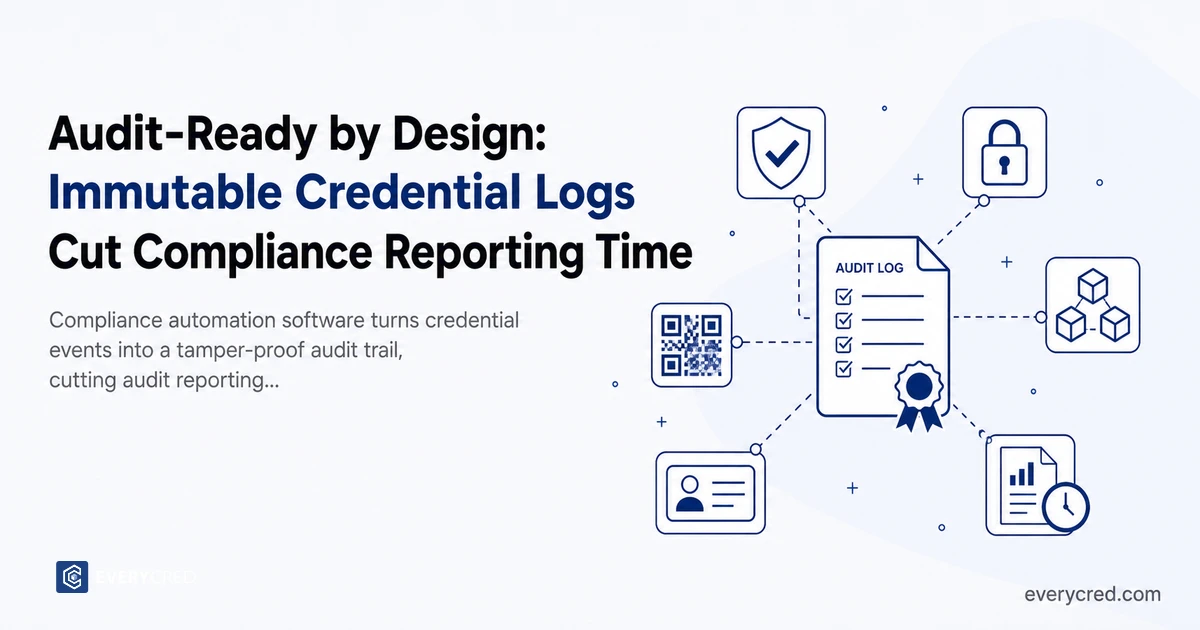
- Why Compliance Reporting Still Takes Weeks
- What an Immutable Credential Log Records
- How Compliance Automation Software Cuts Reporting Time
- Where Compliance Automation Software Meets NIST Standards
- What Audit-Ready Deployment Looks Like in Practice
- See Your Audit Trail Before Your Next Review
- Conclusion
- FAQs


Compliance automation software cuts audit reporting time by recording every credential event in one tamper-proof audit trail. Evidence assembly then takes hours instead of weeks. Compliance teams query a single immutable log that shows who issued, verified, or revoked each credential, and exactly when.
Government agencies and regulated enterprises lose days on audits because credential activity is fragmented. It lives in email threads, spreadsheets, and legacy databases that were never built to prove anything. When an auditor asks who verified a clearance last spring, the answer takes a manual search across disconnected tools.
This use case guide explains what an immutable credential log records and how compliance automation software converts those records into audit reports. It also shows how the model maps to standards like NIST SP 800-63-4. The deployment results are measurable.
Key Takeaways
- Compliance automation software converts scattered credential events into one immutable audit trail, reducing audit prep from weeks to hours.
- Every issuance, verification, and revocation is time-stamped and cryptographically anchored, so auditors see who did what and when.
- Immutable logs align with NIST SP 800-63-4 and W3C Verifiable Credentials 2.0 accountability requirements.
- Raigad Police cut verification from 30 minutes to under 10 seconds and reduced administrative overhead by 85% using this model.
Why Compliance Reporting Still Takes Weeks
Most agencies cannot produce a clean audit trail on demand because credential activity is scattered. Verification happens in one system, issuance in another, and revocation in a third. None of them shares a record.
When an auditor asks who verified a contractor’s clearance last March, the compliance team starts a manual search. They pull logs from separate tools, reconcile timestamps, and hope nothing was edited or deleted. Weeks disappear here.
Consider Dana, an internal audit lead at a state IT department. Her team spent three weeks assembling evidence for one access review, then found that two systems disagreed on a revocation date. Without a tamper-proof record of credential events, she could not prove which log was correct.
This is the core failure. Disconnected systems record credential events inconsistently, and none are built to serve as audit evidence for public sector agencies.
What an Immutable Credential Log Records
An immutable credential log records every credential event as a permanent, time-stamped entry. Once written, the entry cannot be altered or deleted without breaking its cryptographic signature.
Each entry captures four things: the action taken, the actor who took it, the exact time, and the credential involved. Together, they answer the question every auditor asks, which is who verified what and when.
The log covers the full credential lifecycle:
- Issuance: when a credential is created and who signed it.
- Verification: each time a verifier checks a credential, including offline checks synced later.
- Revocation: the moment a credential is invalidated and by whom.
- Presentation: when a holder shares a credential with a verifier.
EveryCRED anchors each entry with SHA-512 hashing, so the immutable logs become secure records that hold up under scrutiny. This is the same principle behind blockchain systems that secure public records against tampering.
How Compliance Automation Software Cuts Reporting Time
Compliance automation software cuts reporting time by making the audit trail a byproduct of daily operations, not a separate project. The evidence is already written, structured, and searchable before the audit begins.
Instead of a manual hunt, an auditor filters the log by date, credential type, or actor and exports the result. A report that once took weeks is generated in minutes. The output stays consistent because it draws from one source.
Maria, a compliance officer at a regulated enterprise, replaced her quarterly evidence scramble with a single query. Her last access-control review took two hours instead of the usual 11 days. The immutable logs gave her a defensible record without one email request.
This is the practical value of compliance automation software for audit-heavy teams. It removes the reconciliation step, because there is only one record of credential events to reconcile against.
Where Compliance Automation Software Meets NIST Standards
Audit readiness is about more than speed. Federal and enterprise auditors need evidence that meets accountability standards, and an immutable audit trail maps directly to those requirements.
NIST SP 800-63-4, finalized in 2025, sets identity and authentication assurance requirements that legacy credential systems do not fully log. An immutable record of credential events supports the accountability and auditability those controls expect.
The financial case is clear, too. The U.S. Government Accountability Office estimates annual federal fraud between $233 billion and $521 billion. Much of it ties to identity gaps that no audit trail ever caught. You can review the scale of the problem through the GAO.
Standards this model aligns with include:
- NIST SP 800-63-4: identity assurance and accountability logging.
- W3C Verifiable Credentials 2.0: interoperable, cryptographically verifiable credential formats.
- Immutable audit trail: tamper-evident records for FISMA-style and internal reviews.
What Audit-Ready Deployment Looks Like in Practice
Live government deployments prove that audit readiness by design works. The measurable results come from operational systems handling real credential events every day.
Raigad Police deployed digital officer credentials that field teams verify in under 10 seconds, down from 30 minutes with paper checks. Administrative overhead dropped by 85%, and every verification wrote an entry to an immutable audit trail. Officers verified credentials offline, and the log synced once connectivity returned.
Supervisors can now reconstruct which officer was verified, where, and when, without a manual search. The model that modernized the Maharashtra Police deployment gives US agencies the audit trail they need for accountability reviews.
For enterprise and government buyers, audit-ready digital credentials replace the evidence scramble with a query. The immutable logs are the report, so compliance automation software becomes a record of credential events you can defend.
See Your Audit Trail Before Your Next Review
We built EveryCRED so every credential event writes to an immutable audit trail automatically. Compliance and audit teams get a defensible record from day one. Agencies replace weeks of evidence assembly with a single query, and the log meets NIST SP 800-63-4 accountability expectations. US government buyers can procure through Carahsoft on NASA SEWP V, ITES-SW2, and NASPO ValuePoint, with no new competitive bid required. Our compliance automation software integrates via REST API with no front-end changes to existing systems. Book a demo to see the audit trail in action.
Conclusion
Audit reporting takes weeks when credential activity is scattered across systems that were never built to prove anything. An immutable audit trail changes the economics of compliance by recording every credential event as it happens.
Compliance automation software turns that record into fast, consistent audit reports, mapped to NIST SP 800-63-4 and W3C standards. The Raigad Police results show the model works at operational scale, with an 85% cut in administrative overhead.
Compliance officers, internal audit leads, and risk managers no longer choose between speed and defensibility. Immutable logs deliver both, and the next audit becomes a query against one source of truth instead of a three-week search.
FAQs
What is compliance automation software for credentials?
It records every credential event in an immutable audit trail and generates audit reports automatically, cutting manual evidence work.
How do immutable logs reduce audit reporting time?
Immutable logs store all credential events in one searchable source, so auditors export evidence in minutes instead of weeks.
Can an audit trail prove who verified a credential and when?
Yes, each entry records the action, the actor, the exact time, and the credential, giving auditors a defensible record.
Does an immutable credential log meet NIST SP 800-63-4?
Yes, immutable logs support the accountability and auditability that NIST SP 800-63-4 identity assurance controls expect from agencies.
Can government agencies buy compliance automation software through existing contracts?
Yes, US agencies procure EveryCRED through Carahsoft on NASA SEWP V, ITES-SW2, and NASPO ValuePoint without new bids.