11th June, 2026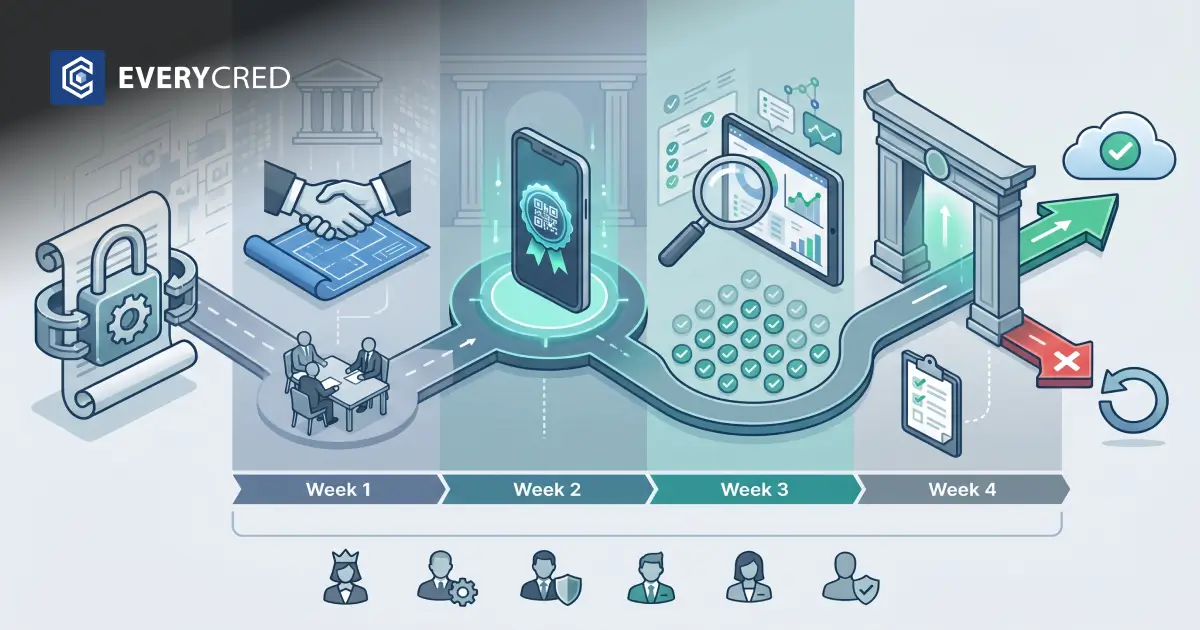
- Why Most Government Credential Platform Pilots Stall in Week One
- Freeze the Scope Before Day One: The Pilot Charter
- Pilot Governance: Who Owns What
- The 30-Day Credential Platform Pilot Plan, Week by Week
- Pilot Success Metrics That Justify Production
- The Go/No-Go Gate: A Decision the Agency Can Defend
- Run Your Pilot Workshop With EveryCRED
- Conclusion
- FAQs


A credential platform pilot should run as a 30-day, scope-frozen plan with named governance roles, quantified success metrics, and a written go/no-go gate. That structure is what separates a pilot who issues and measures real credentials from one who stalls in week one. Most government pilots fail before a single credential is created, because the first three weeks dissolve into scope debate.
This guide gives programme managers a 30-day plan they can run the day after signing. It defines who owns what, what to measure, and how to decide whether to move to production. The plan is built from EveryCRED government deployment experience, where statewide rollouts reach a working pilot by week 20 only because the pilot scope is locked early.
Key Takeaways
– A credential platform pilot needs a frozen scope, a governance RACI, and a written go/no-go gate before day one.
– The 30-day plan issues credentials by week 2 and collects measured results by week 4.
– Seven pilot success metrics, including verification time and cost per check, decide the go/no-go outcome.
– A successful agency pilot can convert to production through NASA SEWP V or ITES-SW2 without a new procurement cycle.
Why Most Government Credential Platform Pilots Stall in Week One
The most common failure mode is not technical. It is the absence of a frozen scope. Dana, a programme manager at a state workforce agency, signed a strong pilot contract in January. Her team spent the next three weeks debating which credential type to start with, which division would verify, and whether to include mobile issuance. No credential was issued until week five. The pilot ran out of runway before it produced a single number.
This pattern repeats across agencies. A pilot that lacks predefined success criteria cannot be judged, so it drifts. Four conditions cause most stalls:
- No frozen scope, so every meeting reopens what the pilot covers.
- No named owner for the integration, so the technical work has no driver.
- No success metrics, so there is nothing to measure at the end.
- No executive sponsor, so decisions escalate and wait.
A credential platform pilot avoids each of these by deciding them in advance. The cost of not doing so is concrete. A stalled pilot burns the contract period and often the fiscal-year window that justified the purchase. Agencies evaluating verification economics can review a government credential cost analysis to frame what the pilot is trying to prove.
Freeze the Scope Before Day One: The Pilot Charter
The pilot charter is a one-page artifact that locks scope before kickoff. It names one use case, one credential type, one integration, and one verifier group. Anything outside those four boundaries is documented as explicitly out of scope for the pilot.
A tight scope is what makes a 30-day plan achievable. Marcus, an innovation officer at a federal civilian agency, ran his agency pilot with a single credential: a contractor access credential for one facility. He resisted pressure to add employee badges and grant eligibility in the same pilot. By holding the line, his team issued the first credentials on day nine and had measured results before the month ended.
The charter should record four decisions in plain language:
- The single credential type that the pilot will issue and verify.
- The one system the credential platform will integrate with.
- The target assurance level is mapped to NIST SP 800-63-4 identity and authentication tiers.
- The verifier group that will scan and confirm credentials in the field or at a desk.
Want to see how a scope-frozen pilot maps to your agency’s systems? A verifiable credential platform built on W3C standards keeps the integration surface small enough to test in 30 days.
Pilot Governance: Who Owns What
Pilot governance assigns a single owner to every decision, so nothing waits for a committee. The plan uses a six-role RACI that fits the size of a 30-day pilot without adding overhead. Each role has one clear responsibility.
| Configures the credential platform, trains the team, and supports issuance. | Responsibility in the pilot |
|---|---|
| Executive Sponsor | Approves scope, removes blockers, owns the go/no-go decision. |
| Programme Manager | Runs the 30-day plan, tracks milestones, reports weekly. |
| Technical / Integration Lead | Owns API connection to the one chosen system. |
| Security & Privacy Reviewer | Confirms NIST and FedRAMP alignment, reviews data handling. |
| Vendor Lead | Configures the credential platform, trains the team, supports issuance. |
| End-User Champion | Represents verifiers and recipients, drives adoption. |
Strong pilot governance also sets a decision cadence. A weekly 30-minute checkpoint keeps the programme manager, technical lead, and sponsor aligned. Decisions made in that meeting are final for the week, which prevents the scope drift that kills pilots. Agencies running credentials across divisions can borrow patterns from multi-agency identity management when the pilot later scales.
The 30-Day Credential Platform Pilot Plan, Week by Week
This is the core of the plan. Each week has one milestone and a clear exit condition. The programme manager checks the exit condition before the pilot moves to the next week.
Week 1: Kickoff and scope freeze. Hold the kickoff workshop, sign the pilot charter, and grant environment and API access. Confirm the target assurance level against NIST SP 800-63-4. Exit condition: the charter is signed, and the technical lead has API credentials.
Week 2: Issue the first credentials. Configure the credential template and issue the first batch to the verifier group. Integrate the credential platform with the chosen system through its REST API. Exit condition: real credentials exist in holder wallets.
Week 3: Roll out verification. Deploy QR or offline verification to the verifier group and begin collecting metrics on every check. Capture verification time, success rate, and any failed scans. Exit condition: Verifiers complete at least 100 live checks.
Week 4: Measure and assemble the decision package. Compare results against the success thresholds and write the go/no-go package for the sponsor. Document integration effort, adoption, and audit-log completeness. Exit condition: the sponsor has a written recommendation.
This sequence works because the agency pilot proves issuance early, then spends the back half of the month gathering evidence. EveryCRED uses the same front-loaded approach in statewide rollouts, where a working pilot is operational by week 20 of a 36-week program.
Pilot Success Metrics That Justify Production
A pilot is only useful if it produces numbers the agency can defend. Define the metrics and their target thresholds in the charter, then measure them in weeks 3 and 4. Seven metrics cover the decision.
| Metric | Target threshold |
|---|---|
| Verification time per check | Under 10 seconds |
| Cost per verification | Under $0.10 |
| Issuance throughput | Full pilot batch issued in one session |
| Integration effort | Working API connection in under 5 working days |
| User adoption | 80% of the verifier group actively scanning |
| Audit-log completeness | 100% of events logged with timestamp and actor |
| Revocation latency | Status change reflected at next verification |
These thresholds are grounded in measured deployments. Raigad Police cut credential verification time from 30 minutes to under 10 seconds and reduced administrative overhead by 85% after deploying digital officer IDs. A pilot does not need to match every production number, but it should show movement toward them. Manual verification costs $15 to $25 per check across most agencies, which is the baseline the pilot’s cost-per-check metric should beat.
The Go/No-Go Gate: A Decision the Agency Can Defend
The go/no-go gate turns pilot results into a written decision that the sponsor can sign. It uses three clear bands, so the outcome is not a judgment call.
- Go: The pilot met at least six of seven metrics, including verification time and audit-log completeness. Move to production planning.
- Conditional go: The pilot met four or five metrics. Address the gaps in a two-week extension, then re-decide.
- No-go: The pilot met three or fewer metrics. Document the reasons and stop.
A defensible gate matters because procurement and oversight teams will ask how the agency reached its decision. A written package with measured metrics answers that question directly. Agencies that ran a structured evaluation earlier can reuse their credential RFP checklist to confirm that the pilot validated each requirement.
A go decision also has a clean path forward. Because EveryCRED is available on federal contract vehicles, a successful agency pilot converts to production without a new competitive procurement. That removes the months of delay that usually follow a successful pilot.
Run Your Pilot Workshop With EveryCRED
We run credential platform pilots as 30-day plans with a frozen scope, named governance roles, and a written go/no-go gate. Our deployment teams have taken government programs from kickoff to a working pilot by week 20 of a statewide rollout, integrating through REST APIs with no front-end changes to existing systems. Every credential event is written to an immutable audit trail, so your decision package is backed by evidence, not estimates. U.S. agencies can deploy through NASA SEWP V and ITES-SW2 with no new procurement cycle. Book a pilot kickoff workshop to lock your scope and start issuing credentials in the first two weeks.
Conclusion
A credential platform pilot succeeds when it is structured before it starts. Freeze the scope to one credential, one integration, and one verifier group. Assign pilot governance with a single owner per decision and a weekly checkpoint. Run the 30-day plan so credentials are issued by week 2 and measured by week 4. Then judge the agency pilot against seven success metrics and a written go/no-go gate. Programme managers who follow this plan replace three lost weeks of scope debate with measured results. The agencies that win in 2026 will be the ones that treat the pilot as a decision instrument, not an open-ended experiment.
FAQs
What is a credential platform pilot?
It is a time-boxed test of a credential platform against one use case, with defined success metrics and a go/no-go decision at the end.
How long should a government credential platform pilot take?
Thirty days is enough when the scope is frozen to one credential type, one integration, and one verifier group before kickoff.
Who should own a credential platform pilot inside an agency?
A programme manager runs the day-to-day plan, while an executive sponsor approves the scope and owns the final go/no-go decision.
What metrics decide a pilot’s go/no-go gate?
Verification time, cost per check, issuance throughput, integration effort, user adoption, audit-log completeness, and revocation latency decide the outcome.
Can a successful pilot move to production without new procurement?
Yes, agencies can convert a successful pilot to production through NASA SEWP V or ITES-SW2 without running a new competitive procurement cycle.