1st January, 2026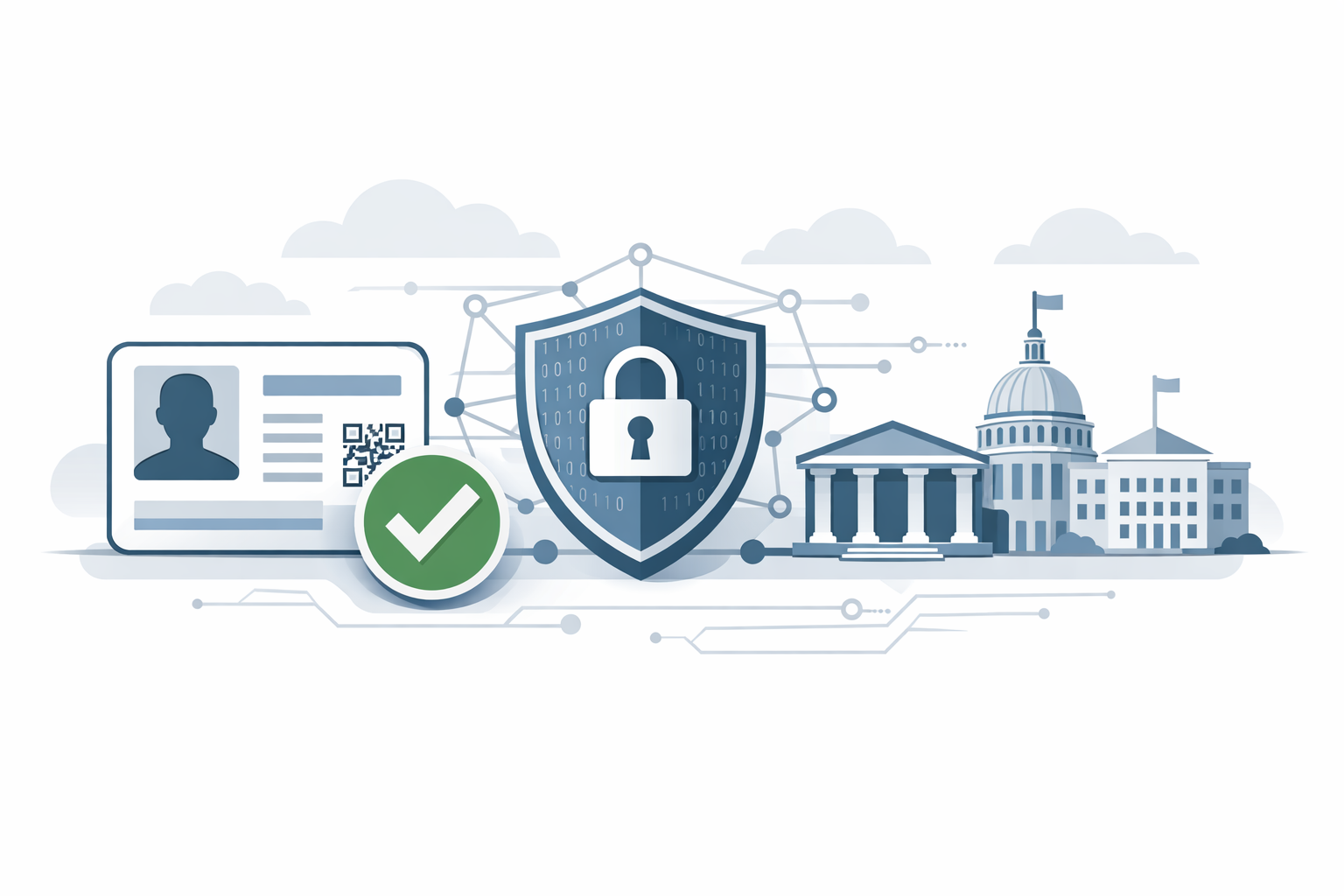
- Related Concepts
- TL;DR Summary
- Why do US government agencies need credential verification software?
- What types of credentials do government agencies verify?
- How does credential verification software work?
- What security and compliance requirements apply in the US?
- What standards should credential verification software support?
- How do government agencies evaluate credential verification software?
- When is credential verification software most relevant?
- Who should be involved in the buying decision?
- What are common limitations and edge cases?
- How does EveryCRED fit into this category?
- Wrap-Up


Credential verification software for government agencies is a class of information systems used to issue, verify, and manage the authenticity of digital or physical credentials such as identity cards, licenses, permits, certifications, clearances, or eligibility documents used in government operations.
These systems ensure that credentials presented by individuals or organizations are valid, untampered, and issued by an authorized authority.
Related Concepts
- Digital Credentials: Electronic representations of identity attributes or qualifications.
- Verifiable Credentials (VCs): Cryptographically signed digital credentials defined by the World Wide Web Consortium.
- Identity Proofing: The process of verifying that a person is who they claim to be.
- Public Key Infrastructure (PKI): A framework for encryption and digital signatures.
- Zero Trust Architecture: A security model requiring continuous verification.
- FedRAMP: US government program for cloud security authorization.
- FISMA: Federal Information Security Modernization Act.
- NIST: National Institute of Standards and Technology guidelines for identity and security.
Terminology is used consistently throughout this page.
TL;DR Summary
- Credential verification software helps US government agencies confirm the authenticity of identities, licenses, and official records.
- These systems reduce fraud, manual verification effort, and inter-agency data silos.
- Government buyers must evaluate compliance, security architecture, interoperability, and scalability.
- Not all credential systems support modern standards like Verifiable Credentials.
- This guide supports procurement teams in making an informed, standards-aligned decision.
Why do US government agencies need credential verification software?
US government agencies manage millions of credentials across federal, state, and local levels. Manual or fragmented verification processes introduce risk.
Credential verification software matters because it:
- Prevents identity fraud and credential forgery.
- Reduces manual checks and paper-based workflows.
- Enables faster eligibility decisions for services and benefits.
- Supports secure data sharing between agencies.
- Aligns with Zero Trust and digital government initiatives.
Without centralized verification systems, agencies rely on siloed databases, phone calls, or document scans, which increases operational cost and error rates.
What types of credentials do government agencies verify?
Credential verification software is used across multiple credential categories.
Identity Credentials
- National or state ID cards
- Employee and contractor badges
- Law enforcement credentials
Eligibility & Authorization Credentials
- Security clearances
- Professional licenses
- Work permits and visas
- Benefit eligibility records
Educational & Training Credentials
- Degrees and certifications
- Government training completions
- Compliance certificates
Each credential type has different verification requirements, risk profiles, and retention policies.
How does credential verification software work?
Credential verification software follows a structured technical process.
Credential Issuance
- An authorized agency issues a credential.
- The credential is digitally signed or recorded in a secure registry.
- Metadata defines issuer, subject, validity period, and revocation rules.
Credential Presentation
- A holder presents the credential digitally or via a reference.
- Presentation may be online or offline depending on system design.
Verification
- The system validates:
- Issuer authenticity
- Credential integrity
- Expiration and revocation status
- Cryptographic verification replaces manual inspection.
Audit & Logging
- Verification events are logged.
- Logs support audits, investigations, and compliance reporting.
Systems using Verifiable Credentials enable verification without direct database access, reducing data exposure.
What security and compliance requirements apply in the US?
Government credential systems must meet strict regulatory and security standards.
Key Regulatory Frameworks
- FISMA for information security controls
- NIST SP 800-53 / 800-63 for identity assurance
- FedRAMP for cloud-hosted systems
- State-level privacy and data protection laws
Security Expectations
- End-to-end encryption
- Role-based access control
- Tamper-evident logs
- Revocation and expiration management
- Disaster recovery and availability guarantees
Procurement teams should require documented compliance mappings during evaluation.
What standards should credential verification software support?
Standards determine interoperability and future readiness.
Essential Standards
- W3C Verifiable Credentials
- Decentralized Identifiers (DIDs) where applicable
- JSON-LD or equivalent structured formats
- OAuth 2.0 / OpenID Connect for access control
Why standards matter
- Enable cross-agency verification
- Reduce vendor lock-in
- Support long-term credential portability
- Align with federal digital identity strategies
Non-standard systems often require custom integrations and limit reuse.
How do government agencies evaluate credential verification software?
Procurement teams typically assess solutions across several dimensions.
Functional Fit
- Credential types supported
- Verification speed and accuracy
- Revocation and update handling
- Offline verification capabilities
Architecture
- Centralized vs distributed models
- On-premise, cloud, or hybrid deployment
- Integration with existing IAM and case systems
Compliance & Security
- FedRAMP authorization status
- NIST alignment documentation
- Audit logging and reporting features
Scalability
- Ability to handle millions of credentials
- Performance under peak demand
- Multi-agency or multi-jurisdiction support
Vendor Viability
- Long-term roadmap alignment
- Support and SLA structure
- Data ownership and exit options
When is credential verification software most relevant?
Credential verification software is especially relevant when agencies:
- Modernize legacy identity systems
- Launch digital citizen services
- Share credentials across departments
- Replace paper-based verification
- Respond to increased fraud or impersonation incidents
Agencies with high verification volume or public-facing services benefit most.
Who should be involved in the buying decision?
Credential verification affects multiple stakeholders.
Primary Decision-Makers
- Procurement and contracting officers
- CIO and CISO teams
- Digital transformation leaders
Supporting Stakeholders
- Legal and compliance teams
- Program administrators
- Data governance officers
Early cross-functional involvement reduces deployment risk.
What are common limitations and edge cases?
No credential verification system is universal.
Common Limitations
- Legacy systems may not support modern standards
- Offline verification may be constrained by device trust
- Inter-state or inter-agency trust frameworks require governance agreements
Edge Cases
- Credentials issued before system adoption
- Cross-border or federal–state interoperability
- Revocation latency in distributed systems
These factors should be addressed during requirements definition.
How does EveryCRED fit into this category?
EveryCRED is a credential verification platform designed around W3C Verifiable Credentials.
It supports:
- Standards-based credential issuance and verification
- Cryptographic verification without shared databases
- Government-aligned security and audit controls
- Interoperable credential formats
Its architecture aligns with agencies seeking standards compliance and long-term interoperability.
Wrap-Up
Credential verification software plays a critical role in how US government agencies validate identity, eligibility, and authorization at scale. As agencies modernize services and increase inter-agency collaboration, manual or fragmented verification methods introduce security, compliance, and operational risk.
For procurement teams, the evaluation should focus on:
- Clear alignment with federal and state security requirements
- Support for recognized standards such as Verifiable Credentials
- Interoperability across agencies and systems
- Auditability, revocation handling, and long-term governance
- Deployment models compatible with existing infrastructure
No single system fits all agencies or use cases. Selection depends on credential types, verification volume, regulatory obligations, and integration constraints. Documented standards support, security controls, and operational transparency are more important than feature breadth.
Fill the inquiry form to book a free demo with us.