22nd April, 2026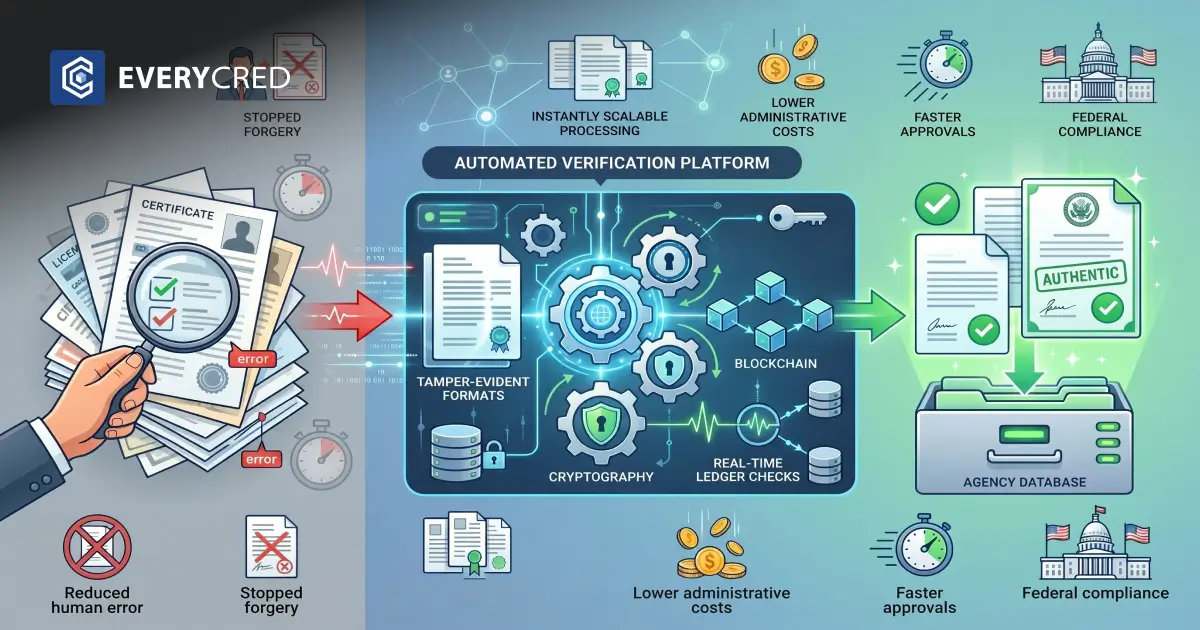


Government agencies manage millions of licenses, certificates, and employee records every year. Compliance agencies face significant operational delays when they rely on physical documents. Manual verification causes administrative errors and slows essential operations. Workers spend hours calling issuing institutions or emailing credential holders to confirm document authenticity. Agencies are adopting automated systems to solve this exact problem. Modern credentials verification platforms check records against secure databases instantly. This shift replaces vulnerable paper trails with cryptographically secure data.
Human Error Stalls Critical Public Services
Compliance teams process thousands of files daily. Manual verification creates severe bottlenecks in the approval pipeline. Human workers experience fatigue and miss expertly forged documents. Relying on visual inspections leads to dangerous compliance gaps.
The U.S. Government Accountability Office reported severe oversight failures in community care programs due to manual checks. The GAO-16-795 report highlighted how unverified healthcare staff entered the federal system because agencies lacked automated verification tools. The report identified systemic issues and oversight failures that occur when organizations depend on slow, human-led verification processes. The solution requires automated systems. Agencies must deploy digital credential software to stop fraud and ensure public safety.
Cryptography Secures the Issuance Process
Physical documents and standard PDFs are obsolete for high-security environments. Agencies now use cryptographically secure records to manage compliance.
Core Components of Modern Systems
- Tamper-evident formats: Digital records show any unauthorized edits immediately. The system rejects the file if a user alters a single character.
- Instant authentication: A credentials verification platform validates data in seconds without human intervention.
- Format standardization: Organizations issue digital credentials to unify data structures across departments.
- Immutable storage: Administrators rely on blockchain digital credentials to create records that hackers cannot delete or modify.
The verification process relies on mathematics instead of visual inspection. The issuing authority generates a unique cryptographic hash for the document. The system stores this hash on a public ledger. The software compares the submitted document’s hash to the ledger’s hash. A match confirms authenticity. A mismatch triggers an immediate compliance alert.
Federal Standards Demand Cryptographic Proof
The government enforces strict rules for identity assurance. Physical ID cards and paper certificates fail to meet modern cybersecurity requirements. The National Institute of Standards and Technology outlines Personal Identity Verification for federal employees and contractors in the FIPS 201-3 standard. This standard requires secure, cryptographically verified, and interoperable identity frameworks.
Agencies need compliant software to meet these precise requirements. Robust credentials verification matches these federal demands exactly. Automated systems ensure that only authorized personnel access sensitive government systems or perform regulated duties. Compliance teams rebuild trust in public services by removing human bias and error from the verification process.
Eradicating Document Forgery With Automated Checks
Bad actors forge physical licenses easily using basic image editing software. Automation prevents this illegal activity entirely. Digital credential software operates on a zero-trust model. The system assumes every submitted document is invalid until cryptographic proof confirms otherwise.
Security Mechanisms in Action
- Real-time validation: Software connects directly to the issuing authority ledger. It does not rely on third-party aggregators.
- Decentralized ledgers: The system stores cryptographic proofs instead of raw personal data. This protects citizen privacy.
- Risk reduction: Organizations build a digital trust service to stop data breaches and maintain strict regulatory compliance.
- Revocation tracking: The system instantly flags credentials that an issuing body has revoked or suspended.
A manual process might approve a suspended medical license if the expiration date looks valid. An automated system checks the live status of the license directly at the source. Compliance teams use digital credential software to approve authentic records with absolute certainty.
Scaling Oversight Without Increasing Budgets
Government compliance agencies face strict budget limitations. Hiring more staff does not solve verification backlogs efficiently. Adding human workers increases overhead costs and introduces more opportunities for human error. Software scales operations infinitely without a proportional increase in costs.
Operational Efficiency Metrics
- Administrative cost reduction: Automated systems lower the cost per verification from dollars to fractions of a cent.
- High-volume processing: Systems handle tens of thousands of background checks and license validations simultaneously.
- Program expansion: Scalable credentials solutions benefit organizations and individuals by speeding up approval timelines from weeks to seconds.
- Audit readiness: The software generates automated logs of every verification event for external auditors.
Agencies process more applications when they implement digital credential software. They reallocate human workers from repetitive data entry tasks to complex compliance investigations.
How EveryCRED Modernizes Agency Compliance
Government entities need secure and compliant infrastructure to manage public services. We provide the technology to modernize your oversight processes. We built EveryCRED to handle complex government ecosystems and cross-department interoperability. Our platform eliminates manual verification completely.
We enable agencies to issue secure, tamper-evident digital credentials. Your compliance team can use our secure credential verifier to authenticate records instantly with a single click. The system resolves decentralized identifiers and validates cryptographic signatures in real time. We give your agency the tools to stop document fraud, lower administrative overhead, and meet strict federal security standards efficiently.
Conclusion
Government oversight requires absolute certainty. Manual processes cannot provide this certainty. They leave agencies vulnerable to fraud, data breaches, and severe operational delays. Credentials verification platforms deliver the speed and security that compliance teams need. Organizations secure their operations and protect public safety by deploying digital credential software today.
FAQs
What is a credentials verification system?
It is a digital platform that automates the authentication of identities and licenses to ensure strict government compliance.
Why do compliance teams need digital credential software?
It eliminates human error, prevents document forgery, and instantly validates records against secure, decentralized cryptographic data ledgers.
How does automated verification improve government compliance?
It replaces slow manual checks with real-time validation, cutting administrative costs and meeting strict federal government security standards.
Are digital credentials secure against data breaches?
Yes. They use advanced cryptographic signatures, making unauthorized alteration or identity theft practically impossible for outside unauthorized entities.
Can automated systems handle cross-department credentialing?
Modern platforms ensure secure interoperability, allowing different agencies to verify shared credentials instantly without redundant and manual processing.