18th May, 2026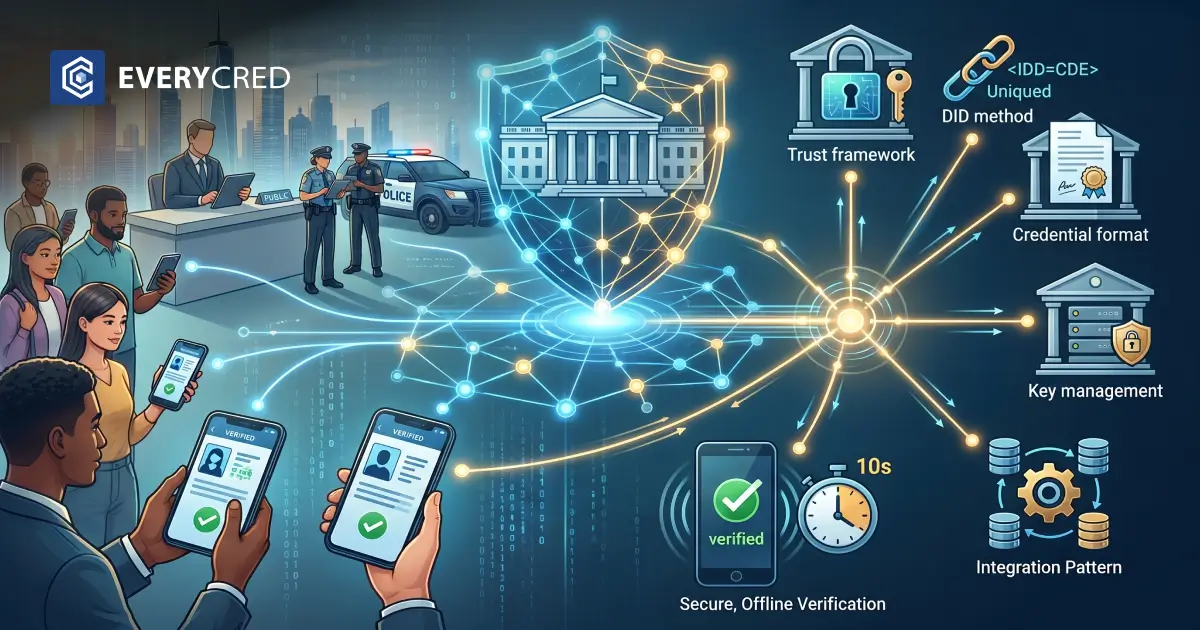
- The Five Decisions That Define an SSI Architecture
- Trust Framework: Naming the Issuers, Verifiers, and Holders
- DID Methods, Credential Format, and Key Management
- Integration Patterns for Existing Government Systems
- Phasing the Rollout: Pilot, Production, and Statewide Scale
- How EveryCRED Supports SSI Architecture Decisions
- Conclusion
- FAQs


Decentralized identity for government runs on five architectural decisions: the trust framework, the DID method, the credential format, the key management model, and the integration pattern. Choose those five correctly, and a self-sovereign identity rollout deploys in months. Choose poorly, and the platform stalls in pilot for years.
Architecture teams in federal, state, and central government agencies face the same problem. Vendors describe self-sovereign identity government deployments as turnkey. They are not. Every government SSI architecture forces specific trade-offs on revocation latency, offline verification, key recovery, and audit reporting.
This guide gives architecture, innovation, and CTO office teams a decision framework grounded in live government deployments: 36-week statewide police rollouts, integrations with national document repositories, and offline field verification at 10-second response times. Use the framework to scope a pilot or to evaluate an RFP response, then move into procurement with clear evaluation criteria.
Key Takeaways
– Decentralized identity architecture rests on five decisions: trust framework, DID method, credential format, key management, and integration pattern.
– W3C Verifiable Credentials Data Model 2.0 and DID v1.1 meet NIST SP 800-63-4 and data minimization requirements simultaneously.
– SSI architecture must support offline verification and credential revocation within seconds, or field deployments fail.
– Statewide rollouts complete in 36 weeks when the architecture is API-first and uses existing procurement vehicles.
– A self-sovereign identity government deployment fails when teams pick the DID method before defining the trust framework.
The Five Decisions That Define an SSI Architecture
Every decentralized identity rollout in the public sector resolves to five technical decisions, taken in order. Reordering them is the most common reason government SSI projects stall in pilot.
The five decisions, in sequence:
- Trust framework: who can issue, who can verify, and which credentials count as authoritative.
- DID method: how identifiers are created, resolved, and rotated across the deployment.
- Credential format: W3C VC 2.0 JSON-LD, SD-JWT, or ISO mDoc, each with different verifier tooling requirements.
- Key management model: where issuer keys, holder keys, and verifier keys are stored and rotated.
- Integration pattern: how the SSI layer connects to existing government databases, HR systems, and citizen portals.
A government SSI architecture cannot skip steps. A team that picks the DID method first locks itself into key management constraints before the trust framework has even named the issuers. A team that picks the credential format first restricts which verifier wallets can read it. The decisions cascade. Architecture leads who run the five decisions as a sequenced review save months in later procurement and integration phases.
Trust Framework: Naming the Issuers, Verifiers, and Holders
The trust framework defines who participates in the ecosystem and on what authority. For any DID government implementation, this is the policy layer, not the technical layer. It is also the layer that consultants under-scope most often.
A working trust framework names:
- Issuers: which government bodies issue which credentials (state HR, police IT, university registrar, healthcare regulator).
- Verifiers: which agencies, businesses, or citizens may request a credential, and under what authority.
- Credential schemas: the data fields, validity period, and revocation policy for each credential type.
- Governance rules: how the framework evolves, how new issuers are admitted, and how disputes are resolved.
In federal deployments, the trust framework usually aligns with NIST SP 800-63-4 authentication assurance levels and federal trust services policies, since most agencies procure through federal contract vehicles that require those baselines. In central government contexts elsewhere, the framework references applicable data protection consent rules and the issuer ecosystem already participating in the national document repository program. Either way, the trust framework is documented before the technical stack is selected. Skipping this step produces a working pilot that no other agency will accept.
DID Methods, Credential Format, and Key Management
These three decisions are technical and tightly coupled. Architecture teams treat them as a single block, because changing one usually forces changes in the other two.
DID Method Selection
DID methods determine where the identifier lives and how it resolves. The W3C maintains a registry of methods, each with different trust assumptions. For SSI architecture in government, three categories matter:
- Anchored DID methods (did:web, did:tdw, did:evrc): identifiers anchored to a public ledger or domain, suitable for issuers that need long-term verifiability.
- Peer DID methods (did:peer): identifiers shared bilaterally between two parties, used for ephemeral interactions.
- Key-based DID methods (did:key): identifiers derived directly from a public key, used for short-lived contexts.
Most government deployments use anchored DID methods for issuers and key or peer methods for holders.
Credential Format
W3C VC Data Model 2.0 is the baseline. SD-JWT and ISO mDoc (ISO/IEC 18013-5) extend it for selective disclosure and mobile driving licence interoperability. A government SSI architecture should support W3C VC 2.0 as the primary format and SD-JWT for use cases requiring zero-knowledge selective disclosure. The W3C Verifiable Credentials specification adds the JSON-LD context and proof formats needed for cross-jurisdiction verification.
Key Management
Issuer keys must be stored in hardware security modules or government-grade key management services, with rotation policies of at most 12 months. Holder keys live in citizen wallets and need a recovery model that does not require the issuer to act as a custodian. Architecture teams that overlook holder key recovery face an adoption ceiling once 5% of citizens lose their devices.
Integration Patterns for Existing Government Systems
The integration pattern is where most DID government implementation efforts fail. The SSI layer must connect to systems that predate W3C standards by decades. Direct database replacement is not feasible.
Three integration patterns work in practice:
- API overlay: the SSI platform sits in front of existing HR, ERP, or police databases via REST API. The existing database remains the system of record. This is the pattern used in the Raigad Police deployment, which integrated with CCTNS and the national document repository without modifying any field officer interfaces.
- Event-driven sync: changes in the source system trigger credential issuance or revocation through a message queue. This works when source systems already emit events for HR or licensing changes.
- Federated issuance: each agency runs its own issuer node, federated through a shared trust framework. This is the pattern recommended for multi-agency deployments where no single agency can act as the central issuer.
The architecture decision is whether one pattern dominates or whether multiple patterns coexist. Most government SSI deployments use API overlay for the first three issuers, then introduce federated issuance once the trust framework is mature. For practical guidance on platform selection at this stage, review the framework on choosing a government identity platform.
Phasing the Rollout: Pilot, Production, and Statewide Scale
A statewide or federal SSI deployment runs in three phases. Mis-phasing the rollout extends the timeline from 36 weeks to several years.
Phase structure:
- Weeks 1 to 8, trust framework and standards lock-in. Issuer schemas drafted. Procurement vehicle selected. For federal agencies, this means choosing among NASA SEWP V, ITES-SW2, NASPO ValuePoint, and OMNIA Partners. For central government IT teams in other jurisdictions, this means aligning with the state IT department and the national document repository program management.
- Weeks 9 to 20, pilot deployment with a single issuer and a single verifier population. The Raigad Police pilot reached operational status at week 20.
- Weeks 21 to 36, scale to remaining issuers and verifiers. Statewide police rollouts in this phase reduced verification time from 30 minutes to under 10 seconds and cut administrative overhead by 85%.
Architecture teams must build risk controls into each phase. The most common risks are credential revocation latency above two seconds, offline verification failure rates above 1%, and key compromise without a documented recovery procedure. Each risk is addressable in architecture review before deployment. Inter-agency rollouts add a fourth risk: cross-agency credential semantics, which is why decentralized government data sharing requires a federated trust framework rather than a single shared schema.
How EveryCRED Supports SSI Architecture Decisions
We deployed a complete decentralized identity architecture for Raigad Police, including DID method selection, credential schema design, integration with CCTNS and the national document repository, and offline verification using cached cryptographic signatures. The deployment reached pilot operations in 20 weeks and statewide scale in 36 weeks. Verification time fell from 30 minutes to under 10 seconds. Administrative overhead dropped 85%. Government architects evaluating self-sovereign identity government rollouts can review our Trust Method product for the underlying DID and credential infrastructure, and compare against our decentralized identity explainer for technical fundamentals. Book a working session to map your architecture decisions against ours.
Conclusion
Decentralized identity for government is not a technology choice. It is a sequence of architectural decisions on trust, identifiers, credential format, key management, and integration. Teams that take the five decisions in order deploy a self-sovereign identity government program in months. Teams that skip the trust framework or pick a DID method before naming issuers stall in pilot. The standards are stable. W3C VC 2.0, DID v1.1, NIST SP 800-63-4, and ISO mDoc cover every public sector use case. The remaining work is policy, procurement, and integration, in that order. Architecture teams ready to move from evaluation to a scoped pilot can complete the framework in a four-week review cycle, then enter procurement with a defensible technical baseline.
FAQs
What is decentralized identity for government?
Decentralized identity for government issues cryptographically signed credentials that citizens hold and verifiers check without contacting the issuing agency directly.
How is SSI architecture different from federated identity?
SSI architecture lets holders carry credentials between systems with no identity broker, while federated identity routes every login through a central trust provider.
Which standards must a government SSI architecture follow?
A government SSI architecture must follow W3C Verifiable Credentials Data Model 2.0, DID v1.1, NIST SP 800-63-4 for authentication, and applicable data protection law.
How long does a DID government implementation take?
A scoped statewide DID government implementation reaches pilot operations in 20 weeks and full deployment in 36 weeks using API-first integration with existing systems.
Can decentralized identity work without internet connectivity?
Yes, offline verification uses cached cryptographic signatures stored locally on the device and confirms credential validity without any network connection required.