18th June, 2026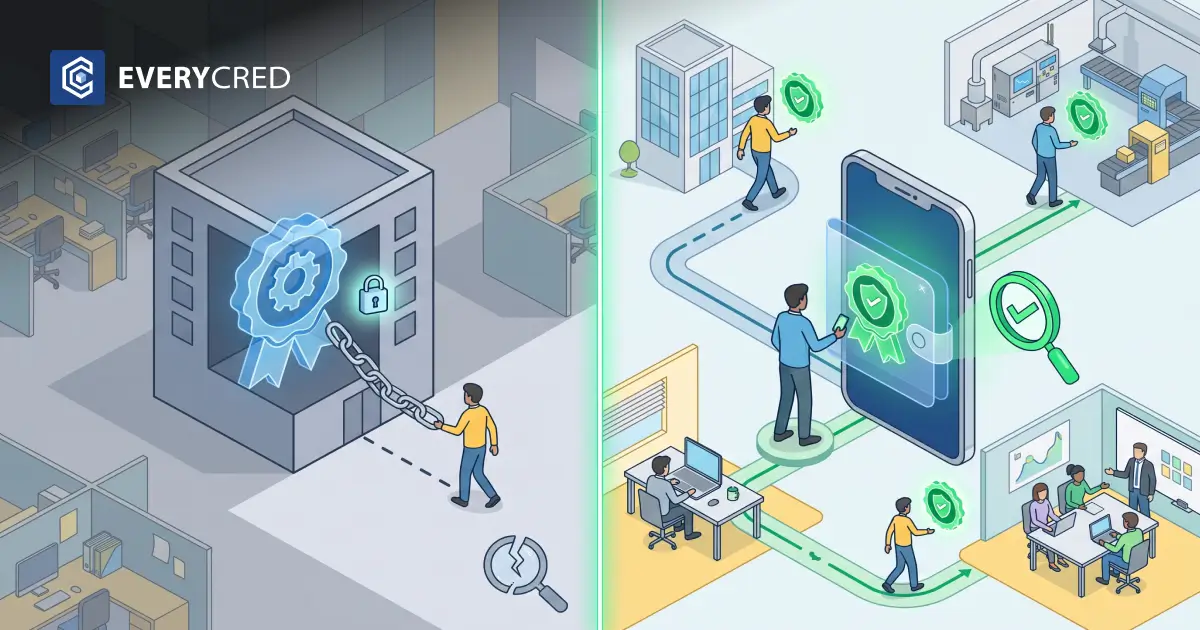


Digital badges are portable, cryptographically verifiable records of a skill a worker has earned. They fail enterprise HR the moment they stay locked inside the learning management system that issued them. A badge that a hiring manager cannot check in seconds is not proof. It is a logo.
U.S. enterprises spend millions of dollars each year on training. Most cannot prove which skills a worker actually holds when that worker moves teams, sites, or employers. The skill record dies inside the LMS. The investment leaves with the person.
This guide explains why platform-locked digital badges break talent mobility, what makes a badge genuinely portable, and how HR teams build a verifier-friendly skills passport. The goal is simple: a credential that a worker carries, and any manager can verify in seconds.
Key Takeaways
– Digital badges issued inside an LMS rarely travel with the worker, so training spent produces no verifiable skills record after a job change.
– Portable workforce credentials built on the W3C Verifiable Credentials Data Model 2.0 are checkable by any verifier without contacting the issuer.
– Manual skill and credential verification costs $15 to $25 per check; cryptographic verification costs under $0.10 and resolves in under 10 seconds.
– A skills passport turns scattered badges into one holder-controlled record that supports talent mobility and skills-based hiring.
– Enterprise upskilling produces measurable ROI only when the resulting badges stay verifiable outside the platform that issued them.
Why LMS Digital Badges Fail Enterprise Talent Mobility
Most enterprise digital badges are image files with metadata stored on a single platform. They look like proof. They do not function as proof once the worker leaves that platform’s walls.
The failure shows up at every internal move. A maintenance technician named Dana completes a 40-hour safety certification at an Ohio plant in 2025. She transfers to a sister site the next quarter. The new site runs a different LMS, cannot read her badge, and re-tests her on skills she already holds. The first investment is wasted.
The same break happens at the company boundary. When Dana applies elsewhere, her badge cannot be verified by an outside hiring manager without a phone call or an email to her former employer. Talent mobility stalls because the credential does not move.
Three structural problems cause this:
- Platform lock-in keeps the badge readable only inside the issuing system.
- No cryptographic signature means an outside verifier cannot confirm the badge is genuine.
- No revocation or status check means a stale or revoked badge still looks valid.
The result is predictable. Enterprises fund training program credentials that cannot prove anything once the learner walks out the door.
What Makes a Digital Badge Actually Portable
A portable digital badge is a verifiable credential: a cryptographically signed record that any party can check using the issuer’s public key, without contacting the issuer. Portability is a property of the standard, not the design of the badge image.
The W3C Verifiable Credentials Data Model 2.0 defines how a credential is structured, signed, and verified across systems. A badge built this way carries its own proof. The worker stores it in a wallet they control. The verifier scans it and gets a result.
This is the skills passport model. The worker holds one record of every verified skill, issued by different employers and training providers, all checkable in the same way. The passport follows the person across teams, sites, and employers.
Three roles make it work:
- The issuer (an employer or training provider) signs and issues the badge.
- The holder (the worker) stores it in a credential wallet and decides who sees it.
- The verifier (a hiring manager or compliance officer) confirms authenticity in seconds.
Selective disclosure adds privacy. A worker can prove “holds an active forklift certification” without exposing unrelated personal data. This meets NIST SP 800-63-4 data minimization expectations for US deployments.
The difference between the two badge types is structural, not cosmetic:
| Property | LMS-issued digital badge | Portable workforce credential |
|---|---|---|
| Travels with the worker | No, tied to the platform | Yes, held in the worker’s wallet |
| Verifiable by outsiders | Requires issuer contact | Verified by signature in seconds |
| Forgery resistance | None for image or PDF | Alteration breaks the signature |
| Revocation | Rarely supported | Status checked at every scan |
| Verification cost | $15 to $25 manual check | Under $0.10 per check |
The Real Cost of Skills You Cannot Verify
Unverifiable skills carry a measurable cost. Manual verification of a credential or skill claim costs $15 to $25 per check and can take days. Cryptographic verification of a portable badge costs under $0.10 and resolves in under 10 seconds.
The arithmetic compounds at enterprise scale. An employer running 500,000 verifications a year against manual processes spends millions on checks that a verifiable credential program eliminates. First-year savings potential reaches $7.4 to $12.4 million at that volume.
Fraud raises the stakes further. AI-generated forged documents grew 311% from Q1 2024 to Q1 2025, and the entry cost for a convincing fake is under $30. A PDF certificate or screenshot badge offers no defense. A cryptographically signed credential breaks on any alteration, so forgery is detectable on the first scan.
There is a strategic cost, too. Skills-based hiring depends on trustworthy skill data. When badges cannot be verified, recruiters fall back to degrees and job titles, and enterprise upskilling investment never shows up in hiring decisions. Portable workforce credentials make the skill itself the unit of trust.
Building a Portable Workforce Credentials Program
A portable badge program does not require replacing the LMS. It adds a credential layer on top of the systems HR already runs, so existing enterprise upskilling investment keeps producing verifiable proof. The badge becomes verifiable outside its origin platform.
Start with the integration path. A credential platform connects to the HRIS, LMS, and training systems through a REST API, with no front-end changes for verifiers. Completion events in the LMS trigger issuance of a signed, portable badge to the worker’s wallet.
When Marcus, an L&D director at a 12,000-person logistics firm, mapped his programs in early 2026, he found 40 separate badge types trapped across three LMS tenants. Issuing them as portable workforce credentials lets internal recruiters verify skills across all sites with one scan, and talent mobility between depots stopped requiring re-certification.
Design the program around four decisions:
- Define which skills become verifiable credentials versus simple completion records.
- Map issuance triggers so badges generate automatically from existing systems.
- Set revocation rules so expired or withdrawn skills lose valid status immediately.
- Give workers a wallet so the skills passport stays holder-controlled and portable.
Distinguish a badge from a heavier credential where it matters. For a quick comparison of formats, see badges versus certificates and how each fits different recognition needs. For granular skills, stackable micro-credentials let a worker assemble a verifiable profile over time.
How We Issue Digital Badges That Travel
We deployed digital officer credentials for Raigad Police, reducing field verification from 30 minutes to under 10 seconds and cutting administrative overhead by 85%. The same architecture issues portable workforce credentials for enterprise HR. Every digital badge is signed under the W3C Verifiable Credentials Data Model 2.0, stored in a worker-controlled wallet, and verifiable by any manager through instant verification without a database lookup. We integrate with your HRIS and LMS via REST API, so badges are issued automatically and stay portable across teams, sites, and employers. To plan a skills passport pilot for your workforce, book a demo with our team.
Conclusion
Digital badges only return value when they travel with the worker. A badge locked in an LMS proves nothing once the worker changes teams or employers, and the training spent behind it goes unrecorded.
Portable workforce credentials fix this at the standard level. Built on W3C Verifiable Credentials, they carry their own cryptographic proof, verify in under 10 seconds, and cost under $0.10 per check. A skills passport gives every worker one holder-controlled record that supports talent mobility and skills-based hiring.
Enterprise HR leaders modernizing skills recognition should treat portability as a requirement, not a feature. Tie every enterprise upskilling program to a portable badge so the skill record outlives the course. The organizations that issue verifiable digital badges now will be the ones that can prove their workforce’s skills tomorrow, wherever those workers go next.
FAQs
What are digital badges used for in enterprise HR?
Enterprise HR uses digital badges to recognize verified skills and certifications so workers can prove competencies across teams, sites, and employers.
Why do LMS-issued digital badges fail when employees change jobs?
LMS badges stay locked in the issuing platform and lack cryptographic signatures, so outside verifiers cannot confirm them without contacting the former employer.
What is a skills passport?
A skills passport is a worker-controlled record of verified skills issued by different employers and training providers, all checkable through one verification method.
How are portable workforce credentials verified?
Portable workforce credentials are verified by scanning the credential and validating its cryptographic signature against the issuer’s public key, with no issuer contact required.
How much does verifying a digital badge cost compared to manual checks?
Manual verification costs $15 to $25 per check, while verifying a cryptographically signed digital badge costs under $0.10 and resolves in under 10 seconds.