25th May, 2026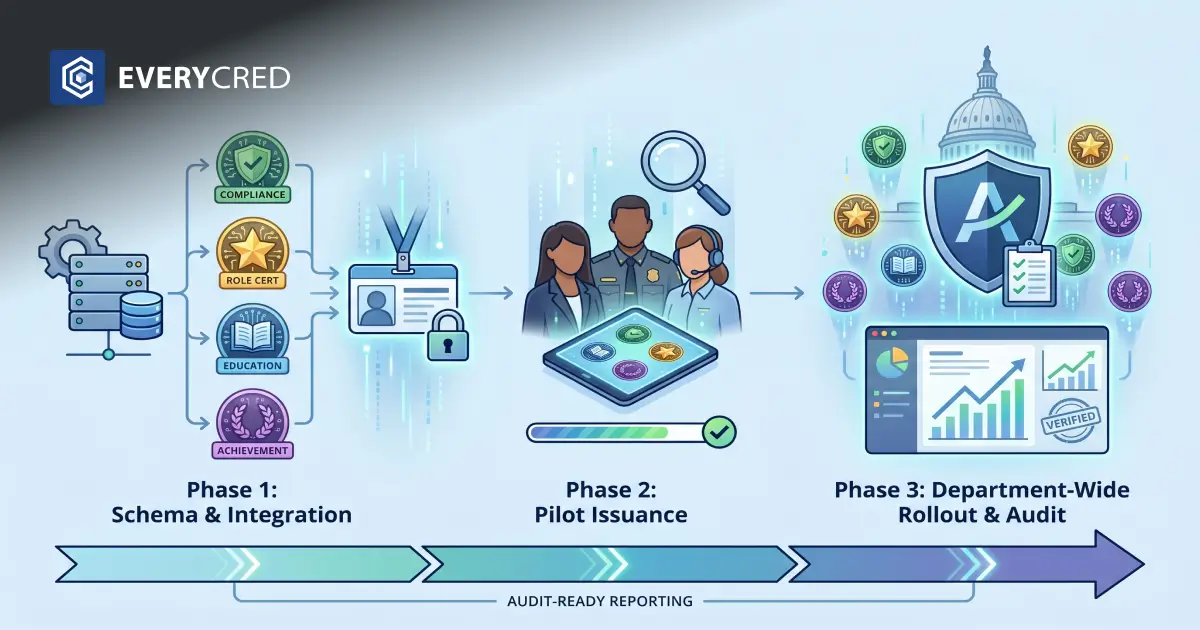
- The Four Digital Badge Categories Government HR Teams Need
- Pre-Deployment: Mapping Compliance Requirements to Badge Schemas
- A Phase-Based Digital Badge Deployment Plan for Government Departments
- How Digital Badges Connect to Audit-Ready Compliance Reporting
- How EveryCRED Deploys Digital Badges for Government Workforce Programmes
- Conclusion
- FAQs


A government workforce digital badges deployment succeeds when HR teams design the badge schema against mandatory compliance requirements before the first credential is issued. This guide gives government HR directors, learning and development heads, and workforce compliance officers a phase-based plan to deploy digital badges across a department, integrate with HRIS and LMS systems, and produce audit-ready compliance reporting from day one.
Most departmental badge programs stall at the same point. The technology is procured, the LMS is integrated, and badges are issued, but the workforce compliance officer still cannot prove during an audit that every employee in role X completed mandatory training Y on date Z. The credential layer was added without the schema discipline that compliance reporting requires.
Key Takeaways
– Government workforce compliance programs need four distinct badge categories: mandatory compliance, role certification, continuous education, and achievement.
– A digital badges deployment that skips schema design fails the first compliance audit, regardless of which platform was chosen.
– HRIS and LMS integration via REST API removes the manual reconciliation that consumes 4 to 6 weeks per audit cycle.
– Mission Karmayogi has registered 1.26 crore civil servants and now integrates Karma Points into the Annual Performance Appraisal Report, raising the bar for verifiable training records.
– A phased deployment reaches department-wide rollout in 24 weeks with pilot validation at week 14.
HR teams currently scoping a workforce badge program can map the phases below to their own departmental structure and identify where the credential workstream gates the compliance reporting timeline.
The Four Digital Badge Categories Government HR Teams Need
A workforce compliance program that issues only one badge type cannot answer the questions auditors ask. Four categories cover the full compliance reporting surface for government departments.
- Mandatory compliance badges: Issued for training the employee must complete to remain in role. Examples include data protection training under the Digital Personal Data Protection Act, anti-corruption refresher courses, and information security awareness training under federal civilian programs.
- Role certification badges: Issued when an employee qualifies for a specific role or rank. Examples include investigating officer certification, procurement officer authorization, and security clearance level confirmation.
- Continuous education badges: Issued for ongoing professional development, including courses completed through programs such as Mission Karmayogi in India or OPM training tracks for US federal employees.
- Achievement badges: Issued for service milestones, commendations, or successful completion of stretch assignments. These contribute to performance appraisal documentation.
Each category requires a distinct schema. Mandatory compliance badges must carry expiry dates and re-issuance triggers. Role certification badges must carry revocation conditions tied to disciplinary processes. Continuous education badges must aggregate across an employee’s career. Achievement badges must carry citation references. Treating all four as the same data model produces a digital badge platform that issues credentials but cannot support an audit.
Pre-Deployment: Mapping Compliance Requirements to Badge Schemas
HR teams complete a three-part mapping exercise before any technology procurement begins. This pre-deployment work determines whether the program will produce audit-ready evidence or another set of certificates that satisfy nobody.
Compliance obligation inventory. List every training, certification, and refresher requirement that applies to staff in the department. For US federal civilian programs, this includes OPM-mandated training tracks, security awareness training, and role-specific compliance courses. For Indian state government departments, this includes Mission Karmayogi modules tied to APAR, sector-specific regulatory training, and statutory refresher cycles.
Audit question inventory. Document every question an internal or external auditor has asked in the past three years that the current system answered slowly or incorrectly. Common audit questions include: which employees in grade X completed training Y in the past 12 months, which contractors received access without completing prerequisite certification, and which training records cannot be produced on demand.
System integration map. Identify every system that must consume or produce badge data. This includes the HRIS holding the employee master record, the LMS running the training, the performance appraisal system that needs to ingest training evidence, and any inter-agency portal that verifies workforce credentials across departments.
Programme officer Priya, running L&D for a state revenue department, used this exercise to discover that 38% of her current compliance training records could not be matched to active employee IDs because the LMS and HRIS held divergent identifiers. The mapping work surfaced the data hygiene problem before badge issuance amplified it.
A Phase-Based Digital Badge Deployment Plan for Government Departments
This government training credentials deployment plan runs across 24 weeks with three phases. Each phase has explicit exit criteria that the next phase depends on.
Phase 1: Schema Design and HRIS Integration (Weeks 1 to 6)
The first phase establishes the data foundation.
- Build the badge schemas for all four categories using W3C Verifiable Credentials Data Model 2.0 and Open Badges 3.0 alignment.
- Define mandatory metadata fields including issuance date, expiry date, role applicability, training reference number, and revocation conditions.
- Integrate the credential issuer with the HRIS via REST API to pull the authoritative employee identity record for every badge issued.
- Configure LMS integration so completed training events trigger badge issuance automatically with no manual intervention.
- Validate that every employee in the target group has a single resolvable identity across HRIS, LMS, and the credential issuer before any badge is created.
Phase 2: Issuance Pilot With One Workforce Group (Weeks 7 to 14)
Phase 2 proves the deployment works for a defined cohort before scaling.
- Select a workforce group with high compliance training volume and clear audit obligations, such as procurement officers or investigators in a regulatory department.
- Issue all four badge categories to the pilot group, including back-dated badges for training already completed within the audit window.
- Run a parallel verification pass: every badge issued must be independently verifiable using its cryptographic signature without querying the issuer system.
- Connect the badge dataset to the performance appraisal system and confirm that earned badges populate the APAR-equivalent fields or US federal performance documentation correctly.
- Generate the first sample audit report from the pilot group and validate that every audit question identified in pre-deployment receives a defensible answer.
The pilot closes when the workforce compliance officer signs off that audit reporting from the pilot group meets the standard the full deployment must achieve.
Phase 3: Department-Wide Rollout and Reporting (Weeks 15 to 24)
The final phase scales the program across the full department.
- Roll out badge issuance to all remaining workforce groups in waves of 500 to 2,000 employees per cycle, gated on data hygiene confirmation.
- Configure compliance dashboards that produce real-time reports on badge currency, training completion rates, and overdue refresher cycles.
- Connect badge revocation to disciplinary processes so a role certification badge can be invalidated in seconds when authority is withdrawn.
- Run the first full departmental audit cycle on the badge dataset and document the time-to-evidence reduction against the previous manual cycle.
- Publish the completed badge inventory to relevant inter-agency portals where workforce credentials require cross-departmental verification.
By week 24, the department has a complete, verifiable workforce compliance record, with every badge tied to a specific training event, a specific employee identity, and a specific compliance obligation.
How Digital Badges Connect to Audit-Ready Compliance Reporting
A digital badges program that does not produce audit-ready reports is a credentialing exercise, not a compliance program. Three reporting outputs separate a deployment that closes audit findings from one that creates new ones.
The first is real-time compliance status by employee. Auditors should be able to query any employee identifier and receive a complete badge inventory with currency status, expiry dates, and the underlying training event for each badge. The second is exception reporting. The system should surface employees in roles requiring specific badges who do not currently hold those badges, with an aging report showing how long the gap has existed. The third is verifiable evidence. Each badge presented in an audit must carry its own cryptographic proof, removing the need for the auditor to trust the reporting system itself.
The Mission Karmayogi program integration with APAR for 2026 sets this expectation explicitly. Training records must be machine-verifiable, not asserted by the HR system. Workforce compliance programs in US federal agencies face the same trajectory under OPM training compliance reporting requirements. A government workforce credentials program built on digital badges meets both expectations because the cryptographic proof travels with each credential.
How EveryCRED Deploys Digital Badges for Government Workforce Programmes
We deploy the workforce digital badge programs this guide describes. For a state law enforcement department, our W3C VC 2.0 badge issuance integrates with the existing HRIS and LMS via REST API, supports offline verification for field staff, and produces audit-ready reporting from week one of full deployment. Administrative overhead in the compliance reporting cycle drops 85% against the manual baseline. Our capabilities for HR-driven workforce buyers include:
- Four badge categories: Mandatory compliance, role certification, continuous education, and achievement, each with distinct schema discipline.
- HRIS and LMS integration: REST API connection to existing systems with no front-end changes.
- Real-time revocation: Badges invalidated in seconds when authority changes.
- Audit-ready reporting: Compliance status, exception, and verifiable evidence reports from issuance onwards.
- Procurement access: Available to US agencies through NASA SEWP V, ITES-SW2, NASPO ValuePoint, and OMNIA Partners.
HR and L&D teams scoping departmental programs can book a workforce demo and walk this deployment plan against their own compliance obligations.
Conclusion
A government workforce digital badges deployment closes the compliance reporting gap that paper records, PDF certificates, and database-only LMS systems leave open. Four badge categories cover the full audit surface. Three phases over 24 weeks produce department-wide rollout with verifiable evidence at every step.
HR directors currently evaluating platforms can use this structure to scope phase exit criteria, schema discipline, and audit reporting against their own departmental compliance obligations. The digital badges program is the verifiable layer between training events and performance appraisal evidence, and the deployment plan above is the path to making it operational without creating new audit risk.
FAQs
What are digital badges in government workforce compliance?
Digital badges are cryptographically signed credentials proving an employee completed a specific training, certification, or compliance requirement on a verifiable date.
How do government HR teams deploy digital badges across a department?
Teams design four badge categories, integrate with HRIS and LMS via REST API, pilot with one workforce group, then scale department-wide across 24 weeks.
How do digital badges support government training compliance audits?
Each badge carries its own cryptographic proof, allowing auditors to verify training completion without trusting the reporting system or the HRIS database.
Can digital badges integrate with existing government LMS and HRIS platforms?
Yes, digital badges integrate via REST API with existing LMS and HRIS platforms, triggering badge issuance automatically when an employee completes mandatory training.
How do digital badges support performance appraisal documentation?
Digital badges produce machine-verifiable training evidence that performance appraisal systems can ingest, supporting Karma Points integration in India and OPM compliance reporting in the US.