20th July, 2026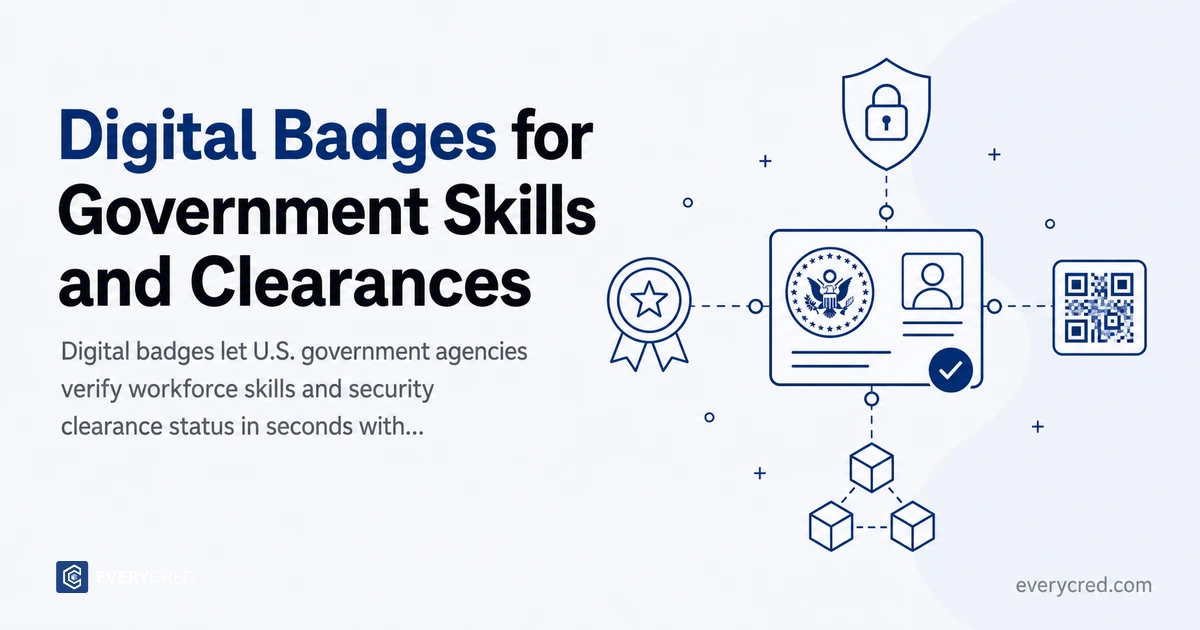
- What Digital Badges Mean for the Government Workforce
- Why Skills and Clearance Records Are Slow to Verify Today
- How Digital Badges Prove Professional Skills
- How Digital Badges Confirm Security Clearance Status
- Verifying Workforce Credentials Across Agencies and Sites
- Issue Digital Badges for Your Workforce with EveryCRED
- Conclusion
- FAQs


Digital badges give U.S. government agencies a fast, tamper-proof way to verify a worker’s professional skills and security clearance status. A modern digital badge is a cryptographically signed credential that confirms what a person is qualified to do or what access they hold, and it can be checked in seconds without a phone call or a records lookup.
Federal and state agencies manage staff and contractors who constantly move between roles, agencies, and sites. Confirming their clearances and qualifications still depends on disconnected systems, slow manual checks, and paper documents that are easy to fabricate. That gap creates delay, cost, and risk.
This explainer covers what digital badges are, how they verify professional skills and security clearance status, and what to look for in a platform built for government workforce credentials.
Key Takeaways
- A digital badge is a cryptographically signed credential that proves a skill, certification, or clearance status and verifies in under 10 seconds.
- Manual credential verification costs $15 to $25 per check, while automated verification with digital badges costs under $0.10 per check.
- Verifiable-credential badges can be revoked in seconds, so a suspended clearance or expired certification stops verifying immediately.
- Selective disclosure lets a verifier confirm a skill or security clearance status without exposing the worker’s underlying personal data.
- Standards-based digital badges built on W3C VC 2.0 and NIST SP 800-63-4 are portable across agencies and verifiable offline.
What Digital Badges Mean for the Government Workforce
A digital badge is a portable, verifiable record that a person holds a specific skill, certification, training completion, or clearance status. Unlike a paper certificate or a PDF, a modern digital badge is cryptographically signed by the issuing authority, so any change to it breaks the signature and is detectable at the moment of verification.
Digital badges started in education and professional development as visual markers of achievement. Early badges under the Open Badges standard proved a skill but relied on a callback to the issuer’s server to confirm authenticity. They were hard to verify offline and had no built-in way to revoke a badge once issued.
Government workforce use raises the bar. A badge that represents professional skills or a security clearance must be tamper-proof, revocable, and verifiable across agencies. A modern digital badge platform issues credentials built on the W3C Verifiable Credentials Data Model 2.0. They carry the issuer’s cryptographic signature, verify without contacting the issuer, and can be revoked in real time.
Why Skills and Clearance Records Are Slow to Verify Today
Most agencies still confirm skills and clearances through manual steps. A hiring team emails a prior employer, waits for a records office, or checks a system that does not talk to other agency systems. Each manual credential check costs $15 to $25 and can take days.
The records themselves are easy to misrepresent. AI-generated forged documents grew 311% from the first quarter of 2024 to the first quarter of 2025, and the entry cost for document fraud is now under $30. A convincing fake certificate or clearance letter is cheap to produce and hard to catch by eye.
Fraud at scale is expensive. The U.S. Government Accountability Office (GAO) estimates annual federal fraud at $233 billion to $521 billion. When a contractor moves between sites, the receiving office often cannot confirm that a clearance is current or that a skill certification is genuine. Disconnected systems turn a simple check into a bottleneck.
How Digital Badges Prove Professional Skills
Digital badges prove professional skills by tying each skill to a signed record from the body that awarded it. When a worker completes a training program or a contractor earns a certification, the issuer creates a badge that states exactly what was achieved, when, and by whom.
A verifier scans a QR code or checks the badge reference and gets a verified result in seconds. There is no need to call the training provider or trust a printed certificate. The badge either passes the cryptographic check or it does not.
This matters for workforce credentials that expire or need renewal. A safety certification, a technical qualification, or a completed compliance course can be issued as a badge with a clear validity period. Agencies running large programs can issue badges in bulk, then let any authorized office confirm a worker’s professional skills without a manual request. Government training credentials become instantly portable across teams and roles.
How Digital Badges Confirm Security Clearance Status
A digital badge can represent security clearance status without exposing the investigation behind it. The authorized issuer signs a badge that attests the clearance level and whether it is active, and the badge carries nothing more than the verifier needs.
Selective disclosure makes this privacy-preserving. Using zero-knowledge proofs, a verifier can confirm that a person holds an active Secret clearance without seeing their full record. This supports the data minimization principles in NIST SP 800-63-4, the federal digital identity standard finalized in July 2025.
Real-time revocation is the second advantage. When a clearance is suspended or revoked, the issuing authority invalidates the badge, and every check after that returns an invalid result, even on a badge already stored on a device. A cleared worker reassigned yesterday cannot present a valid clearance badge today.
Every issuance, presentation, and verification writes to an immutable audit trail. That gives personnel security officers audit-ready credentials for compliance reviews and investigations.
Verifying Workforce Credentials Across Agencies and Sites
The hardest workforce verification problem is movement. Staff and contractors shift between agencies, facilities, and job sites, and each destination needs to confirm credentials quickly.
Standards-based digital badges solve this because verification does not depend on the issuer’s systems being reachable. A badge built on open W3C standards can be checked by any authorized verifier, and offline verification works from cached cryptographic signatures when there is no network. Field sites, remote facilities, and secure areas can confirm a badge without connectivity.
Portability is the point. One badge for a skill or clearance is verifiable at every site, which removes repeated manual checks as a worker moves. This is the core of cross-agency verification.
For agencies evaluating a platform, the checklist is specific. Look for W3C VC 2.0 and NIST SP 800-63-4 compliance, REST API integration with existing HR and personnel systems, real-time revocation, and offline verification. Agencies that want to issue digital badges should also confirm the platform is available on their existing procurement vehicles.
Issue Digital Badges for Your Workforce with EveryCRED
We built EveryCRED to issue tamper-proof digital badges that confirm professional skills, training completion, and clearance status in seconds. Each badge is signed with W3C VC 2.0 and NIST SP 800-63-4 compliant cryptography, verifies offline, and can be revoked in real time. Selective disclosure keeps personal data private, and every verification writes to an immutable audit trail. U.S. agencies can procure through Carahsoft on NASA SEWP V, ITES-SW2, NASPO ValuePoint, and OMNIA Partners, with no new competitive bid. To see how issuance and verification work for government workforce credentials, book a demo with our team.
Conclusion
Digital badges give U.S. government agencies a practical fix for a persistent problem: confirming what workers can do and what access they hold, quickly and without fraud risk. A signed, standards-based badge verifies professional skills and security clearance status in seconds, works offline, and stops verifying the moment a credential is revoked.
For agencies managing staff and contractors across many sites, this turns a multi-day manual check into an instant one. It also cuts verification costs and creates an audit trail that holds up under review. As federal identity standards move toward stronger assurance, standards-based workforce credentials will become the baseline. Agencies that adopt digital badges now build the verification infrastructure their workforce will need next.
FAQs
What is a digital badge for government workforce verification?
A digital badge is a cryptographically signed credential that proves a worker’s skills, certification, or security clearance status instantly.
Can digital badges verify security clearance status?
Yes, an authorized issuer can sign a badge attesting clearance level and active status, verifiable without exposing personal records.
How do digital badges prevent credential fraud?
Each badge carries a cryptographic signature, so any alteration breaks it and is detected instantly at verification.
Are digital badges verifiable across different government agencies?
Yes, standards-based digital badges built on W3C VC 2.0 verify across agencies and sites, even offline without network access.
How can U.S. agencies procure a digital badge platform?
Agencies can procure EveryCRED through Carahsoft on NASA SEWP V, ITES-SW2, NASPO ValuePoint, and OMNIA Partners contract vehicles.