16th June, 2026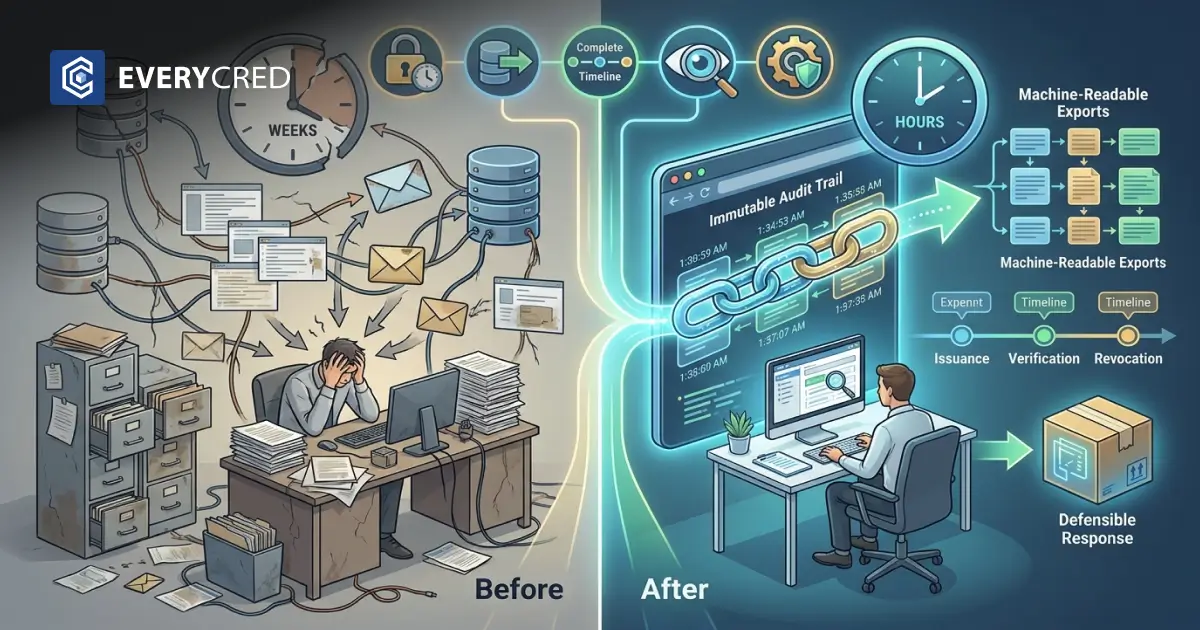
- Why FOIA Requests Break Legacy Credential Records Management
- Five Digital Credential Platform Design Choices That Decide FOIA Response Time
- Mapping Digital Credential Platform Choices to a Defensible FOIA Response
- A FOIA Response Template for Credential Records
- How EveryCRED Builds FOIA-Ready Credential Records
- Conclusion
- FAQs


The design choices in your digital credential platform decide whether a FOIA response takes hours or weeks. Five choices matter most: an immutable audit trail, exportable records, complete issuance and revocation history, access logging, and retention controls. Get these right at selection time, and a records officer can answer a public records request the same day it arrives.
Most agencies discover the gap only after a request lands. First, a records officer searches three systems, exports screenshots, and still cannot prove who verified a credential or when staff revoked it. Meanwhile, public records request volume keeps rising, and manual reconstruction does not scale.
This guide gives records officers a design checklist that ties each platform choice to a defensible FOIA response. In short, it serves FOIA officers, IT compliance leaders, and general counsels who own the records management risk.
Key Takeaways
– The right digital credential platform design turns a weeks-long FOIA response into a same-day export.
– An immutable audit trail with timestamps is the single most important records management feature for public records defensibility.
– Machine-readable exports, not screenshots, are what survive an appeal or litigation.
– Access and verification logging answers the “who checked this credential, and when” question that most legacy systems cannot.
– A digital credential platform should map every credential event to a retention schedule before deployment, not after.
Why FOIA Requests Break Legacy Credential Records Management
A FOIA request for credential activity asks a simple question: who issued, verified, or revoked a credential, and when. Legacy systems hold that data, but not in a form a records officer can produce on demand.
The data sits in separate places. For example, issuance lives in an HR database, verification in an access-control log, and revocation in an email thread. As a result, pulling a single defensible record means joining legacy systems that vendors never built to talk to each other.
Consider a county records officer named Dana. When a request arrives asking for every revocation of contractor access credentials over 18 months, her current tools return partial logs with no timestamps she can defend. As a result, she spends three weeks assembling a response, and the requester appeals it anyway because the public records package has gaps.
The problem is not effort. Instead, the agency chose the digital credential platform for issuance speed, not for records management. Because no one set audit-readiness as a selection criterion, the audit trail does not exist in exportable form. This is exactly the gap that audit-ready credentials close.
Five Digital Credential Platform Design Choices That Decide FOIA Response Time
Five design choices define a FOIA-ready digital credential platform. Each one maps directly to a question a public records request will ask. Therefore, evaluate any platform against all five before purchase.
An immutable, time-stamped audit trail for every event
The platform must log every issuance, verification, and revocation to an immutable record with a timestamp and the actor’s identity. Immutability matters because a public records response must prove that no one edited the log after the fact. Otherwise, a mutable log invites the question no records officer wants: how do we know no one changed this?
Exportable, machine-readable records
The platform must export records as structured data, not screenshots or PDFs of a dashboard. Then, a records officer can filter, redact, and package those machine-readable exports for a FOIA response in minutes. By contrast, screenshot evidence forces manual reassembly and weakens the record under appeal.
Complete issuance, verification, and revocation history
A defensible answer needs the full lifecycle of each credential in one place. Specifically, one query should return when the agency issued a credential, every time someone verified it, and the exact moment staff revoked it. Revocation timing, after all, is the detail that litigation turns on most often.
Access and verification logging
The audit trail should record who verified a credential and when, not only who issued it. FOIA requests frequently ask which officials accessed or relied on a credential. Without verification logging, therefore, that question has no answer.
Retention and redaction controls aligned to records schedules
The platform must let records management staff apply retention schedules and redact exempt fields before release. Public records law requires releasing responsive records while withholding exempt personal data. Consequently, a digital credential platform without redaction controls forces manual review of every line.
Mapping Digital Credential Platform Choices to a Defensible FOIA Response
A checklist only helps if it produces a workflow. So turn the five choices into a request-to-package sequence that your team runs the same way every time.
The workflow has four steps. First, receive the request and identify the credential events in scope. Second, query the audit trail by date range, credential type, and actor. Third, export the matching records as machine-readable data. Finally, apply redaction and assemble the response package.
When the audit trail is immutable and time-stamped, step two takes minutes. Then the export in step three becomes the chain-of-custody artifact: a tamper-evident record that shows the requester exactly what happened and when. This is the same blockchain-anchored property that secures public records against later dispute.
A second scenario shows the contrast. Marcus, a state FOIA officer, runs the same request Dana struggled with, but on a platform that follows these five choices. First, he filters the audit trail to the 18-month window. Then he exports 4,200 revocation events as a structured file, redacts two exempt fields, and releases the package in a single afternoon. As a result, the request that took three weeks now takes hours.
A FOIA Response Template for Credential Records
A defensible public records package for credential activity contains four elements. Standardize them so every response looks the same, regardless of which officer assembles it.
- A scope statement naming the credential types, date range, and event types covered.
- The machine-readable export of matching audit trail records, with timestamps intact.
- A redaction log noting which fields the team withheld and the exemption cited.
- A verification statement confirming the export came from the immutable record.
This template works because the platform produces each element directly. For instance, the export comes from the audit trail, the verification statement rests on immutability, and the redaction log comes from the platform’s retention and redaction controls. As a result, strong compliance automation generates most of this package without manual assembly.
In addition, the United States Department of Justice publishes FOIA response guidance that emphasizes timely, complete, and properly redacted releases. A digital credential platform that follows these five choices makes that standard achievable for credential records specifically, where timing and tamper-evidence carry the most weight.
How EveryCRED Builds FOIA-Ready Credential Records
We log every credential issuance, verification, and revocation to an immutable audit trail with a timestamp and actor identity. Records officers then query that trail by date, credential type, and actor, and export structured records ready for a FOIA response. In addition, our platform supports the full design checklist in this guide:
- Immutable audit trail: SHA-512 blockchain anchoring makes every record tamper-evident.
- Machine-readable export: Credential events export as structured data, not screenshots.
- Real-time revocation history: The platform logs every revocation with its exact timestamp.
- Procurement-ready: Available on NASA SEWP V, ITES-SW2, and NASPO ValuePoint.
Records and compliance teams can book a demo to run a FOIA-readiness review against their current systems.
Conclusion
A FOIA response should take hours, not weeks, and you decide the difference when you choose your digital credential platform. The five design choices that matter are an immutable audit trail, machine-readable exports, complete lifecycle history, access logging, and retention controls aligned to your records schedules.
Records officers who evaluate platforms against these five criteria stop reconstructing data after each request and start exporting it on demand. As a result, the audit trail becomes the chain-of-custody artifact that survives appeals and litigation. In short, strong records management is a platform design decision, made once, that pays off on every public records request that follows. Ultimately, agencies that build this capability now will meet rising request volume without adding staff.
FAQs
What makes a digital credential platform FOIA-ready?
A FOIA-ready platform logs every credential event to an immutable, time-stamped audit trail and exports those records as machine-readable data on demand.
How does an audit trail speed up a FOIA response?
An immutable audit trail lets a records officer query and export credential events by date and type in minutes, replacing weeks of manual reconstruction.
Why are machine-readable exports better than screenshots for public records?
A records officer can filter, redact, and package machine-readable exports quickly, and they hold up under appeal far better than screenshots of a dashboard.
Can a digital credential platform handle records retention requirements?
Yes, a well-designed platform applies retention schedules and redaction controls so records management staff can release responsive records while withholding exempt data.
Does revocation history matter for FOIA requests?
Yes, the exact timestamp of each revocation is often the detail that determines whether a public records response withstands an appeal or litigation.