3rd February, 2026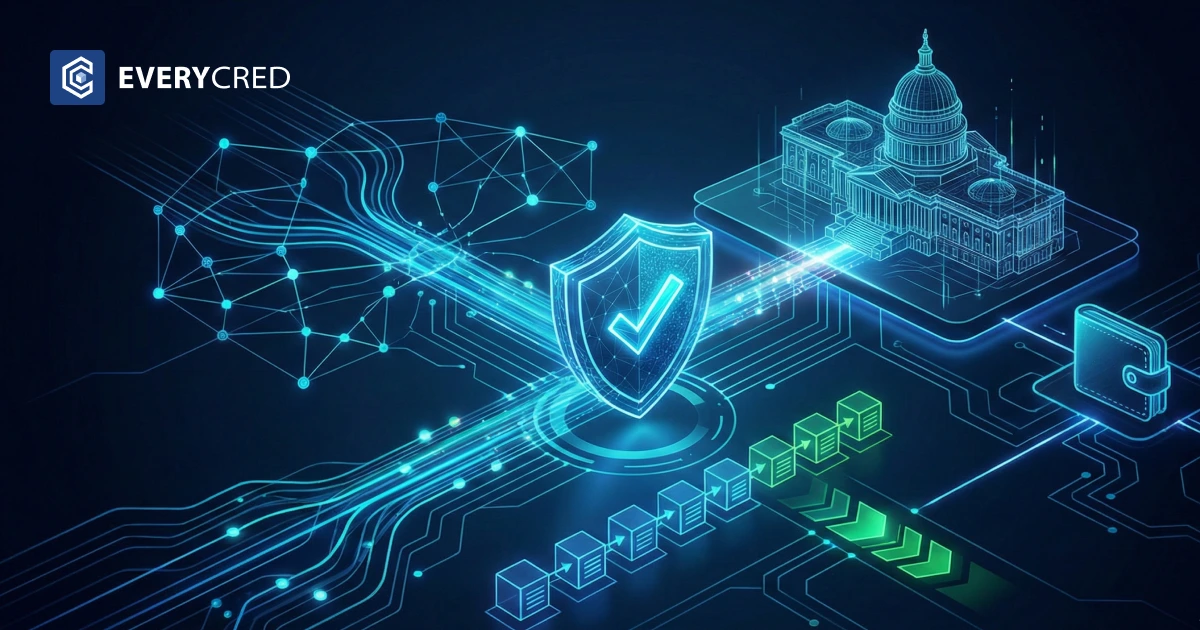
- The Threat of Fake Credentials in 2026
- Implement Digital Verification Standards
- The Mechanics of Verifiable Credentials
- Comparative Analysis: Manual vs. Digital Verification
- Benefits for U.S. Government Agencies
- Continuous Monitoring and Liveness Biometrics
- Challenges in Transitioning to Digital Systems
- Secure Government Credentials with EveryCRED
- Conclusion


U.S. government agencies face a significant increase in sophisticated fraud. In 2026, the prevalence of fake credentials has reached a critical point due to advancements in generative AI and synthetic identity theft.
Federal and state entities now require robust digital credential verification to maintain security and public trust. Here, we will discuss how agencies can transition to digital verification to eliminate manual processing errors and secure their workforce.
The Threat of Fake Credentials in 2026
The Department of Labor and other agencies deal with thousands of fake credentials annually. Traditional background checks rely on visual inspection or manual phone calls to issuers. These methods are slow and susceptible to error. Credential verification must happen in real-time to be effective against modern forgery techniques.
The rise of deepfake technology allows bad actors to create realistic but fraudulent certificates. These documents often pass visual inspections. Agencies need a system that relies on cryptographic proof rather than visual markers.
By 2026, the cost of employment-related fraud has grown significantly. Government IT departments must prioritize systems that detect fake credentials before an individual enters the secure network.
Implement Digital Verification Standards
The National Institute of Standards and Technology (NIST) updated its guidelines in NIST SP 800-63-4 to address these risks. These guidelines promote the use of verifiable credentials to reduce the need for remote registration via physical documents.
This technology allows an agency to verify a claim without contacting the original issuer for every individual check. It uses a decentralized model.
Agencies can integrate digital credential verification into their existing IT infrastructure to automate this process. According to NIST, the transition to these standards is necessary to combat the evolution of digital identity theft.
Using standardized protocols ensures that different government departments can share and verify data seamlessly.
The Mechanics of Verifiable Credentials
The W3C Verifiable Credentials standard provides a technical framework for secure data exchange. It involves three parties: the issuer, the holder, and the verifier.
- The Issuer: A government agency or educational institution that signs a digital document with a private key.
- The Holder: The individual who stores the digital credential in a secure wallet.
- The Verifier: The agency checking the credential.
When a government agency acts as a verifier, it uses digital verification to check the authenticity of the document. This prevents the use of fake credentials by requiring a digital signature that only the issuer could have provided. The system checks the signature against a public key available on a distributed ledger or a trusted registry.
This process takes seconds. It removes the human error associated with manual credential verification.
Comparative Analysis: Manual vs. Digital Verification
The following table outlines the operational differences between legacy methods and modern digital verification systems.
| Feature | Manual Verification | Digital Verification (2026 Standard) |
| Speed | 3–10 business days | Near-instant (milliseconds) |
| Security | Low (susceptible to AI forgeries) | High (cryptographically secured) |
| Cost per Check | High (labor intensive) | Low (automated) |
| Reliability | Variable based on human review | Absolute based on mathematical proof |
| Fraud Prevention | Fails against synthetic identities | Detects fake credentials automatically |
Benefits for U.S. Government Agencies
Adopting digital credential verification offers several operational advantages for the public sector.
Improved Security Posture
Agencies must protect sensitive data and infrastructure. Credential verification is the first line of defense. By using verifiable credentials, agencies ensure that every person accessing their systems has a legitimate, proven background. This reduces the risk of insider threats and unauthorized access.
Operational Efficiency
The government often struggles with administrative backlogs. Automating the verification process frees up staff for higher-priority tasks. Digital verification platforms handle high volumes of data without slowing down. This is critical for agencies that manage large-scale hiring or licensing, such as the Department of Veterans Affairs or state health departments.
Regulatory Compliance
New federal mandates require agencies to modernize their identity management systems. Implementing verifiable credentials helps agencies meet the requirements of the Executive Order on Improving the Nation’s Cybersecurity. It also aligns with the shift toward Zero Trust Architecture.
Continuous Monitoring and Liveness Biometrics
In 2026, digital verification is not a one-time event. Agencies are moving toward continuous verification. This means the system periodically checks that a credential remains valid.
If a professional license is revoked, the system updates the status immediately. This prevents individuals from using formerly valid but now fake credentials to maintain employment.
Furthermore, agencies are integrating liveness biometrics. This technology ensures that the person presenting the credential is a live human and matches the identity on record. It counters the use of deepfakes during the remote onboarding process.
The Department of Homeland Security actively funds the development of these privacy-preserving technologies to secure national interests.
Challenges in Transitioning to Digital Systems
Legacy systems present a hurdle for many government departments. Older databases often lack the APIs necessary for modern digital verification. IT managers must plan for a phased rollout. This involves:
- Updating data schemas to support W3C standards.
- Training staff on how to issue and verify verifiable credentials.
- Ensuring interoperability between state and federal systems.
Despite these challenges, the risk of continuing with manual checks is too high. The ease with which criminals generate fake credentials necessitates a technological response.
Secure Government Credentials with EveryCRED
EveryCRED provides the infrastructure required for automated issuance and instant credential verification. Our platform is built to handle the rigorous security requirements of the government sector.
Our system utilizes the latest digital verification protocols to ensure that every credential issued is immutable and easily verifiable. We enable agencies to issue verifiable credentials that users can carry in secure digital wallets.
This eliminates the need for paper-based systems and reduces administrative overhead by 80%. EveryCRED’s API-first approach allows for seamless integration with existing HRIS and identity management platforms.
By using EveryCRED, agencies can implement a digital credential verification strategy that scales. Our data-backed approach shows that automated systems reduce the time-to-hire by an average of 12 days. This efficiency is vital for maintaining a modern and secure public sector workforce.
Conclusion
The threat environment in 2026 requires a move away from manual document review. Fake credentials are now too sophisticated for visual detection. U.S. agencies must adopt digital verification to protect their operations and the public.
By implementing verifiable credentials based on NIST and W3C standards, the government can ensure a secure, efficient, and fraud-resistant future.
Credential verification is a critical component of the national security infrastructure. Transitioning to a digital credential verification model is the most effective way to eliminate fraud and streamline agency operations.