24th February, 2026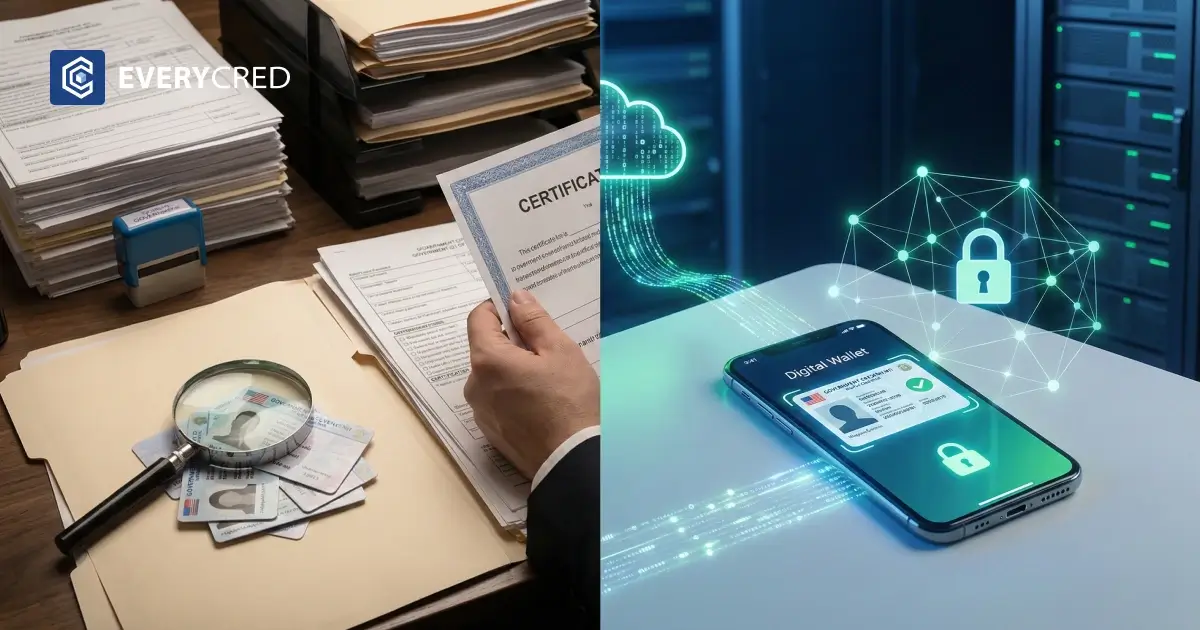
- Manual Verification Drains Federal Resources
- Federal Security Standards Demand Verifiable Credentials
- Decentralized Networks Secure Citizen Data
- Compare Traditional Documents to Digital Systems
- Citizens Move Public Records to the Digital Wallet
- Cryptographic Methods Eliminate Document Forgery
- Infrastructure Requirements for Public Sector Issuance
- The Future of Public Sector Identity Systems


United States government agencies process millions of records every day. These agencies historically issued physical paper documents to citizens. Physical documents create administrative delays. Federal and state departments are adopting digital credentials government frameworks to improve processing speed.
This transition replaces paper forms and plastic cards with secure electronic files. Digital systems automate data checks and remove human error from the authentication process. Government agencies issue digital credentials to citizens for licenses, permits, and official certifications.
Manual Verification Drains Federal Resources
Government employees spend thousands of hours checking physical identification documents. This manual verification requires staff to examine watermarks, holograms, and printed text. Human operators experience fatigue. Fatigue causes errors during visual inspections. Agencies must train staff continuously to recognize new document formats. Manual verification costs public sector organizations significant financial resources.
Physical documents easily suffer damage or loss. Citizens must request replacements. Government workers must process these replacement requests manually. This creates backlogs in public administration offices. Agencies also rely on manual verification to cross-check physical documents against separate databases. Employees type data from paper into computer terminals. Data entry errors occur frequently.
A robust digital identity system reduces these administrative costs. Digital systems read cryptographic data instantly. Software authenticates the record without human intervention. Government offices reduce wait times when they eliminate manual verification. Agencies can learn more about implementing automated systems by reviewing the benefits of a digital credentials platform. Automated systems process requests simultaneously.
Federal Security Standards Demand Verifiable Credentials
Federal agencies require strict proof of authenticity for public records. Traditional electronic files, like basic PDFs, lack internal security. Fraudsters alter standard PDFs easily. Verifiable credentials solve this security problem. Verifiable credentials contain cryptographic signatures. The issuing agency applies a digital signature to the file.
The National Institute of Standards and Technology (NIST) creates security guidelines for federal agencies. The government requires secure digital identity management. According to the NIST Special Publication 800-63 guidelines, federal systems must use strong cryptographic controls for authentication. Verifiable credentials meet these strict federal standards.
When a citizen presents verifiable credentials, the receiving agency software checks the cryptographic signature. The software uses a public key to confirm the issuing agency signed the document. The software also confirms no one altered the data after issuance. Verifiable credentials provide mathematical proof of origin. This mathematical proof replaces the visual inspection of paper documents.
Decentralized Networks Secure Citizen Data
Traditional data systems store citizen information in central databases. Central databases present a high security risk. Hackers target central databases to steal large volumes of data. A decentralized system distributes data differently. Decentralized networks remove the single point of failure.
In a decentralized system, the government issues the credential directly to the citizen. The citizen stores the data on their personal device. The central government database does not need to track every time the citizen uses the credential. This decentralized approach protects citizen privacy. Citizens maintain control over their digital identity.
Government agencies use decentralized identifiers to manage these records. The agency issues the digital credentials. The citizen holds them. The citizen shares them with a third party. Read more about what digital credentials are to understand this issuance cycle. A decentralized infrastructure prevents unauthorized tracking by third parties. Digital credentials, government programs use this architecture to comply with privacy laws.
Compare Traditional Documents to Digital Systems
Government IT departments evaluate several factors when upgrading infrastructure. The following table compares physical documents with modern digital systems.
| Feature | Physical Documents | Digital Systems |
| Storage Method | Physical filing cabinets and wallets | Secure digital wallet |
| Authentication | Visual inspection and manual verification | Cryptographic signature verification |
| Data Sharing | All printed data is visible to the viewer | Selective disclosure of specific data points |
| Forgery Risk | High (physical alteration and copying) | Low (tamper-evident cryptography) |
| Issuance Speed | Days or weeks via postal mail | Instant network delivery |
Citizens Move Public Records to the Digital Wallet
Citizens use applications to store electronic files safely on their smartphones. These applications function as a digital wallet. Consumers currently use a digital wallet for payment cards and boarding passes. Citizens now add government-issued IDs to the digital wallet.
State motor vehicle departments currently issue mobile driver’s licenses. Citizens download these licenses directly to a secure digital wallet on their mobile device. Federal agencies accept these mobile IDs for official purposes. The Transportation Security Administration (TSA) processes passengers using these records. The TSA digital identity program reads mobile driver’s licenses at airport security checkpoints.
The digital wallet transmits the identification data securely to the government scanner. TSA officers do not need to handle physical plastic cards. This eliminates another layer of manual verification. The digital wallet uses encrypted wireless connections. The citizen retains physical possession of their mobile device throughout the transaction. Digital credentials government initiatives expand as more citizens adopt mobile storage applications.
Cryptographic Methods Eliminate Document Forgery
Counterfeiters duplicate physical paper easily. Criminals forge professional licenses and public certificates. Digital credentials use cryptography to prevent forgery. Software generates a unique digital fingerprint for every issued record. The system records this fingerprint on a secure ledger.
When a user submits verifiable credentials, the receiving software calculates the file’s fingerprint. The software compares the new fingerprint with the original fingerprint on the ledger. A match proves the document is authentic. A mismatch indicates tampering. Organizations can explore how to conduct business with verifiable digital credentials to secure their verification processes.
The system rejects altered files immediately. This process happens in milliseconds. Cryptography ensures the digital identity remains highly reliable. Government agencies trust the mathematical verification process.
Infrastructure Requirements for Public Sector Issuance
Agencies require specific software infrastructure to modernize their document systems. The software must generate verifiable credentials securely. The platform must connect to existing government databases. The software must support decentralized network protocols. It must format the files correctly for storage in a standard digital wallet.
EveryCRED provides a blockchain-backed platform for issuing secure digital certificates. The platform automates the entire issuance process for public sector agencies. EveryCRED eliminates the need for manual verification. Government agencies use EveryCRED to issue tamper-proof records directly to citizens.
EveryCRED utilizes decentralized identity methods to ensure data privacy and security. The platform integrates seamlessly with existing government software via REST APIs.
The Future of Public Sector Identity Systems
The United States public sector is changing its administrative processes. Agencies issue secure digital credentials instead of paper forms. They use verifiable credentials to ensure data authenticity and prevent fraud. Citizens store their verified digital identity safely inside a personal digital wallet.
Government IT departments rely on decentralized networks to secure this data and protect privacy. This technology transition ends the government reliance on slow manual verification. Digital credentials government programs improve processing speed, increase data security, and reduce administrative costs for all public agencies.