9th July, 2026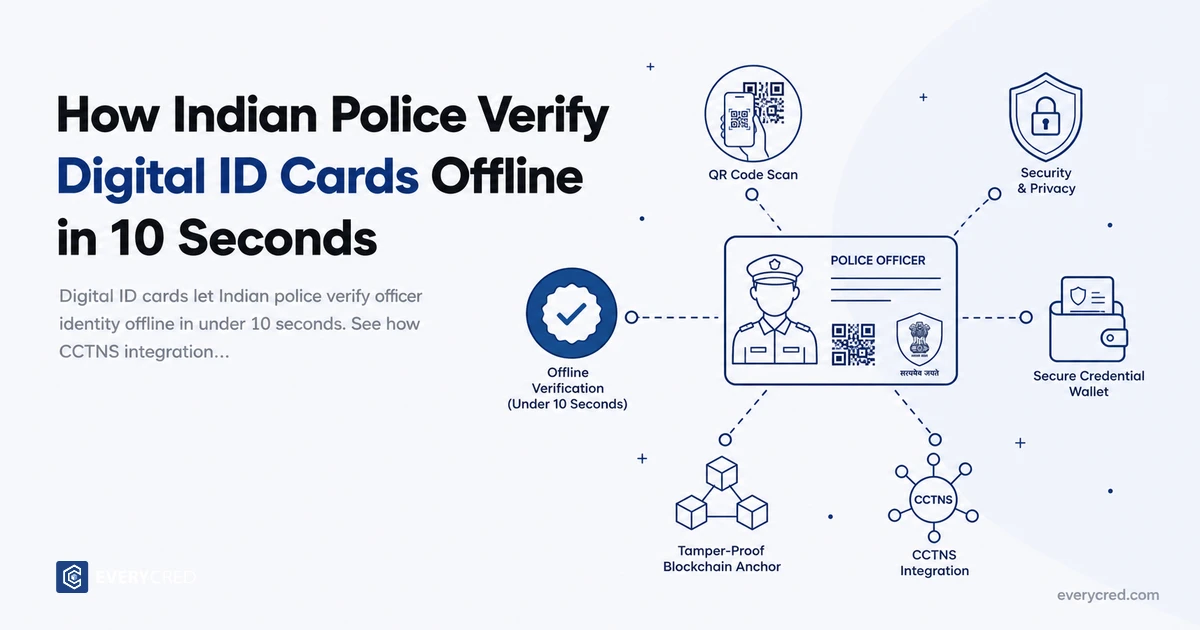
- Why Officer ID Checks in the Field Took Up to 30 Minutes
- How Digital ID Cards Verify Police Officers in Under 10 Seconds
- Offline Verification That Works Without a Network Signal
- How CCTNS Integration Links Existing Police Databases
- Real-Time Revocation Stops Officer Impersonation
- Rolling Out Police Digital ID Cards Statewide
- Deploy Offline Police Verification with EveryCRED
- Conclusion
- FAQs


Indian police forces verify officer identity in the field by scanning a digital ID card. The scan returns a cryptographically signed result in under 10 seconds, even with no network connection. The credential is checked against a signature cached on the device, so a constable at a rural checkpoint confirms a colleague’s identity without calling a control room.
This guide covers how police digital ID cards work. It shows how offline verification stays fast where connectivity fails. It also explains how CCTNS integration connects to the records that police already maintain. It is written for state police IT heads, home department technology leads, and district SP offices planning a move off paper cards.
Raigad Police deployed this system and cut officer verification time from 30 minutes to under 10 seconds. Here is how the same approach works, step by step.
Key Takeaways
- Digital ID cards let police verify officer identity in under 10 seconds by scanning a QR code against a cached cryptographic signature.
- Offline verification works with no network connection, so field checks continue in rural areas and low-signal zones.
- CCTNS integration connects the credential system to existing police databases via a REST API, with no changes required on the front end.
- Raigad Police reduced verification time from 30 minutes to under 10 seconds and cut administrative overhead by 85%.
Why Officer ID Checks in the Field Took Up to 30 Minutes
Paper officer identity cards create a verification gap that impersonators exploit. A printed card can be easily photographed, copied, or forged. A verifier in the field has no fast way to confirm it is genuine.
Consider a night check on a state highway. A team stops a vehicle carrying people in police uniform and needs to confirm their identity. With paper cards, the options are a radio call to a control room or a visual guess.
Confirming identity through a control room or a manual register took up to 30 minutes per check. During joint operations, night patrols, and inter-district deployments, the delay slows the whole operation.
Connectivity makes it worse. Many checkpoints, border posts, and rural stations have weak or no mobile signal. A method that depends on a live database call fails where officers need it most. Digital ID cards remove that trade-off.
How Digital ID Cards Verify Police Officers in Under 10 Seconds
A police digital ID card is a cryptographically signed credential, not a photo of a card. When an officer presents it, the verifier scans a QR code or taps an NFC chip. The scanner reads the embedded signature and checks it against the issuing authority’s public key.
The security comes from open standards, not a proprietary format. The credentials follow the W3C Verifiable Credentials standard, which defines how a credential is signed, presented, and verified. Because the proof travels with the credential, the verifier does not contact the issuing office during a check.
If the signature is valid and the credential is not revoked, the check returns a verified result in under 10 seconds. If anyone alters a single field, the signature breaks and verification fails at once. Trust shifts from the look of a card to cryptographic proof. That is what makes a digital ID card fast to verify and hard to forge.
Offline Verification That Works Without a Network Signal
Offline verification is the capability that matters most for field policing. EveryCRED stores the signatures needed to validate credentials locally on the verifying device. The check runs against that cached data, so it completes with no internet connection.
For a field officer at a rural checkpoint, this means a verification in under 10 seconds, even with no mobile signal. EveryCRED deployed this privacy-first, offline credential verification model for Raigad Police field officers in 2025. The device confirms a credential is genuine and current without pinging a central server.
Offline capability protects operations during network outages and in low-coverage areas. A system that works only online fails when it is needed most. Remote posts, large gatherings, and disaster response all demand checks in poor connectivity. Cached signatures refresh whenever the device reconnects, so revoked credentials are caught quickly.
How CCTNS Integration Links Existing Police Databases
CCTNS integration lets a digital ID system work with the records that police already maintain. EveryCRED connects through a REST API. It exchanges data with the Crime and Criminal Tracking Network and Systems (CCTNS) without replacing existing software.
The same approach connects to NAFIS, the National Automated Fingerprint Identification System, and to Dial 112 response systems. Verifiers keep their current interfaces. No front-end changes are required for officers or control room staff.
CCTNS integration also supports DigiLocker, giving officers a familiar way to hold and present credentials. This law enforcement deployment adds verifiable officer IDs as a layer over the current stack, not a multi-year replacement. When an officer’s status changes in the source system, that change flows through to verification.
Real-Time Revocation Stops Officer Impersonation
A digital ID card is only as trustworthy as its ability to be cancelled. When an officer is suspended, transferred, or retires, the credential must stop verifying at once. EveryCRED revokes a credential in seconds from the admin portal.
After revocation, every future check returns invalid, including checks on a credential already stored on the officer’s device. This closes the ghost credential gap, where a suspended officer could still show a valid-looking ID the next day.
This matters most for impersonation. The Raigad Police digital ID system pairs instant revocation with offline verification, so a cancelled credential is flagged once a device reconnects. A stolen or expired identity becomes far harder to use.
Real-time revocation also creates an audit trail. Every issuance, verification, and revocation is logged, which supports internal reviews, court questions, and DPDP Act accountability requirements.
Rolling Out Police Digital ID Cards Statewide
A statewide police digital ID rollout follows a structured timeline. In comparable deployments, a full rollout runs about 36 weeks, with a working pilot operational by week 20. The phased approach lets a department test issuance and field verification in one district before scaling.
The first phase covers issuer setup and integration with CCTNS and HR records. The second issue credentials to a pilot group and trains verifiers. The third extends issuance across districts and enables offline verification on field devices.
Planning a rollout of digital ID cards starts with three questions: which records are authoritative, which field conditions need offline support, and how revocation is governed. The police identity white paper walks through each decision with a deployment checklist. Answering these early keeps the rollout on schedule.
Bulk issuance lets a force credential thousands of officers in batches rather than one at a time. That keeps a large rollout on schedule without adding manual work for administrative staff.
Deploy Offline Police Verification with EveryCRED
We deployed digital officer IDs for Raigad Police, cutting field verification time from 30 minutes to under 10 seconds and reducing administrative overhead by 85%. The system integrates with CCTNS and NAFIS through a REST API and verifies credentials offline, with no network needed at the point of check. Credentials are revoked in seconds, and every event is logged to an audit trail. State police forces and home departments can deploy the same system as a layer over existing databases, without a rip-and-replace project. Book a demo to see offline verification and CCTNS integration working end-to-end.
Conclusion
Field policing needs identity checks that are fast, tamper-proof, and independent of connectivity. Paper cards meet none of these needs, and online-only systems fail where signal drops. Digital ID cards close the gap by moving verification to a cryptographic proof that a device checks in under 10 seconds, offline.
The Raigad Police deployment shows the model works at scale. Verification time fell from 30 minutes to under 10 seconds, and administrative overhead dropped 85%. CCTNS integration keeps the system aligned with records police already trust, and instant revocation shuts down impersonation. For state police teams weighing a move off paper credentials, a phased rollout turns officer identity from a bottleneck into a routine 10-second check.
FAQs
How do police verify digital ID cards without the internet?
Verifiers scan the credential and check it against a cryptographic signature cached on the device, so no network is needed.
How fast is offline officer ID verification?
A scan returns a verified result in under 10 seconds, matching the Raigad Police deployment result.
What is CCTNS integration in a police digital ID system?
It connects the credential platform to CCTNS through a REST API, keeping officer records in sync without front-end changes.
Can a suspended officer’s digital ID card still be used?
No. Credentials are revoked in seconds, and every subsequent verification returns invalid, even on devices that stored the credentials.
How long does a statewide police digital ID rollout take?
A full rollout runs about 36 weeks, with a working pilot operational by week 20.