10th July, 2026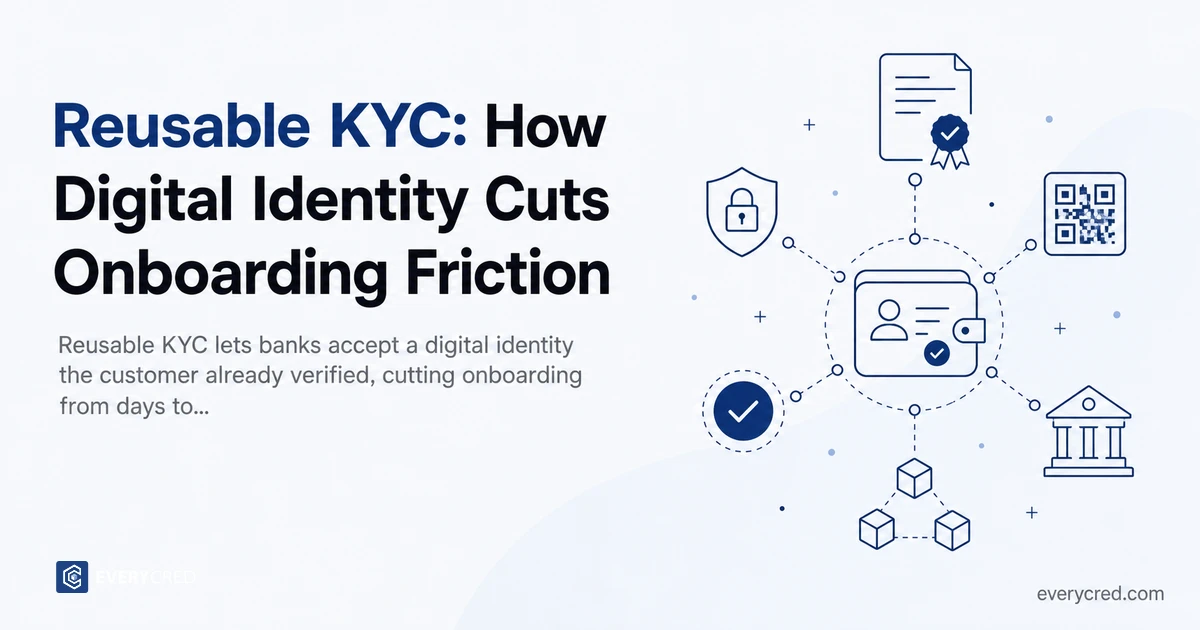
- Banks Re-Run Identity Checks on Customers Who Already Passed
- How a Verified Digital Identity Becomes Reusable KYC
- Selective Disclosure Shares Only What the Bank Needs
- How Reusable KYC Cuts Banking Onboarding From Days to Minutes
- What a Reusable Digital Identity Means for AML Compliance
- Deploy Reusable KYC With EveryCRED
- Conclusion
- FAQs


Reusable KYC lets a financial institution accept a digital identity that the customer already verified elsewhere, instead of re-running the entire Know Your Customer (KYC) check. The customer proves their identity once, stores that proof as a verifiable credential, and presents it to the next bank or fintech in seconds. This use case guide explains how reusable KYC works, how selective disclosure protects customer data, and how it removes days of friction from banking onboarding. It is written for onboarding directors, compliance officers, and anti-money laundering (AML) managers who verify identities at scale. Manual identity verification costs $15 to $25 per check and can take days to clear. Reusable KYC turns that repeated cost into a one-time event that the customer carries with them.
Key Takeaways
- Reusable KYC lets banks accept a digital identity the customer verified once, ending repeat checks across institutions.
- Selective disclosure through zk-SNARKs shares only the fields a bank needs, reducing stored personal data.
- Manual identity verification costs $15 to $25 per check; automated verification costs under $0.10.
- Reusable digital identity can cut onboarding friction by up to 12 times versus manual verification.
- Verifiable credentials follow W3C VC 2.0, so an identity verified once verifies across banks and fintechs.
Banks Re-Run Identity Checks on Customers Who Already Passed
Most banks and fintechs treat every new customer relationship as a blank slate. A customer who passed KYC at one institution last month must repeat the full process at the next. They resubmit the same passport, the same proof of address, and the same selfie, then wait again.
This duplication is expensive. High-volume KYC verification runs $15 to $25 per manual check, and a single onboarding can trigger several checks across identity, sanctions, and document steps. At scale, those costs compound fast.
The delay hurts more than the cost. Multi-day verification pushes applicants to abandon accounts before they open. In lending and payments, lost time is lost revenue.
Fraud pressure makes manual review harder. AI-generated forged documents grew 311% from the first quarter of 2024 to the first quarter of 2025. A document that looks authentic to a human reviewer may be entirely synthetic.
How a Verified Digital Identity Becomes Reusable KYC
A reusable KYC credential is a verified digital identity that the customer holds and reuses. An accredited issuer, such as a bank or a licensed identity provider, verifies the customer’s identity once and issues a verifiable credential. The customer stores it in a digital wallet.
The credential follows the W3C Verifiable Credentials Data Model 2.0. It carries the issuer’s cryptographic signature. Any change to the data breaks that signature, so tampering is detected during verification.
When the customer opens an account at the next institution, they present the credentials. The verifier checks the signature against the issuer’s public key. Verification resolves in seconds, with no callback to the original issuer.
This is the practical meaning of reusable KYC: verify once, then reuse the same digital identity across institutions. The same model already powers KYC for banks and fintechs, where each verifier trusts the cryptographic proof instead of repeating the check.
Selective Disclosure Shares Only What the Bank Needs
Selective disclosure lets a customer prove a fact without revealing the underlying data. Using zero-knowledge proofs (zk-SNARKs), a credential can confirm that a customer is verified or over 18, without exposing the full document.
For a bank, selective disclosure means seeing a verified answer instead of storing another copy of a passport. That reduces the personal data the institution holds, and it shrinks the attack surface for a breach.
Selective disclosure also supports data minimization, a core principle in modern privacy and identity rules. The verifier receives only the fields it needs to meet its obligation, and nothing more.
The customer stays in control. They keep the credentials in a credential wallet and choose which fields to share with each verifier. Selective disclosure turns identity from a bulk data transfer into a targeted proof.
How Reusable KYC Cuts Banking Onboarding From Days to Minutes
Banking onboarding slows at the identity step. Reusable KYC removes that step for any customer who already holds a verified credential. The check becomes a scan and a signature validation, not a fresh document review. This is how verifiable credentials in banking change the onboarding math.
Consider a regional bank onboarding a small-business owner who verified their identity at a partner institution last quarter. Instead of resubmitting documents, the owner presents a reusable KYC credential. The bank validates it in seconds and moves straight to account setup.
The effect on banking onboarding is direct. Digital identity verification through reusable credentials can reduce onboarding friction by up to 12 times compared with manual checks. Fewer steps mean fewer drop-offs and a faster first transaction.
Cost falls with the friction. Manual checks cost $15 to $25 each; automated instant verification against a signed credential costs under $0.10. For a fintech onboarding thousands of customers a month, banking onboarding shifts from a cost center to a background process.
What a Reusable Digital Identity Means for AML Compliance
A reusable digital identity does not weaken compliance. It strengthens it. Every issuance, presentation, and verification is logged to an immutable audit trail, so an institution can prove who verified what and when.
Revocation is immediate. If a customer’s status changes, the issuer revokes the credential, and every subsequent verification returns invalid. A credential valid on Monday cannot be presented as valid on Tuesday once revoked.
Open standards keep the model auditable. EveryCRED follows W3C VC 2.0 and DID v1.1, and aligns with the identity assurance levels in NIST SP 800-63-4, finalized in July 2025. Examiners can trace each check to a signed, timestamped record.
Reusable KYC also cuts fraud at the source. A verifiable credential cannot be forged without breaking its signature, so synthetic documents fail at verification. That protects both the institution and the customer whose digital identity is reused.
Deploy Reusable KYC With EveryCRED
We built EveryCRED so a customer’s verified digital identity works across institutions. Our platform issues W3C-compliant verifiable credentials, supports selective disclosure through zk-SNARKs, and verifies in seconds, online or offline. In production, Raigad Police field officers verify credentials in under 10 seconds without a network connection, the same speed reusable KYC brings to banking onboarding. Verification runs through a REST API, with no front-end changes to existing onboarding systems. Public-sector and government finance teams can procure through Carahsoft on NASA SEWP V and ITES-SW2. Book a demo to see the reusable KYC workflow from issuance to verification.
Conclusion
Reusable KYC changes the economics of identity for banks and fintechs. Instead of re-running a check the customer already passed, the institution accepts a signed digital identity and verifies it in seconds. Selective disclosure keeps the data exchange minimal, so the bank sees only what it needs to meet its obligation. The result is faster banking onboarding, lower per-check costs, and a cleaner audit trail for examiners. The credential stays under the customer’s control and remains verifiable across institutions because it follows open standards. As reusable identity adoption grows, banks that treat verified identity as a portable asset will open accounts while competitors are still collecting documents.
FAQs
What is reusable KYC?
Reusable KYC lets a customer verify their identity once and reuse that verified credential across multiple banks and fintechs.
How does selective disclosure protect customer data?
Selective disclosure shares only the fields a verifier needs, proving a fact without exposing the full identity document.
Is reusable KYC compliant with US identity standards?
Yes, reusable KYC follows W3C VC 2.0 and aligns with NIST SP 800-63-4 identity assurance levels for compliance.
How much faster is banking onboarding with reusable credentials?
Reusable digital identity can reduce onboarding friction up to 12 times versus manual checks, cutting days to minutes.
Can a reusable KYC credential be revoked?
Yes, issuers revoke credentials in seconds, and every subsequent verification returns invalid once the credential is revoked.