9th June, 2026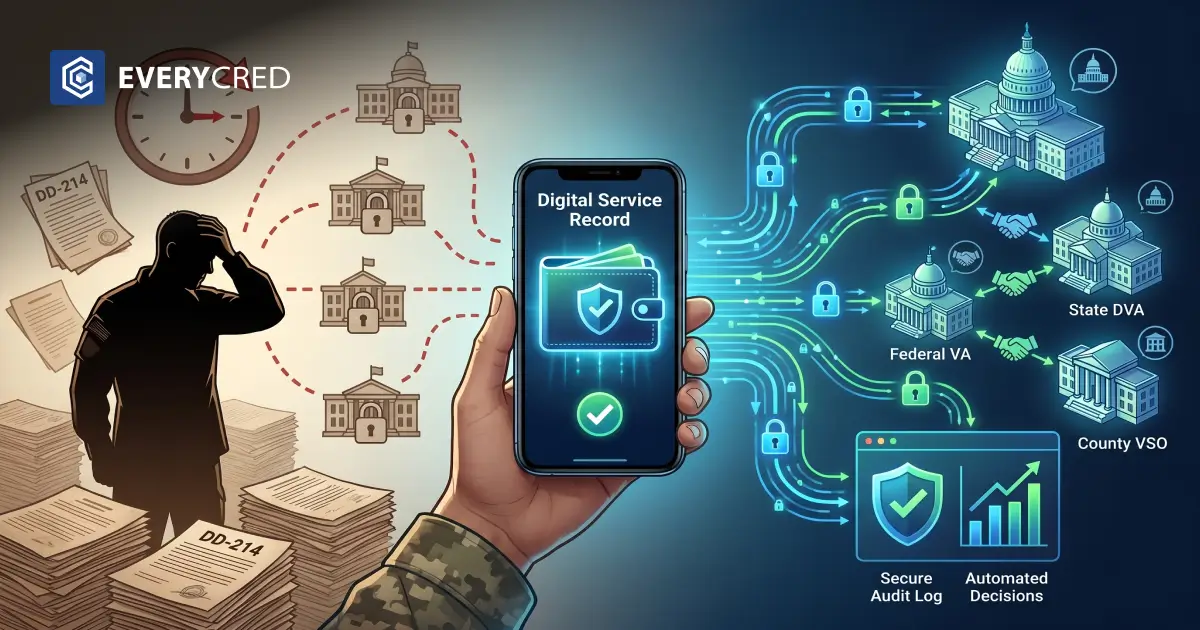
- Why VA Service Record Verification Is Duplicated and Slow
- What a Digital Trust Model Changes for VA Identity and Service Records
- Federated by Design: Verifying Without Centralizing Veteran PII
- The Business Case: Payment Integrity, Audit Trails, and Faster Decisions
- A VA Deployment Model: Pilot to State Rollout in 36 Weeks
- How We Help VA Programs Deploy Digital Trust
- Conclusion
- FAQs


A digital trust model lets a veteran hold a verified service record once and present it to any veteran benefits program, with each agency confirming it cryptographically. It removes the duplicate DD-214 request that the federal VA, state Departments of Veterans’ Affairs, and county Veteran Service Officers each run today. That duplication slows benefit decisions and re-exposes veteran personal data at every step.
Most VA modernization work fixes the wrong layer. Sign-in tools like ID.me and Login.gov answer whether the right person is logged in. They do not make the underlying service record portable, self-verifying, or shareable across program boundaries. This guide shows how a digital trust approach closes that gap, and how to deploy it without centralizing veteran data.
Key Takeaways
– The DD-214 is re-requested separately by federal VA, state DVAs, and county CVSOs, exposing veteran PII at each handoff.
– A digital trust model issues the service record once as a verifiable credential that the veteran holds and shares on demand.
– Selective disclosure lets a program confirm one claim, such as honorable discharge, without exposing the full record, satisfying NIST SP 800-63-4 data minimization.
– The VA issued at least $5.1 billion in compensation and pension overpayments from FY2021 to FY2024, raising the stakes for audit-ready verification.
– A federated deployment respects VA data boundaries, with each authority verifying without taking custody of records it cannot legally hold.
Why VA Service Record Verification Is Duplicated and Slow
Service record verification happens many times for a single veteran. The DD-214 is the master eligibility document for VA disability compensation, healthcare, education benefits, and burial honors. Each veteran benefits program requests and re-checks it independently.
The custodians are separate by law. The federal VA, 50 state Departments of Veterans’ Affairs, and county Veteran Service Officers each hold and process their own copies. A veteran applying across these layers resubmits the same record to staff who re-verify it from scratch.
The delay is real. A records request through the National Personnel Records Center can take four to six weeks or longer. Identity proofing through ID.me or Login.gov adds another step before a benefit decision moves forward.
Every duplicate request re-handles personal data. The DD-214 carries a Social Security number, date of birth, and full service history. The federal government itself warns that the DD-214 exposes veterans to identity theft, and each new copy widens that exposure.
What a Digital Trust Model Changes for VA Identity and Service Records
Digital trust for VA programs is an infrastructure layer that lets a veteran hold a cryptographically signed service record and present it to any program, where the verifier confirms authenticity in seconds without contacting the issuing authority. It treats the record as portable proof rather than a document to re-request.
The mechanism uses the three-party model. The issuing authority signs the service record as a verifiable credential. The veteran stores it in a credential wallet. Any program verifies the cryptographic signature against the issuer’s public key.
This is where VA identity work usually stops short. Identity proofing confirms the person. A digital trust layer confirms the record itself, so service record verification no longer depends on phoning the issuer or pulling a fresh copy.
Consider a concrete case. A veteran named Daniel separated in 2025 and applied for disability compensation, a state property-tax exemption, and a county transportation benefit. Today, he proves his DD-214 three times to three offices. Under a digital trust model, he holds one signed service record and shares it three times in seconds, and each office verifies it independently.
Federated by Design: Verifying Without Centralizing Veteran PII
A workable model for VA identity cannot pool veteran data in one place. Federal VA, state DVAs, and county offices are distinct legal custodians. A digital trust design respects those boundaries by letting each authority verify a record without taking custody of it.
Verification resolves against a public key, not a shared database. The veteran presents the credential, and the program checks the signature locally. No agency has to expose its records to another agency to enable trust across the group.
Selective disclosure handles the federated PII problem directly. A program that only needs to confirm honorable discharge or 90-plus days of active duty verifies exactly that claim. It never sees the full DD-214, which reduces federated PII exposure across every benefit touchpoint.
This aligns with current standards. The NIST Special Publication 800-63-4 update sets data minimization expectations that selective disclosure satisfies by design. Sharing one attribute instead of an entire record is the practical form of that principle. Approaches like privacy-first verification show how this works without a phone-home step.
The Business Case: Payment Integrity, Audit Trails, and Faster Decisions
The financial stakes make service record verification a payment-integrity issue. The VA issued at least $5.1 billion in compensation and pension overpayments from FY2021 to FY2024, and was found non-compliant with the Payment Integrity Information Act in a VA Office of Inspector General audit. Weak verification feeds improper payments.
Imposter fraud compounds the risk. An AARP survey found nearly four in ten veterans, more than seven million people, have been approached by fake government or VA scams. Verifiable records give programs a way to confirm legitimacy without relying on documents that are easy to fake.
An immutable audit trail answers the accountability question. Every issuance and verification event is logged with a timestamp. Auditors can prove which program verified which record, when, and whether it was valid at that moment.
The cost math favors automation. Manual verification runs $15 to $25 per check, while cryptographic verification costs under $0.10. Across millions of annual veteran benefits interactions, that gap funds the modernization on its own and strengthens benefit fraud prevention.
A VA Deployment Model: Pilot to State Rollout in 36 Weeks
Deployment follows a staged path that proves value before scaling. The same model that drove a statewide government rollout in 36 weeks, with a pilot operational by week 20, applies to a VA program. Start narrow, then expand by program and jurisdiction.
- Scope one high-volume program, such as state disability exemptions or education benefits, and define the single claim each verifier needs.
- Issue the service record as a verifiable credential to enrolled veterans through the issuer portal.
- Integrate via REST API into the existing benefit portal, with no front-end changes for staff or applicants.
- Enable QR-based and offline verification so county offices can confirm records without a live database connection.
- Scale across programs and to additional state DVAs and counties once the pilot proves throughput.
This path keeps digital trust additive rather than disruptive. Agencies layer verification onto systems they already run. Teams comparing options against current tooling can use a credential platform comparison to frame the build-versus-replace decision.
How We Help VA Programs Deploy Digital Trust
We deployed digital identity credentials for Raigad Police, reducing verification time from 30 minutes to under 10 seconds and cutting administrative overhead by 85%. The same architecture supports VA service record verification across federal, state, and county programs. Our platform issues records as verifiable credentials, enables selective disclosure to limit federated PII exposure, and logs every check to an immutable audit trail. It integrates via REST API with no front-end changes, and US agencies can procure through NASA SEWP V, ITES-SW2, and NASPO ValuePoint. Download our VA modernization guide or contact our team for a consultation scoped to your programs.
Conclusion
Veteran benefits stall when every program re-verifies the same service record and re-handles the same personal data. A digital trust model breaks that cycle by issuing the record once and letting each authority verify it independently. Selective disclosure limits federated PII exposure, and an immutable audit trail strengthens payment integrity against a backdrop of $5.1 billion in recent overpayments. The federated design respects the legal boundaries between federal VA, state DVAs, and county offices. Programs that adopt this VA identity layer cut verification delays, reduce fraud exposure, and make faster benefit decisions. The deployment model is proven, additive, and ready to scale program by program.
FAQs
What is digital trust for VA programs?
Digital trust is an infrastructure layer that lets veterans hold verified service records and share them across benefit programs without re-verification.
How does a digital trust model reduce veteran PII exposure?
Selective disclosure shares only the required claim, such as honorable discharge, so programs verify eligibility without seeing the full DD-214.
Does this replace ID.me or Login.gov for VA identity?
No. Those tools prove the person; digital trust makes the underlying service record portable, self-verifying, and shareable across VA programs.
How does federated verification respect VA data boundaries?
Each authority verifies a credential against a public key locally, without taking custody of records held by another agency.
Can VA agencies deploy digital trust through existing contracts?
Yes. Procurement is available through NASA SEWP V, ITES-SW2, and NASPO ValuePoint, with no new competitive procurement cycle required.