4th August, 2026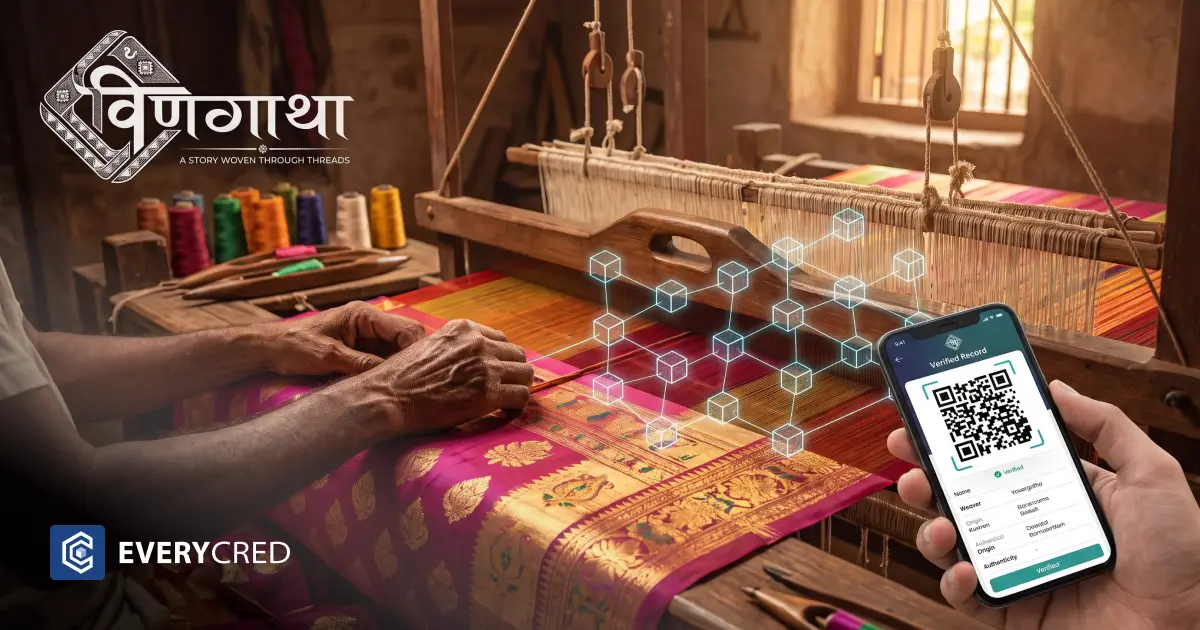


A Paithani saree is slow to make. A weaver works silk and zari by hand into motifs passed down through generations, and depending on the design, a single piece can occupy a loom for weeks.
A powerloom turns out a copy in a fraction of that time.
Both end up in shops. Both get called Paithani. And unless you can read the reverse of the fabric or count the threads in a border, you probably cannot tell which one you are holding.
That gap is what Vingatha was built to close, and handloom saree authentication is the short way of describing what it does.
What Vingatha is
Vingatha (विणगाथा) is a blockchain-enabled textile traceability platform we designed and developed for the Department of Textiles, Government of Maharashtra. It launched on 15 July 2026 at Bharat Tex 2026 in New Delhi.
The name means something close to a story woven through threads, which is a fair description of the product. Every registered saree carries a verifiable record of where it came from, who wove it and how it was made. A buyer scans a QR code and sees that record.
This post is the introduction. The structured version, with the full problem statement and architecture, is in the Vingatha case study.
The problem is older than the solution
Maharashtra’s handloom tradition is not one thing. Paithani traces back to the town of Paithan and a great deal of it is woven today in Yeola. Karvati Kathi, with its distinctive saw-tooth border, comes out of the Vidarbha belt. Each has its own techniques and its own weaving communities.
What they share is a counterfeit problem.
Machine-made sarees are sold under the same names at a fraction of the price and a fraction of the effort. Before Vingatha, a buyer had one way to check: ask the seller. The department had no structured view of what circulated under these names, weavers had no digital presence attached to their output, and records sat in separate places, mostly on paper.
The usual answer is certification. A label, a tag, a stamp. But labels can be copied about as easily as the sarees, and a certificate in a filing cabinet does nothing for a customer standing in a shop. The gap between owning a name and being able to police it deserves its own post, and it will get one.
There is a second cost, and this is our reading rather than a measured finding: when buyers cannot tell the difference, some stop paying handloom prices at all. Uncertainty pushes people to the cheaper option, so counterfeits plausibly drag down what genuine work can command, not only who gets the sale.
What was missing was never certification. It was verification, at the moment of purchase, by the person doing the buying.
What we did not replace
Worth being clear about what Vingatha does not do, because it explains where the trust comes from.
The judgement about whether a saree is genuinely handwoven is still made by people. Departmental verification and cluster-level knowledge decide who counts as an authentic weaver and which units may register products. That process existed before us and it works, because it rests on expertise that cannot be automated.
So we left it alone. What the department lacked was a way to carry the result of that judgement to the point of sale. It had verification and no carrier. Vingatha is the carrier. The problem it solves at the weaver end is the same shape as the one we see across supply chains generally, which we wrote up separately in digital trust services for supply chain vendor authentication if you want that angle.
How handloom saree authentication works in practice
Weaver and cluster onboarding: Before any saree can be registered, the weaver or weaving unit behind it is verified and mapped to a cluster. If the source is not trusted, nothing downstream is either.
Registration, which is the issuance step: Each saree is entered individually with its production details, design information, weaving origin and handloom verification data. It comes out with a digital identity of its own, not a batch number shared with a hundred other pieces.
Anchoring: The verification record is committed so that it cannot be quietly edited later.
QR verification, which handles delivery and checking together: Each saree carries a unique QR code. Scanning it with an ordinary phone camera returns the record: authenticity, origin and the weaver behind the piece.
Note what is absent. There is no wallet to install and no credential for the buyer to claim, because the saree itself carries the code. A verification system that needs instructions does not get used.
Beyond the single check, the platform records the lifecycle from registration through verification, so the department sees a chain rather than a snapshot. It is the same supply chain credential model we apply elsewhere, narrowed to one product category. Worth a look if you are weighing this up for a different sector.
Why blockchain, specifically
Blockchain gets attached to plenty of projects that do not need it, so we would rather be direct about why it is here.
A traceability record is only worth what its trustworthiness is worth. If it lives in a database an administrator can edit at will, the whole system rests on trusting one party. Anchoring removes that dependency: once a verification is committed, altering it leaves a trace. Nobody has to take anyone’s word for it, including ours. For the mechanics rather than the summary, see how blockchain credential verification works.
That is a narrow claim and it is the right one. Blockchain does not determine whether a saree is handwoven. People do. What it guarantees is that once the verification has happened, the record holds.
How it was built, and where it stands
The work ran in five stages: understanding the existing verification process, designing registration, onboarding weavers and clusters, anchoring records, and building the QR layer. Each stage fed the next, so the verification workflow was settled before any of the technology was built around it.
Responsibility splits cleanly. The Department of Textiles owns the programme, sets verification policy and decides who is a verified weaver. EveryCRED designed and built the platform. Registration and verification data comes from authorised departmental stakeholders and verified weaving units, not from us. We built the rails; the department decides what goes on them.
The platform launched in July 2026, so the programme is still early. We would rather report registration and onboarding figures once they are settled and checked against the department’s records than put round numbers in a launch post. When they are, we will publish them in a follow-up rather than quietly editing this page.
The same caution applies to speed. A scan returns a record in about the time a phone camera takes to focus, but that describes how the system works, not a measured gain on what came before. There was no timed baseline, because the previous process was asking the seller. What changed is the kind of answer available: an assurance became a record.
What changes for the weaver
The part of this project we find most interesting has little to do with counterfeits.
Handloom sarees have always reached buyers anonymously. The weaver’s name does not travel with the product. Someone spends weeks at the loom and the finished piece turns up in a shop with no indication of who made it.
Vingatha attaches the maker to the product. Scan the code and the weaver is part of what you see. For a buyer that is a better story. For a weaver it is recognition that has been absent from the supply chain, and we expect it to compound into reputation and better prices over time. That is the outcome we are aiming at, not one we have evidence for yet. Those stories deserve telling properly, weaver by weaver, and that is a post we are looking forward to more than this one.
Where this goes next
Vingatha launched with Paithani and Karvati Kathi, but the architecture was not built for two products and Maharashtra has more heritage textiles than that. Himroo, Khana, Ghongadi. The same approach extends to any of them without a rebuild.
Beyond Maharashtra the problem is not regional. Any craft product with a reputation worth copying runs into it, and GI-tagged goods are the obvious case: a registration establishes who may use a name, but on its own it gives a shopper no way to check the piece in their hands.
Export markets are moving the same way. The European Union has named textile apparel a priority category for its Digital Product Passport, with the rules for textiles expected in 2027.
For exporters, traceability is shifting from a differentiator to a baseline requirement, which we covered at more length in why textile brands need supply chain traceability.
Talk to us about traceability
If you are working on authenticity, provenance or traceability, whether for a craft cluster, a state programme or an export supply chain, we would be glad to hear about it. The same infrastructure applies well beyond textiles, and this is not our first project with the Government of Maharashtra: we also built the digital identity system for Maharashtra Police.
Write to us at admin@everycred.com.