15th April, 2026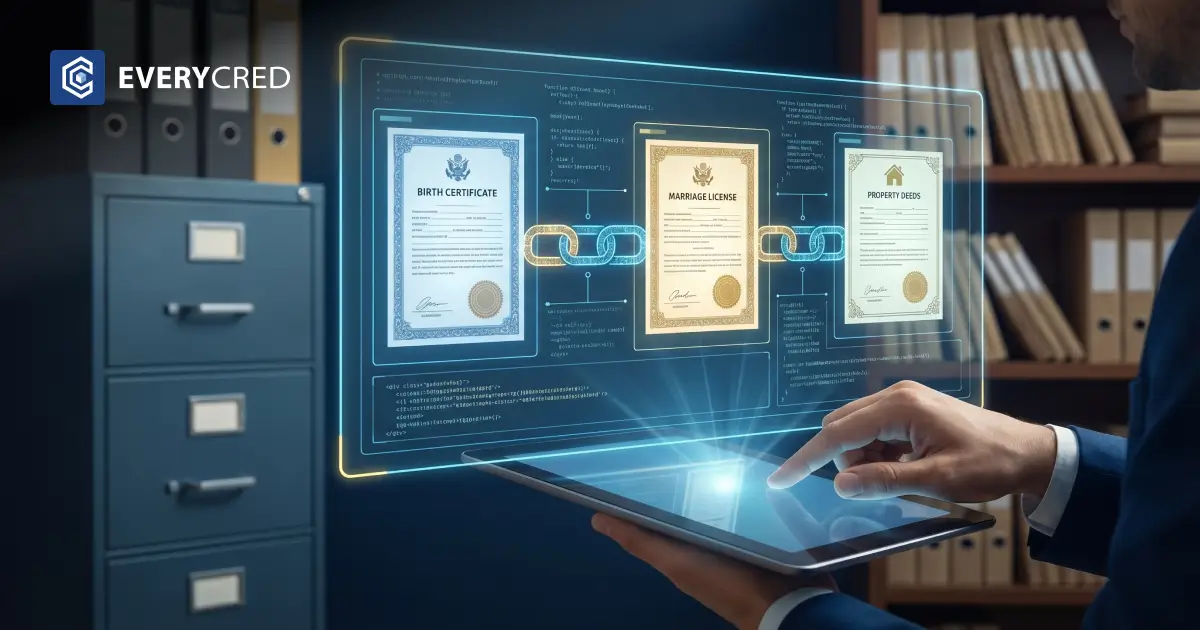
- The Fraud Is More Systematic Than Most Registrars Realize
- Why Centralized and Paper-Based Systems Cannot Solve This
- How Blockchain Credentials Protect Every Record at Issuance
- The Record Types Government Agencies Can Issue on Blockchain
- U.S. States That Have Already Moved
- Why Blockchain Outperforms Standard Digital Record Systems
- EveryCRED Is Built for Government-Grade Public Record Issuance
- Conclusion
- FAQs


Government registrars issue documents that define a person’s legal existence. Birth certificates, marriage licenses, death records, and property deeds are not administrative formalities. They determine access to federal benefits, healthcare, employment, financial services, and legal rights. Yet these records remain among the most targeted documents in the country for fraud.
The Federal Trade Commission recorded more than 1.1 million identity theft reports in 2024. Government documents and benefits fraud ranked as the single most reported identity theft category, accounting for nearly 396,000 cases. Total fraud losses across all categories reached $12.5 billion, a 25 percent increase over 2023. These numbers are not the result of isolated incidents. They reflect a structural problem in how public records are issued, stored, and verified.
Blockchain credentials offer a direct technical solution to this problem. Let us explain what that solution looks like for government registrars, why current systems fall short, and what U.S. jurisdictions have already put into practice.
The Fraud Is More Systematic Than Most Registrars Realize
The U.S. Department of Health and Human Services Office of Inspector General found that more than 14,000 versions of legitimate birth certificates exist across the country, issued by over 6,000 separate entities. Each version uses different paper, formats, and signatures. This fragmentation makes large-scale fraud detection near impossible.
Key fraud patterns that exploit this fragmentation include:
- Delayed birth registrations filed with minimal supporting evidence, which are harder to authenticate
- Identity theft using deceased individuals’ records, obtained before death-birth record matching is completed
- Forged vital records used as “breeder documents” to obtain passports, Social Security cards, and driver’s licenses
Once a fraudulent birth certificate enters the system, it creates downstream fraudulent documents across multiple agencies. The Government Accountability Office estimates the U.S. government loses between $233 billion and $521 billion annually to fraud. Identity-based schemes are a significant driver of that figure.
Why Centralized and Paper-Based Systems Cannot Solve This
Traditional vital records live in physical archives or centralized government databases. Both share the same core vulnerability: they depend on a single controlling authority. If that database is breached, all stored records are exposed. If a paper record is altered, the change may go undetected for years or even decades.
A standard digital certificate stored as a PDF carries similar risks. Basic software tools can edit PDF files. Without a verification mechanism connected to the original issuer, anyone receiving that document must contact the issuing office directly to confirm it is real. That process adds days to workflows that should take seconds. It also depends on the issuing office being available, staffed, and operating on compatible systems.
There is no audit trail. There is no tamper evidence. The verifier simply has to trust the document. These limitations are what blockchain-based credentials are designed to address at the infrastructure level.
How Blockchain Credentials Protect Every Record at Issuance
A blockchain credential works by creating a cryptographic hash of a document at the moment of issuance. This hash is a unique digital fingerprint anchored to a distributed ledger. The record itself is not stored on-chain. Only the fingerprint is. Any subsequent change to the document, including a single altered character, produces a different hash. The mismatch is immediately detectable.
The technical components that make this work for government registrars are:
Cryptographic Hashing: Each digital certificate receives a unique hash that acts as a permanent record of its original content. Platforms like EveryCRED use SHA-512 hashing, which creates a fingerprint that cannot be reverse-engineered or replicated.
Decentralized Identifiers (DIDs): Each public record is assigned a DID, a permanent identifier that does not depend on any single issuing authority. This resolves the jurisdictional silo problem. A marriage certificate issued in Nevada can be verified by a federal agency without contacting the original county office.
W3C Verifiable Credentials Standard: This international standard ensures that a digital certificate issued by one compliant system can be read and verified by any other. It enables cross-agency and cross-state interoperability in a way that current centralized databases do not support. Understanding how verifiable credentials operate at the protocol level matters for any agency evaluating this infrastructure.
Zero-Knowledge Proofs (ZKPs): A citizen can prove that a document is valid without disclosing every piece of information it contains. A registrar can confirm a person was born in a specific state without exposing the full birth record to every requesting party.
The Record Types Government Agencies Can Issue on Blockchain
Blockchain credentials are not limited to one document category. Government registrars can apply this infrastructure across the full range of official records:
- Birth certificates
- Death certificates
- Marriage licenses and certificates
- Divorce decrees
- Property titles and land deeds
- Professional licenses issued by state licensing boards
- Court-issued legal documents
Each document type has the same core vulnerability: it relies on physical or centralized systems that can be altered, forged, or destroyed. Blockchain issuance applies uniform tamper protection across all of them.
U.S. States That Have Already Moved
According to the Brookings Institution, at least 19 U.S. states have established official study groups to evaluate blockchain applications for government records. Several jurisdictions have moved beyond research into active deployment.
- California (SB 786, 2022): Governor Gavin Newsom signed legislation enabling county offices to issue birth, death, and marriage certificates on blockchain. The state’s Department of Motor Vehicles has also used blockchain to digitize 42 million vehicle titles.
- Sutter County, California: Deployed blockchain for birth and death records, improving delivery speed and reducing administrative costs.
- Elko County, Nevada: Actively piloting blockchain-based digital certificate issuance for birth records.
- Washoe County, Nevada: Reduced marriage certificate delivery from seven to ten business days to under 24 hours after adopting blockchain issuance on the Ethereum network.
- Baltimore, Maryland: Registered over 200,000 property land titles on a blockchain platform to reduce deed fraud.
- Wise County, Virginia: Building a 40-year smart land record system on distributed ledger technology.
These implementations confirm that the legal and technical frameworks already exist. The remaining barrier for most registrars is selecting a platform that integrates with current records management infrastructure and meets federal and state compliance requirements.
Why Blockchain Outperforms Standard Digital Record Systems
A digital record stored in a government database is an improvement over paper. It is searchable and easier to transmit. But it does not inherently prevent tampering or unauthorized modification. A blockchain credential adds a verification layer that a standard database record does not include.
The operational advantages for government agencies are specific:
- No intermediary verification required: Any authorized agency, employer, or institution verifies a blockchain credential in real time without contacting the issuing office.
- Resilience against physical disasters: Hurricane Katrina in 2005 left thousands of Louisiana residents unable to prove their identity because paper records were destroyed. Decentralized storage keeps records accessible even when physical infrastructure fails.
- Immutable audit trails: Every access event and verification request is logged on-chain. This record supports legal review, compliance audits, and fraud investigations.
- Interoperability across agencies: Federal agencies including the Social Security Administration and state motor vehicle departments can verify the same digital certificate from a single authoritative source.
The shift from centralized records to this kind of digital identity infrastructure changes what “secure record” means in practice. It moves from a trust-on-presentation model to a cryptographically verifiable one.
Building this kind of digital trust infrastructure is now a measurable government priority, with the global blockchain government market projected to grow from $711.6 million in 2025 to $2.64 billion by 2030.
EveryCRED Is Built for Government-Grade Public Record Issuance
EveryCRED supports the issuance and verification of public records including identity documents, birth certificates, marriage licenses, death certificates, and property records. The platform uses SHA-512 hashing to anchor each digital certificate to the blockchain at the moment of issuance. Any post-issuance alteration is immediately detectable.
Our platform is W3C Verifiable Credentials compliant, supports decentralized identifiers, and connects to existing systems through open REST APIs. We are also a strategic partner with Carahsoft. Government registrars can issue blockchain credentials at scale without replacing their current records management workflows entirely. Customization options allow agencies to align issuance templates with official formatting and branding requirements.
EveryCRED’s credential solutions are designed for institutions that handle high-stakes records, where a single fraudulent document can trigger cascading consequences across multiple government programs.
If your agency manages vital records and is evaluating tamper-proof document infrastructure, request a demo to see how EveryCRED handles public record issuance end to end.
Conclusion
Government registrars manage records that every other part of the public system depends on. The current infrastructure, built on paper archives, centralized databases, and manual verification calls, is not adequate for the fraud environment registrars now operate in.
Blockchain credentials provide a technically sound, standards-compliant path forward. Immutable issuance, cryptographic verification, decentralized storage, and real-time access without issuer dependency are not future features. They are operational today, in counties and states across the country.
The question for most government agencies is no longer whether this technology works for public records. It is which platform meets their compliance requirements and integrates with the systems they already use.
FAQs
What are blockchain credentials for government records?
Cryptographically secured, tamper-proof digital certificates issued by government registrars and instantly verifiable on a decentralized ledger without contacting the issuer.
How does blockchain prevent forged birth or marriage certificates?
Blockchain anchors each record with a unique cryptographic hash. Any alteration to the document immediately produces a different hash, flagging the record as fraudulent.
Can U.S. county registrars legally issue blockchain-based vital records?
Yes. California’s SB 786, signed in 2022, authorizes county offices to issue birth, death, and marriage certificates on blockchain under state law.
What happens to vital records if a government agency’s system goes down?
Blockchain’s decentralized network keeps records accessible across multiple nodes simultaneously, eliminating single points of failure or catastrophic data loss.
How do blockchain credentials protect citizen privacy in public records?
Zero-Knowledge Proof technology allows identity verification without exposing underlying personal data, ensuring only authorized parties see sensitive details.